
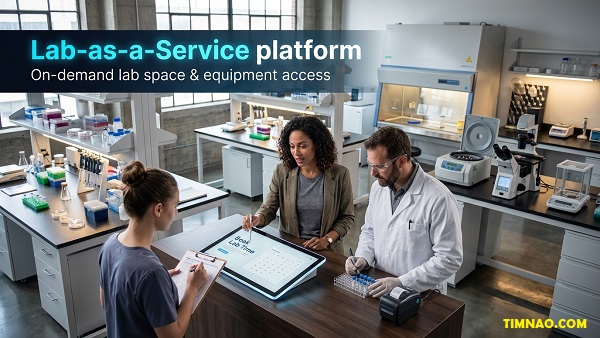
The Profitable Blueprint for a Lab-as-a-Service Platform Researchers Love 🧪
A Lab-as-a-Service platform is a simple idea with a big impact: instead of forcing teams to own expensive lab space and equipment, you help them access what they need, exactly when they need it. If you’ve ever spoken to a biotech founder, a university researcher, or even a product R&D team at a consumer brand, you’ll hear the same frustration—great ideas move slowly when labs are hard to get.
Here’s the good news: the world has more scientific infrastructure than it can efficiently use, and more teams that need flexible access than ever before. A well-run LaaS business turns that mismatch into a practical service—one built around trust, safety, scheduling, and reliability, not just a booking calendar.
🧩 A Simple Way to Picture a Lab-as-a-Service Platform
Think of it like “coworking + booking + guardrails”
A Lab-as-a-Service platform is basically a way to rent scientific capability without owning it. Customers don’t lease a building, hire a lab manager, and buy a $50k instrument just to run a few weeks of experiments. They book what they need—bench space, a device, or technician-supported instrument time—then move on.
The simplest mental model is “coworking for R&D,” but with stricter rules. In a normal coworking space, you worry about noise and meeting rooms. In a lab, you worry about safety, contamination, calibration, and who’s responsible when something breaks.
If you’re explaining LaaS to a beginner, try this sentence: “We give teams fast, reliable access to lab space and equipment—by the hour, day, or month—without long-term commitments.” That’s the core promise, in plain English.
What “on-demand lab space” actually includes
Most people hear “lab space” and imagine a single kind of lab. In reality, on-demand lab space is a menu of environments, and beginners appreciate clarity more than variety. You’ll do better if you define 2–3 space types clearly, instead of listing every possible room.
Here are beginner-friendly categories you can use right away:
- Basic bench access (wet lab): a shared bench, sink access, basic storage, standard rules.
- Specialty bench zones: fume hoods, biosafety cabinets, controlled rooms (often with extra onboarding).
- Storage as a service: fridge/freezer space, short-term cold storage, sample holding with check-in/out.
A helpful trick: describe lab space the same way hotels describe rooms—what’s included, what’s not, and what rules apply. The fewer surprises a customer encounters, the more likely they are to book again.
What “lab equipment rental” looks like in real life
The phrase lab equipment rental can mean two very different experiences. If you don’t separate them, you’ll confuse both your customers and your supply partners.
Option A: Self-serve equipment booking (customer operates).
This works best for lower-risk gear where training is quick, like centrifuges, microscopes, incubators, balances, or pH meters. Your platform needs an onboarding and verification flow so lab owners feel safe.
Option B: Assisted or “operator-run” booking (lab operates).
This is often the easiest way to start, even for a brand-new platform. Customers book time on an instrument with a technician, then receive data and results. It reduces training needs, lowers damage risk, and keeps the experience consistent.
If you’re a beginner founder, it’s perfectly fine to start with “operator-run” access for expensive or sensitive instruments. You’ll learn faster, and your early customers will feel more confident.
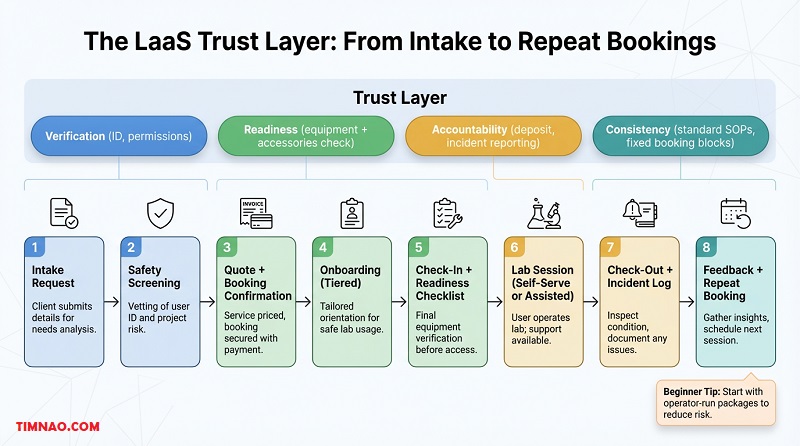
The “trust layer” is your real product
Here’s the thing most people miss: your platform isn’t a calendar. Your platform is trust. Without trust, no serious team will run experiments through you, and no lab owner will offer capacity.
A practical trust layer usually includes:
- Verification: who the customer is and what they’re allowed to do.
- Readiness: the equipment works, accessories are present, and rules are clear.
- Accountability: damage policies, incident logs, and clean handoffs.
- Consistency: the experience feels the same across sites and partners.
You don’t need to build all of this in software on day one. You can run early trust workflows manually with tools like Typeform (intake), Airtable (database), DocuSign (agreements), and Stripe (payments). What matters is that the customer feels “this is handled.”
A simple “one booking” walkthrough (so you can design the experience)
If you can map one booking end-to-end, you can build a LaaS business. Here’s a beginner-friendly flow you can copy:
- Customer request: “I need BSL-2 bench access twice a week for a month” or “I need HPLC runs for 10 samples.”
- Pre-check: materials allowed? training required? assisted vs self-serve?
- Quote + schedule: confirm time slots, pricing, cancellation rules, and what’s included.
- Onboarding: safety briefing, access rules, ID verification, and checklist sign-off.
- Execution: customer uses space, or operator runs the equipment.
- Close-out: checklist, cleaning confirmation, incident report (if any), invoice, feedback request.
This flow might sound formal, but it’s exactly what makes a lab experience feel safe and repeatable. Once you have it working in one niche, you can expand.
What not to do first (common beginner traps)
A LaaS platform can be built lean, but it can also become a mess if you start in the wrong place. Avoid these traps early:
- Don’t start “for everyone.” Start with one customer type and one category of access.
- Don’t chase the most complex instruments first. Advanced workflows bring advanced risk and slow onboarding.
- Don’t build a full marketplace UI before you’ve run bookings manually. If you haven’t handled edge cases, your software will be wrong.
If you keep the first version small and operationally tight, you’ll earn the right to scale. And once you can picture the experience clearly, the next question becomes obvious: why is this such a “right now” opportunity?
🌍 Why On-Demand Lab Space Is a “Right Now” Opportunity
The simple economics: expensive assets + imperfect utilization
Scientific infrastructure is costly, and it rarely runs at full capacity 24/7. Even great facilities experience downtime: nights, weekends, seasonal project gaps, staff turnover, maintenance windows, and shifting budgets.
That gap creates a natural opportunity. If you can safely package unused time into bookable access, you create value on both sides. Lab owners monetize idle capacity, and customers avoid huge upfront spending.
This dynamic is why “access over ownership” keeps expanding across industries. Labs are simply one of the most expensive categories where the model makes sense.
Funding pressure makes “pay-as-you-go” feel smarter
When budgets tighten, teams become allergic to large commitments. They still need data, prototypes, and validation—but they want flexible costs. That’s exactly what on-demand lab space and lab equipment rental provide.
For early-stage startups, the “build a lab” path can be a trap. It locks them into leases, ongoing staffing, equipment maintenance, and compliance overhead before they’ve proven the business. LaaS flips the model: run the work first, scale ownership later (if ever).
This isn’t just about saving money. It’s about preserving optionality. Founders want freedom to pivot without being stuck with expensive, specialized infrastructure.
“Speed to experiment” is the new competitive advantage
In R&D, velocity matters. Teams win by iterating quickly, testing hypotheses, and generating credible evidence. But lab access is often the slowest link in the chain, especially for newer teams without institutional privileges.
A good LaaS platform sells “time,” not just equipment. Customers will pay more to reduce delays, avoid waiting lists, and get predictable scheduling. If you’re new to this space, this is an important pricing insight: reliability can outperform discounts.
When you position your platform, make “fast, verified access” the headline. Beginners understand that instantly.
Three trends making LaaS easier than it used to be
Even if labs have existed forever, the ability to package lab access as a service is improving. A few shifts are helping founders build LaaS businesses faster:
1) Better workflow tooling.
You can run onboarding, scheduling, payment, and documentation with modern software instead of custom systems. Early operators can stitch together Calendly, Notion, Stripe, and Zapier to run surprisingly professional operations.
2) A growing culture of shared lab ecosystems.
Networks like BioLabs and LabCentral show that shared lab access is not weird—it’s normal in many startup hubs. That cultural shift matters because it reduces buyer hesitation.
3) Remote and operator-run lab models are more accepted.
Platforms like Emerald Cloud Lab helped normalize the idea that lab execution can be “software-mediated.” Even if your platform is local and manual at first, customers are increasingly comfortable with structured access models.
The takeaway is simple: the world is more ready for LaaS than it was 10 years ago. The question isn’t whether customers will accept it—it’s whether your version feels safe and dependable.
Where the opportunity is strongest for beginners
If you’re starting fresh, pick environments where coordination problems are real but compliance complexity is manageable. You want a space where customers feel pain, but you’re not drowning in regulatory requirements on day one.
Beginner-friendly “sweet spots” often include:
- Early wet-lab work (basic bench access + common equipment)
- Materials and product testing for consumer brands (often simpler than clinical workflows)
- Operator-run specialized instrumentation (customers pay for outcomes, not equipment operation)
- Short-term project bursts (2–6 week needs are perfect for on-demand)
You can absolutely expand into deeper compliance categories later. But in your first iteration, your goal is to become excellent at a narrow, repeatable workflow.
A quick “right now” test you can run this week
Want to know if your city has a LaaS opportunity without doing months of research? Run this simple test:
- Identify 10 labs or facilities in your area.
- Ask one question: “Do you have equipment time or bench capacity that sits unused?”
- Identify 10 potential customers.
- Ask one question: “What’s the most painful delay you face when you need lab access?”
If both sides say “yes, we have idle capacity” and “yes, access is a bottleneck,” you have the raw ingredients. From there, the next step is choosing the right first customers—because not every customer type is equally easy to serve.
🎯 Your Best First Customers (Beginner-Friendly Targeting)
The golden rule: start with urgency and repeatability
In the beginning, you’re not building a giant platform. You’re building a repeatable service. So your first customer group should have a consistent job-to-be-done and enough urgency to pay for speed.
A great first customer segment usually:
- has a recurring need (weekly or monthly),
- has a deadline (fundraising, publication, product launch),
- and values reliability more than the lowest price.
If you pick customers who are “curious but not committed,” you’ll waste time. Pick customers who need the outcome.
Four beginner-friendly customer personas that actually convert
1) Seed-stage biotech founders and small R&D startup teams
They need on-demand lab space to generate proof-of-concept data. They often need flexibility: a month of bench access, a few specialized instrument runs, and help navigating lab operations.
Your beginner advantage here is packaging. If you offer “bench + core equipment + onboarding + predictable schedule,” you’re immediately useful.
2) University labs facing bottlenecks (overflow demand)
Even well-equipped institutions face scheduling constraints. Equipment breaks, maintenance takes time, and core facilities can be booked out.
These customers often don’t want to “shop around.” They want a trusted access channel that reduces procurement friction and paperwork. If you can make booking feel official and organized, you’ll stand out.
3) Product R&D teams in non-biotech categories
Think food tech, cosmetics, personal care, materials, and consumer products. They may need stability testing, microscopy, or analytical runs without building full internal infrastructure.
These customers often care about practical outcomes and documentation, not academic novelty. That makes them a great beginner market because their needs can be standardized into packages.
4) Teams that need operator-run access (results delivered, not tools)
Some customers don’t want to touch the equipment. They want the data.
This segment is powerful because it turns your platform into a service business with clearer accountability. It can also unlock higher margins through “tech time + reporting” bundles.
Segment customers by “what they’re trying to do,” not their title
Beginners often target by job title (“researchers,” “founders”). A better approach is targeting by use case. Here are a few use-case buckets that make your offer more concrete:
- “I need to run a repeatable assay for 4–6 weeks.”
- “I need 1–2 days on a specific instrument to generate data.”
- “I need storage and handling for samples while we run tests.”
- “I need help because we don’t have trained staff yet.”
Once you know which bucket dominates in your market, you can design pricing, onboarding, and operations around it. That’s how you become the obvious choice.
How to pick your first niche in 15 minutes (simple filter)
If you’re stuck choosing, use this quick filter. Write down 3 niche ideas, then score each from 1–5:
- Demand urgency: do customers have deadlines?
- Operational complexity: can you deliver safely as a beginner?
- Supply availability: can you find 3–5 partners quickly?
- Repeatability: can you package it into a simple workflow?
- Willingness to pay: does reliability matter enough to command fair pricing?
Pick the niche with the highest total score, not the coolest technology. Cool doesn’t pay bills; repeatable access does.
A beginner-friendly customer interview script (steal this)
When you reach out to potential customers, avoid pitching a “platform.” Pitch a problem you’re solving and ask specific questions.
Use this script:
- “When you need lab access, what slows you down the most?”
- “What do you do today—wait, borrow, outsource, or buy?”
- “What would ‘perfect access’ look like for you in the next 30 days?”
- “How often would you need it—once, weekly, monthly?”
- “If I could deliver that access safely within 72 hours, what would you expect to pay?”
These questions help you learn the real buying criteria: speed, support, documentation, privacy, or equipment condition. You’ll also discover whether your target customer is a real buyer or just a casual browser.
How to land your first 10 customers without ads
For early traction, you want communities where trust travels fast. Start with places that cluster your target segment:
- Startup incubators and accelerators
- University entrepreneurship programs
- Local biotech or hardware meetups
- LinkedIn groups where founders and lab managers hang out
- Shared lab communities (members and alumni)
Keep your offer ridiculously simple: “We provide verified on-demand lab space and equipment access, with onboarding and clear rules.” Then ask for a pilot booking.
As you move from a few conversations to real bookings, you’ll naturally learn what your platform should become—and what it should never try to be. In the next section of the article, we can translate these customer insights into a practical operating model that’s easy to run and easy to scale.
😣 The Pain Points You Solve (What People Actually Pay For)
The “delay tax”: when weeks disappear for non-scientific reasons
A lot of R&D time isn’t lost to hard science. It’s lost to scheduling chaos, paperwork, waiting lists, and “we can’t access that room until next month.” Customers pay for LaaS because it reduces that invisible delay tax.
Think of a startup founder trying to hit a fundraising milestone. They don’t just need a PCR machine—they need a predictable slot on Tuesday morning, the right consumables, and confidence that the run won’t get bumped. If your platform makes that predictable, you’re already valuable.
A beginner-friendly way to package this benefit is simple: “reliable access, faster than doing it yourself.” Avoid technical jargon early. Lead with speed and clarity, then let the details support that promise.
Buying equipment feels straightforward until you live with it. Ownership includes calibration, maintenance, repairs, downtime, missing accessories, training, cleaning routines, and someone responsible for everything. That “someone” is often a founder who should be building the company instead.
On the space side, labs aren’t like offices. Ventilation, safety rules, storage, waste handling, and specialized utilities add layers of cost and coordination. Customers pay for on-demand lab space because it turns a heavy operational burden into a manageable monthly or per-use expense.
This is where beginner founders can position LaaS as a relief valve: “No lease. No long onboarding. No surprise upkeep.” It’s not about being cheap—it’s about avoiding expensive mistakes.
The trust gap: “Is this equipment actually ready to use?”
In labs, “available” doesn’t always mean “ready.” A microscope might be present but missing an adapter. An HPLC might be technically working but overdue for maintenance. A freezer might have space, but nobody knows whether temperature logging is stable.
Your LaaS platform becomes valuable when you close this trust gap. Customers pay for the confidence that what they booked will be usable, clean, and correctly configured.
A practical trust layer doesn’t need to be complicated. Start with three basics:
- Readiness checklist (accessories present, basic function verified)
- Clear usage rules (what’s allowed, what’s not, who supervises)
- Simple incident reporting (so issues don’t repeat)
If you do those consistently, you’ll feel “premium” even if your platform is still early.
The operator problem: “We don’t have someone who can run this”
Many teams aren’t blocked by lack of equipment—they’re blocked by lack of expertise. They might not have a trained person to run a sensitive instrument, interpret output files, or troubleshoot when something looks off.
This is why operator-assisted access can be your strongest beginner wedge. You can sell outcomes (data delivered) rather than tools (equipment used). Customers often prefer this because it reduces risk and speeds up execution.
Here’s a simple example: instead of “Rent HPLC by the hour,” you offer “HPLC sample run package: 10 samples + standard reporting + repeat run option.” Beginners can understand that, and buyers can justify it faster.
The procurement and approvals headache
In many organizations, especially universities and corporate R&D, procurement processes are slow. Even if the team wants to move fast, internal approvals can delay purchases or long-term commitments. A well-structured LaaS platform can be easier to approve because it’s a service, not an asset purchase.
This is where professional packaging matters. Clean invoices, predictable pricing, and clear terms make you easier to adopt. Using tools like Stripe for payments and DocuSign for signatures can make even a small operation feel enterprise-ready.
If you want repeat business, make the “admin experience” as smooth as the lab experience. Many competitors ignore this—and that’s your opening.
What customers truly pay for (a quick, useful list)
When customers say yes, they’re usually paying for some combination of these:
- Speed: access this week, not next month
- Predictability: time slots that won’t change last minute
- Safety: clear rules, onboarding, and supervision where needed
- Readiness: equipment works, accessories included, space prepared
- Support: someone can help when things get confusing
- Documentation: logs, basic records, and professional billing
Notice how “cheap” isn’t the headline. Beginners often try to underprice. In lab services, reliability often beats discounts.
Turn pain points into beginner-friendly offers (so buyers don’t overthink)
The fastest way to sell LaaS is to productize the work into packages. Packages reduce decision fatigue and make your operations repeatable.
Here are a few starter package patterns you can adapt:
- “Bench Access Sprint”
- 1–2 weeks of bench access
- onboarding + rules + scheduling
- optional add-on: technician hours
- “Instrument Time Blocks”
- 2-hour blocks on common equipment
- includes basic setup + shutdown checklist
- add-on: training session for first-time users
- “Operator-Run Results Package”
- customer submits samples + requirements
- lab runs instrument + delivers data
- add-on: repeat-run discount if results need confirmation
You can run these manually at first using Notion pages for package definitions and Typeform for intake. The key is consistency, not perfection.
🏗️ Pick Your Model: Marketplace, Managed Access, or Remote Labs
Model 1: Marketplace (connect + book)
A marketplace model is the lightest operationally. You list lab spaces and equipment, customers book, and you take a fee. It sounds simple—and it can work—especially if your supply partners already have staff and systems.
But here’s the catch: pure marketplaces struggle when trust requirements are high. Labs are not hotel rooms. If a booking fails, a customer might lose a week of work, not just a weekend trip. That risk makes buyers cautious.
If you start marketplace-style, you’ll still need minimum guardrails:
- partner vetting (basic safety and readiness standards)
- cancellation and rescheduling rules
- clear scope: what’s included, what’s not
- a real support channel (even if it’s just email + Slack)
Marketplace works best when your niche has standardized usage and low operational complexity.
Model 2: Managed access (standardized experience, higher trust)
Managed access means you’re not just connecting people—you’re shaping the experience. You define onboarding, checklists, basic safety rules, and what “ready” means. In return, you can charge more because customers aren’t buying randomness. They’re buying confidence.
This model is more work, but it’s also more defensible. Competitors can copy listings, but they can’t easily copy operational reliability. If you’re serious about building a long-term brand, managed access is usually the path.
A beginner-friendly version of managed access doesn’t require full-time staff. It can simply mean:
- standardized intake + screening
- mandatory checklists for partners
- consistent booking rules
- a clear escalation path when something goes wrong
You can manage these workflows with tools like Airtable and Zapier before you build custom software.
Model 3: Remote labs (sell outcomes, not access)
Remote lab models flip the customer experience. Instead of customers coming into the lab, they ship samples or provide requirements, and the lab runs the work. This can be appealing for customers who lack trained operators or don’t want to deal with lab logistics.
The advantage is clarity: you sell deliverables. The risk is operational complexity around shipping, chain-of-custody, sample integrity, and turnaround time. But if you pick a narrow service (say, a specific assay type or instrument run), it can be very manageable.
Platforms like Emerald Cloud Lab popularized the idea of “software-enabled lab execution.” You don’t need their level of automation to learn from the model: customers love predictable workflows, transparent turnaround times, and standardized output.
Remote labs can also pair well with a marketplace approach. You can offer both: on-site access for some customers and operator-run outcomes for others.
The beginner-friendly hybrid that works in practice
If you’re starting from scratch, the easiest path is often a hybrid:
- Start with concierge matching (you manually coordinate)
- Offer operator-run packages for sensitive equipment
- Introduce managed access rules as you learn edge cases
- Add self-serve bookings only after onboarding is repeatable
This progression keeps risk low while you build credibility. It also helps you discover which model customers actually prefer in your niche.
Most importantly, it prevents you from building a “big platform” before you understand what needs to be standardized.
A simple decision checklist (pick your model in 10 minutes)
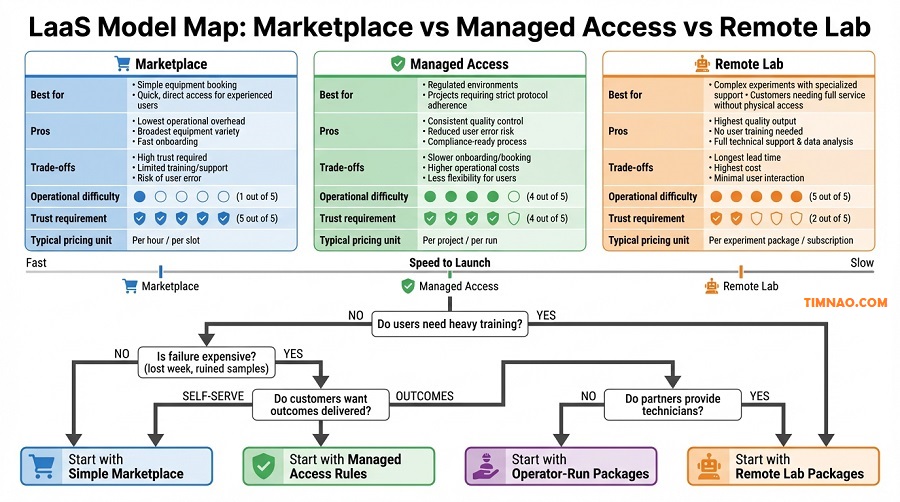
If you’re unsure, score each model 1–5 for your specific niche:
- Safety complexity: do users need heavy training?
- Operator availability: can partners provide staff support?
- Standardization: can you package the workflow easily?
- Trust requirements: is failure expensive for customers?
- Speed to launch: can you run pilots in 30 days?
As a beginner, choose the model that minimizes risk and maximizes repeatability. You can always expand later—but early chaos is hard to recover from in a trust-based industry.
🛠️ How to Start Small Without Owning a Lab
Your 14-day pilot plan (simple, realistic, and learn-fast)
You don’t need a perfect website to launch. You need a pilot that proves people will pay and that you can deliver safely.
Here’s a beginner-friendly two-week plan:
- Day 1–2: Choose one narrow offer
Example: “BSL-2 bench access + core equipment” or “operator-run instrument package.” - Day 3–6: Recruit 3 supply partners
Aim for partners who want extra utilization and are open to structured rules. - Day 7–10: Pre-sell 3 bookings
Don’t overpromise. Offer a “pilot rate” with clear scope and scheduling. - Day 11–14: Run bookings + collect feedback
Track what breaks, what confuses people, and what feels smooth.
Your goal is not scale. Your goal is learning: what needs to be standardized so the next 10 bookings are easier than the first 10.
Where to find supply partners (and what to say)
Good supply partners include shared labs, incubators, university core facilities (where allowed), private labs, and companies with underused capacity. You’re looking for people who already feel the pain of idle assets and are motivated to monetize them.
Your pitch should be risk-reducing, not hype-driven:
- “We bring vetted customers.”
- “We handle booking, payments, and agreements.”
- “We standardize rules so your team isn’t burdened.”
- “We start with a small pilot and learn together.”
If you sound like you’ll create extra work, partners will say no. If you sound like you’ll reduce admin and increase revenue, you get the meeting.
The minimum “trust kit” you need before your first booking
Even a small LaaS pilot should feel safe and professional. Before you run a single booking, prepare these basics:
- One-page rules: what’s allowed, what’s not, cleanup expectations
- Intake form: materials, experience level, timeline, documentation needs
- Booking confirmation template: date/time, inclusions, cancellation rules
- Simple agreement: liability, responsibilities, confidentiality basics
- Incident log: a place to record what went wrong (or what almost did)
You can implement the paperwork quickly with DocuSign and store templates in Notion. The point is consistency and clarity, not legal complexity.
A no-code operations stack that works for beginners
You can run early operations smoothly with a lightweight stack:
- Intake + screening: Typeform
- Inventory + partner database: Airtable
- Scheduling: Calendly
- Payments: Stripe
- Docs + SOPs: Notion
- Automations: Zapier
- Team communication: Slack
This setup helps you look credible while staying flexible. You can replace parts later when you know what actually needs software.
Your first 10 bookings playbook (so you don’t drown in custom requests)
Beginners often say yes to everything and then struggle. Instead, enforce a tight scope. Your first 10 bookings should feel like variations of the same workflow.
A practical playbook:
- Offer two packages only (one self-serve, one operator-run)
- Require a 48–72 hour lead time
- Use a standard checklist for every session
- Collect feedback immediately after each booking
- Improve one thing per week, not ten things per day
If a customer requests something outside scope, don’t reject them—route them to the operator-run option or schedule it as a “custom pilot” with higher pricing and longer lead time.
What to measure early (so you know it’s working)
You don’t need fancy analytics. Track a few signals that matter:
- Time-to-book: first contact → confirmed booking
- Show rate: bookings that actually happen
- Repeat rate: customers who book again within 30 days
- Incident rate: problems per booking (missing parts, downtime, confusion)
- Partner satisfaction: would suppliers keep working with you?
If repeat rate is strong and incidents trend down, you’re building something real. If incidents stay high, your trust layer needs strengthening before you scale demand.
When to invest in software (or even your own space)
Custom software is worth it when manual operations become the bottleneck. A simple sign is when you’re spending more time coordinating than improving quality.
Owning space is a bigger decision. It can make sense later if you have consistent demand and a clear operational model. But early on, ownership often slows you down and increases risk.
A smarter progression is: prove demand → standardize operations → scale partners → then consider deeper investments. When your process is solid, everything you build next becomes more effective.
As you move forward, you’ll naturally shift from “Can we deliver access?” to “How do we fill the pipeline reliably?” That’s where marketing strategy and growth loops become the next practical focus.
💰 Pricing and Business Model Options That Don’t Confuse Customers
Start with a pricing goal: “easy to approve” beats “perfectly optimized”
When you’re new, the biggest pricing mistake isn’t charging too much or too little—it’s making pricing feel complicated. In labs, people already worry about safety, readiness, and timelines. If your pricing page adds extra mental load, they’ll bounce or delay the decision.
A simple rule: your first pricing should be easy to understand in 10 seconds and easy to approve internally. That usually means clear units (hour/day/week), a short list of add-ons, and obvious cancellation rules. You can always get fancy later, once you have repeat customers and real data.
Before you publish numbers, decide what you want pricing to do. For beginners, the goal is usually one of these: fill underutilized capacity quickly, prove willingness to pay, or push customers toward an operator-assisted option that reduces risk.
The 3 most beginner-friendly ways to price lab access
Most LaaS platforms end up using a mix, but starting with one primary model keeps things clean.
1) Time-based access (hourly / half-day / daily)
This is the easiest for customers to grasp. It fits bench space and common equipment where usage time maps to value.
- Best for: bench access, microscopes, centrifuges, incubators
- Make it clearer by bundling: “2-hour block” or “half-day session”
- Include a short note on what’s included (basic support vs technician support)
2) Package-based pricing (results or workflow bundles)
Packages are perfect when customers don’t want to operate equipment themselves. You’re selling a deliverable, not a tool.
- Best for: HPLC/LC-MS runs, imaging sessions with operator, standardized assays
- Example bundle: “10 samples + standard method + data file + quick summary”
- Packages reduce back-and-forth and protect your ops from custom chaos
3) Subscription or membership (credits / priority booking)
Subscriptions work when customers have repeat needs and want predictable approvals. It also stabilizes your revenue.
- Best for: startups running weekly experiments, university groups with recurring work
- Simple structure: “X credits/month” + “priority booking window” + “rollover rules”
If you’re unsure, start with time-based access for space and basic tools, then add packages for sensitive instruments.
Add-ons that increase revenue without confusing people
Add-ons are where many LaaS businesses become profitable, but only if you keep them simple. Think of add-ons as “reduce headache” options.
Here are add-ons beginners can sell without sounding pushy:
- Onboarding session (one-time): safety briefing + equipment basics
- Technician support hour: “hands-on help” without committing to full service
- Documentation pack: maintenance log, calibration proof (if relevant), usage record
- Consumables kit: standard items needed for a session (clearly defined)
- Extended hours: evenings/weekends premium
To keep this beginner-friendly, limit yourself to 3–5 add-ons. Too many options feels like a telecom plan.
Pricing guardrails: deposits, cancellations, and “oops” policies
Labs are high-trust environments. Your pricing needs guardrails so partners feel safe and you don’t lose money to no-shows.
A clean starter policy often includes:
- Deposit or pre-authorization for first-time customers
This reduces flakiness without feeling punitive. - Clear cancellation window
Example: free cancellation up to 48 hours; partial fee inside 48 hours. - Overtime rules
If a session runs long, define a simple overtime rate in advance. - Damage policy
Keep it calm and specific: what counts as damage, how it’s assessed, and how disputes are handled.
You can run payments and deposits easily with Stripe. For agreements and signatures, DocuSign keeps the process professional even when you’re small.
A beginner pricing template you can copy
If you want a simple structure that works across many niches, try this layout:
- Access Price (by hour/day/week)
- What’s Included (3–6 bullets)
- Optional Add-ons (3–5 items)
- Policies (cancellation, overtime, deposits)
- “Not Included” (avoid surprises)
This format reads like a menu. That’s good. Customers aren’t shopping for poetry—they’re shopping for clarity.
Business model: how you actually make money (without squeezing partners)
Once pricing is clear, your business model becomes a lot easier to explain. Most LaaS platforms monetize in one or more of these ways:
- Take rate: a percentage of each booking
- Booking fee: fixed fee per transaction
- Membership fee: recurring subscription revenue
- Service margin: margin on technician hours, documentation, consumables
- Enterprise contracts: prepaid access packages for incubators or companies
Early on, avoid looking like you’re “taxing the lab.” Partners will only stick around if the deal feels fair and the admin burden drops. If your platform saves them time and fills idle capacity, a take rate feels justified.
⚙️ Operations That Build Trust (Supply, Safety, Scheduling)
Treat operations like your product (because it is)
Your UI might look great, but your reputation will be built in the messy moments: a missing adapter, a late technician, a booking conflict, or a confused customer holding the wrong sample tube. In LaaS, operations isn’t a back-office function—it’s the core experience customers remember.
A simple operational mindset helps: every booking should feel repeatable. If each booking is a custom adventure, you’ll burn out and partners will lose confidence.
Your job is to turn lab access into something closer to a “service routine.” Predictable input → predictable process → predictable outcome.
Supply onboarding: standardize the listing before it goes live
When you onboard a partner lab or instrument, you’re building a promise to customers. Don’t rely on a casual description like “PCR available.” That’s how misunderstandings happen.
Create a “listing packet” for every space or instrument:
- Model/specs (simple, customer-friendly)
- What accessories are included
- Permitted use cases and restrictions
- Support level: self-serve vs technician-assisted
- Lead time required for booking
- Maintenance readiness notes (basic, not overwhelming)
- Any special entry rules (PPE, training required)
You can store listing packets in Notion and track partner inventory with Airtable. The tools matter less than having a consistent format.
The “minimum viable SOP” for clean handoffs
Beginners often fear SOPs because they imagine thick binders. You don’t need that. You need short checklists that prevent repeat issues.
Build three short SOP checklists:
1) Pre-session checklist
- Confirm accessories present
- Confirm room ready (basic cleanliness)
- Confirm booking details (time, user, access level)
2) During-session checklist
- Check-in procedure (who arrived, when)
- Confirm the user follows the rules
- If assisted: technician notes anything unusual
3) Post-session checklist
- Clean-up complete
- Any issues logged (even minor)
- Confirm next steps (data delivery if operator-run)
These checklists make you feel professional and reduce “I thought you were handling that” confusion.
Scheduling that doesn’t implode at 20 bookings
Scheduling becomes hard when you have multiple labs, multiple equipment types, and variable lead times. The fastest way to avoid chaos is to standardize booking windows.
Beginner-friendly rules that work:
- Use fixed blocks (2 hours / half-day / full day) instead of free-form start times
- Require a minimum lead time (48–72 hours) for most bookings
- Limit “urgent requests” to one controlled lane with a premium fee
- Confirm bookings in writing with a standard template
For early scheduling, tools like Calendly can handle time slots cleanly. If you want live chat for questions, Intercom can help once you have steady traffic.
Customer onboarding: keep it short, but real
You don’t want to scare beginners with a compliance wall, but you also can’t treat lab access like renting a camera. The trick is a tiered onboarding approach.
Tier 1: Basic access
- identity verification
- basic lab rules
- simple safety acknowledgment
Tier 2: Sensitive equipment or special rooms
- quick training module
- supervised first session
- approval for self-serve later
Tier 3: High-risk workflows
- operator-run only (at least until the customer proves competency)
This tiering lets customers start easily while protecting your partners.
Support: the simplest thing that makes you feel “real”
Support doesn’t have to be expensive. But it must exist.
A beginner-friendly support setup:
- one shared inbox (fast replies)
- one escalation contact per partner lab
- a simple “what to do if something goes wrong” guide
Customers don’t expect perfection. They expect you to take ownership when issues arise.
The quiet engine: data and feedback loops
If you want trust to compound, track the basics and improve one thing every week. You don’t need dashboards; you need a feedback loop.
Track:
- booking lead time (request → confirmed)
- no-show rate
- incident rate (missing parts, downtime, confusion)
- repeat booking rate
- partner satisfaction score (quick monthly check-in)
You can run this in Airtable or even a simple sheet. The point is learning fast and lowering operational friction over time.
🔒 Risks, Compliance, and “Trust Layer” Basics
Start with a calm truth: risk is normal—unmanaged risk is fatal
Labs involve equipment, safety, and high-stakes timelines. That means things will go wrong sometimes. Your job isn’t to eliminate all risk; it’s to design the business so risk is visible, priced, and managed.
If you handle risk thoughtfully, customers trust you more. If you ignore it, you lose both customers and supply partners.
The “trust layer” is simply your risk system: rules, onboarding, logs, agreements, and escalation.
Risk 1: Damage, downtime, and “who pays?”
This is the first fear most lab owners have. And it’s valid.
Beginner-friendly risk controls:
- deposits for new customers
- tiered access (self-serve only after approval)
- operator-run default for expensive instruments
- pre/post checklists with photo evidence when needed
- clear damage assessment process
You can also explore insurance options with established providers like Hiscox or Allianz depending on your region and model. Even if you’re not ready to purchase coverage immediately, understanding what insurance requires will improve your agreements and policies.
Risk 2: Confidentiality and IP
R&D customers worry about three things: other people seeing their work, data being mishandled, and unclear ownership boundaries.
Practical steps that help:
- NDAs available as a standard option (signed via DocuSign)
- access logs (who entered and when)
- private booking windows for sensitive sessions (premium option)
- clear policy: “your samples and data remain yours”
Even small steps like consistent access logs can make you feel enterprise-grade.
Risk 3: Safety and compliance creep
Compliance can expand quickly if you say yes to everything. A beginner platform should define “what we do” and “what we don’t do yet.”
A safe early approach:
- define permitted materials categories
- prohibit high-risk categories until you have experienced partners
- require training for special rooms and biosafety zones
- default to operator-run for higher-risk workflows
If you ever find yourself improvising safety rules during a booking, that’s a signal you’re outside your current scope.
Risk 4: Marketplace disputes and bad fits
Even with clear policies, you’ll see disagreements: “We left it clean,” “The device was already broken,” “We didn’t know that accessory wasn’t included.” Disputes don’t kill you—unclear processes do.
Set up a simple dispute pathway:
- incident report filed within 24 hours
- evidence gathered (photos, logs, staff notes)
- neutral review standard (what counts as proof)
- resolution within a defined timeline
Customers respect fairness. Partners respect consistency. Both hate ambiguity.
The minimum compliance toolkit (beginner edition)
You don’t need to copy a giant institution’s compliance department. You need a minimum set of documents and routines that reduce risk.
At a minimum, have:
- a one-page “lab rules” document
- onboarding acknowledgment for each tier
- booking confirmation template with inclusions/exclusions
- incident log template
- partner checklist for readiness
- NDA option for sensitive work
Store templates in Notion and automate reminders with Zapier. Keep documents short and readable. People follow policies they can actually understand.
A final mindset shift that makes everything easier
If you’re building LaaS, don’t think “We rent lab stuff.” Think “We deliver reliable lab access.” That small shift changes how you price, how you operate, and how you handle risk.
Reliable access is what customers will pay for, recommend, and return to. It’s also what partners will trust you with when they decide whether to share their most valuable assets.
From here, once pricing and operations are stable, the next natural question becomes: how do you consistently fill the pipeline and grow demand without losing quality? That’s where marketing and growth loops come in.
📣 Marketing: Get Your First 10 Bookings the Simple Way
Lead with a promise beginners can understand in one breath
When someone lands on your page or reads your message, they should immediately know what you do and why it’s useful. Skip abstract phrases like “R&D infrastructure enablement.” Use a clear line like: “Book verified on-demand lab space and lab equipment rental—without long leases.”
That single sentence signals speed, clarity, and reduced commitment. It also gives people something easy to repeat when they refer you. If they can’t describe you to a friend, they can’t recommend you.
The first 10 bookings come from people who already trust someone
In the early days, cold ads usually underperform because lab access is a high-trust purchase. Your first customers tend to arrive through warm channels: incubators, accelerators, university programs, and referrals. So your marketing job is less “broadcasting” and more “showing up” in the right rooms consistently.
A helpful mindset is to sell one thing: a reliable shortcut for a specific workflow. Once that workflow works, you can expand the menu.
Pick one “hero offer” and market that, not everything
Beginners often try to list every instrument and every room type. That’s how you get ignored. A tighter approach is to pick one hero offer that’s easy to explain and easy to deliver.
Three beginner-friendly hero offers that convert well:
- Bench Access Sprint (1–2 weeks of bench access with onboarding)
- Operator-Run Instrument Package (data delivered, not DIY operation)
- Priority Booking Membership (credits + priority scheduling for repeat users)
Make one offer famous inside one community first. Variety can come later.
Where to find customers without spending on ads
Your first 10 bookings will likely come from a few channels that cluster your target customers:
- Incubators and accelerators
Offer a simple perk for the cohort: “priority access credits” or a discounted pilot package. - University entrepreneurship centers
They’re dense networks of founders, lab managers, and advisors. One supportive program manager can introduce you to several teams quickly. - LinkedIn (done the calm, human way)
Skip the pitch. Ask a real question: “When you need lab access, what slows you down most—scheduling, approvals, or training?” - Local niche meetups
Biotech meetups, hardware nights, product testing groups, founder coffee chats. Your goal is not to present; it’s to listen and find repeating bottlenecks.
A simple outreach sequence you can reuse
Keep messages short. One question per message. No pressure.
Message 1 (opening):
“Hi [Name]—I’m building a Lab-as-a-Service platform that helps teams book on-demand lab space and equipment quickly. When you need lab access, what usually slows you down the most?”
Message 2 (follow-up, 2–3 days later):
“If you could get verified access within 72 hours for [bench/equipment], would that be useful this month?”
Message 3 (offer a pilot):
“I’m running a small pilot with vetted partners. If you have a project coming up, I can propose a simple package and a few schedule options.”
This sequence feels human because it’s not trying to “close.” It’s trying to learn and offer help.
Your “first 10 bookings” landing page checklist
You don’t need a giant website. You need a page that answers silent buyer questions quickly.
Include:
- One-sentence promise (what you do)
- What’s available (3–7 bullets, not 30)
- How booking works (3 steps)
- What’s included (and what isn’t)
- Safety + onboarding basics (simple, reassuring)
- Pricing format (even ranges at first)
- Contact + response-time promise (“reply within 24 hours”)
You can ship this fast with Webflow or WordPress. Clarity beats polish.
Make trust visible: “proof” beats persuasion
In lab services, persuasion is weak and proof is strong. Show that the process is real and controlled.
Beginner-friendly proof ideas:
- photos of the space (clean, professional, not cluttered)
- a short “what to expect” checklist
- a partner vetting statement (“verified equipment + defined rules”)
- 2–3 mini stories (no sensitive details): “A team booked X, ran Y, got results in Z days”
Once you have a few wins, turn them into small “proof blocks” on your landing page. People don’t need a novel—they need evidence.
Simple content marketing that actually leads to bookings
You don’t need to publish “thought leadership.” Publish the things customers and partners are already confused about, in plain language. When you do that consistently, you become the helpful, obvious option.
Beginner-friendly content ideas:
- “How to book lab space safely: a 10-minute checklist”
- “Self-serve vs operator-run: what’s faster for your project?”
- “Common lab booking mistakes (and how to avoid losing a week)”
Host these as short blog posts or a single “guides” page. If you’re using WordPress, keep it simple: one helpful post per week for a month is enough to see traction.
Partnerships that fill your calendar (even before you’re famous)
The easiest growth is when someone else already has the audience you need. Your early partnership targets are incubators, accelerators, and university programs that want their teams to move faster.
Offer partners a clean package:
- a small pool of credits for their cohort
- priority booking windows
- one “office hours” session where teams can ask questions
If you can show that your platform saves teams time, programs will keep sending people. That’s how you build a repeatable pipeline without advertising.
How to grow after the first 10 bookings
After 10 bookings, your job shifts from “getting anyone” to “getting the right repeat customers.” Repeat bookings make your operations smoother and your revenue more predictable.
A practical growth loop:
- Ask each happy customer for one introduction
- Offer referral credits (hours, not cash)
- Publish one SEO “capabilities catalog” page
- Partner with two orgs (incubator + university program)
- Launch a simple membership for recurring customers
Do these consistently and growth starts to feel less like hustle and more like momentum.
🌟 Real-World Examples (and What to Copy as a Beginner)
Shared lab networks validate the core insight: startups will pay for flexible lab access when it’s well-run. Brands like BioLabs and LabCentral show that membership-style lab access can thrive in innovation hubs.
What to copy isn’t their scale. Copy their consistency: clear rules, visible support, and a predictable environment. Your platform can replicate that reliability across partners, even if you don’t own the space.
A practical copy move: publish a simple “partner readiness standard” so every location feels familiar to customers.
Cloud labs: selling outcomes, not rooms
Cloud lab models made a big idea feel normal: you don’t always need to be physically present to get scientific work done. Emerald Cloud Lab is a useful mental model even if your first version is local and manual.
What to copy is workflow clarity. Define inputs, steps, turnaround times, and outputs. That same thinking turns an “operator-run instrument package” into a repeatable product customers can trust.
Scientific services marketplaces: orchestration at scale
Some teams don’t want access—they want outsourcing. Marketplaces like Science Exchange show how standardized procurement and supplier coordination can unlock value in research-heavy environments.
The beginner lesson is simple: admin friction is expensive. If you reduce quote chaos and approvals headaches, customers pay for that time savings.
A practical copy move: use one quoting template across partners so buyers can compare options without mental gymnastics.
Equipment ecosystems: renting and re-commerce are already accepted
Technical equipment rental is already a mature category in adjacent industries. Companies like Electro Rent have shown that renting expensive gear can scale when logistics and maintenance are handled well.
For lab instruments, marketplaces like LabX show that equipment behaves like tradable inventory—new, used, refurbished. This matters later if you choose to own a small set of “high-demand basics” to smooth availability.
A practical copy move: track utilization by category. If the same item is always booked, owning can become a reliability decision—not a vanity purchase.
Non-lab analogies that teach you how subscriptions work
If you’re building memberships, look at access-based businesses. ClassPass is a famous example of “credits + partner network + flexible booking,” and the framework maps surprisingly well to labs.
The key lesson is how they reduce choice overload: limited plans, clear credits, obvious value. Your membership should feel just as simple, especially for beginner customers.
A practical copy move: offer two membership tiers at first. More tiers often slows approvals and confuses buyers.
What these examples should do for you
Examples aren’t just inspiration. They help you justify decisions to partners and customers: “This model is real. We’re packaging it for a narrower, faster workflow locally.”
When someone asks, “Will people use this?” you can answer confidently, then bring it back to your niche: “Yes—and we’re making it simpler to adopt and safer to run.”
✅ Your Next 24 Hours: The First Step That Actually Moves the Idea Forward
Step 1: Write your one-sentence niche (and don’t overthink it)
Open a doc and write one sentence that includes customer type, what access you provide, where, and how fast.
Example: “We help seed-stage biotech teams in [City] book verified bench space and essential equipment within 72 hours.”
If you can’t write this sentence clearly, pause and simplify your offer before doing anything else.
Step 2: Create your first “offer card” (a one-page package)
Instead of building a full catalog, create one offer card in Notion or a simple PDF.
Your offer card should include:
- what’s included (bullets)
- who it’s for
- how booking works (3 steps)
- lead time required
- starting price range
- safety/onboarding note
This becomes your portable sales asset. You can send it to customers, partners, and program managers today.
Step 3: Build a 20-person list (10 supply, 10 demand)
Momentum comes from lists, not vibes. Make two columns.
Supply list (10): shared labs, incubators, private labs, testing facilities, corporate labs with idle capacity.
Demand list (10): startups, university labs, product R&D teams, founders who need data soon.
Don’t aim for perfect. Aim for reachable names you can message right now.
Step 4: Send five messages today (and track responses)
Send:
- 3 messages to potential supply partners
- 2 messages to potential customers
Track replies in Airtable or a simple sheet. If you get one “yes,” schedule a 15-minute call and learn the constraints. If you get only “maybes,” sharpen your niche sentence and try again.
Here are two short message templates you can copy:
- To supply: “Do you have bench/equipment capacity that sits unused at times? I’m organizing vetted bookings with clear rules and minimal admin—open to a small pilot?”
- To demand: “If you could book verified access for [use case] within 72 hours, would you use it this month?”
Step 5: Run one booking manually (the “concierge proof”)
Your first booking is your thesis test. Coordinate it manually and make it feel clean and professional.
Use Calendly for slots and Stripe for payment. Use DocuSign for a basic agreement. Then capture feedback immediately, while the experience is fresh.
A simple “first booking” checklist:
- confirm what’s included (accessories, support level)
- confirm lead time and arrival instructions
- run pre/post checklists
- log any issues (even tiny ones)
- ask one question after: “What would make this 20% easier next time?”
A small but powerful rule for day one
Only promise what you can control. Reliability compounds; broken promises destroy trust.
If you end today with one solid partner conversation and one clear pilot opportunity, you’re already building a real business.
🙋 FAQs: Beginner Questions About Lab-as-a-Service platform Answered
What’s the difference between LaaS and a coworking lab?
A coworking lab is usually one operator offering space and shared equipment under their own rules. A Lab-as-a-Service platform can include coworking labs, but it typically coordinates access across multiple partners, spaces, and instruments.
In short: coworking is a location; LaaS can be a network. Your value is standardization—making access searchable, bookable, and predictable.
Do I need to own lab space or equipment to start?
No, and most beginners shouldn’t. Ownership increases cost and complexity before you know what customers truly want.
Start as a concierge coordinator. Prove you can bring demand to supply reliably. Consider ownership only when you have repeat bookings and clear utilization.
Should I build an app right away, or use no-code tools?
Start with no-code unless you already have steady demand. Most early problems are operational, not technical. If you can’t deliver a smooth booking manually, software won’t save you.
Tools like Typeform, Airtable, and Zapier can carry you surprisingly far. Build custom software when coordination becomes the bottleneck.
How do I avoid getting stuck in complicated compliance work?
Define your scope early and put boundaries in writing. Start with lower-risk categories and clear restrictions. When a request crosses into sensitive territory, default it to operator-run or decline politely.
A helpful rule: if you find yourself inventing safety rules during a booking, you’re outside your current lane.
What should I charge for the first bookings?
Charge enough to be taken seriously, but not so much that you can’t secure pilots. Early pricing is about proving willingness to pay and learning costs, not maximizing margin.
Offer a pilot package with a limited scope and clear policies. Then adjust based on demand, incident rate, and partner economics.
How do I handle invoicing for universities or enterprise teams?
Some organizations prefer invoices or purchase orders instead of card payments. You can still start simple: collect a booking request, confirm terms, then invoice through a basic billing flow.
Tools like QuickBooks can help you issue invoices and track payments cleanly. Keep your documentation consistent so procurement teams don’t get stuck asking you for new formats every time.
Do I need insurance from day one?
Not always, but you should understand your risk exposure early. Start with deposits, clear terms, tiered access, and operator-run defaults for sensitive assets. Then evaluate insurance when bookings and liability feel meaningful.
If you explore providers, look at established names like Hiscox. Even the process of getting a quote can teach you what risks you need to address in your operations.
Who handles consumables and reagents?
It depends on your model. For self-serve space, customers usually bring their own consumables. For operator-run packages, you can include standard consumables or list them as add-ons.
The key is clarity: write “included” and “not included” in plain language, and confirm before booking.
Lead with reduced admin and controlled risk. Lab owners worry about damage, safety, and extra work.
Your pitch should include vetted customers, clear booking rules, deposits, onboarding, and a simple incident process. If you sound organized, partners relax.
What if two customers want the same time slot?
This is why you standardize booking windows and enforce lead times. For high-demand assets, reserve fixed blocks for members or create a premium priority lane.
Avoid solving this with endless custom scheduling. Rules keep things fair and scalable.
How do I handle cancellations and no-shows?
Use deposits or pre-authorization for new customers and define a simple cancellation policy. Make it visible before payment, not buried in terms.
Over time, reward reliable customers with more flexible policies. That turns good behavior into retention.
Can LaaS work outside biotech?
Yes. Materials testing, electronics prototyping, product QA/QC, and education-focused lab access can fit the model.
The deciding factor is whether there’s expensive equipment or specialized space that’s underutilized—and whether customers have urgency or repeat needs.
What’s the biggest reason LaaS startups fail?
They scale demand before they standardize trust. A few messy bookings can damage reputation in a tight-knit community.
Treat operations as the product. Build a narrow, repeatable workflow, and grow through partnerships and referrals before chasing volume.
🧠 What to Remember (and Use Right Away)
- Build the first 10 bookings through trust-based channels like incubators, universities, and referrals—not broad paid ads.
- Market one hero offer first, then expand only after that workflow is repeatable and low-incident.
- Copy proven patterns: shared labs for consistency, cloud labs for workflow clarity, marketplaces for admin simplicity.
- In the next 24 hours, create a niche sentence, one offer card, and send five outreach messages—then run one booking manually.
- Protect trust with simple rules: lead times, deposits, checklists, and a calm, consistent incident process.
Disclaimer
This article is provided for general informational and educational purposes only. It is not legal, regulatory, medical, safety, financial, or professional advice, and it should not be relied on as a substitute for advice from qualified professionals.
Lab operations can involve hazardous materials, specialized equipment, and strict safety and compliance requirements that vary by country, region, facility type, and project scope. Before starting, renting, operating, or granting access to any laboratory space or scientific equipment, you should consult appropriate experts (e.g., legal counsel, insurance advisors, EHS/safety officers, and regulatory specialists) and ensure you follow all applicable laws, standards, and facility policies.
Any examples, tools, or companies mentioned are for illustration only and do not constitute endorsement or guarantees of results. Outcomes will vary based on your market, partners, execution, and risk controls. By reading or using this information, you agree that you are responsible for your own decisions and actions.
If this guide helped you, consider supporting the work behind it ☕✨
Your “coffee” keeps this blog running and helps me publish more practical, beginner-friendly playbooks like this. 🙌📚
👉 Buy me a coffee here: https://timnao.link/coffee 💛







)
For the reason that the admin of this site is working, no uncertainty very quickly it will be renowned, due to its quality contents.