Sell Travel Itineraries Online With Confidence: A Smart Beginner Blueprint ✈️
Sell travel itineraries online can look like a crowded, hard-to-enter space, but for beginners, it often starts much smaller than people think. You do not need a huge audience or a full travel business to begin—just a clear traveler problem, a useful plan, and a simple way to turn your local knowledge into something people will gladly pay for. In this guide, you’ll see how to shape that knowledge into a practical offer, build trust, and move toward your first real sales.
The week Mia stopped posting pretty travel photos and built a product
Mia did what a lot of beginners do at the start.
She posted nice travel photos. A café corner here. A sunset there. A quiet side street with a short caption about how “underrated” it was. People liked the posts. A few saved them. Some sent messages like “I need this trip.”
But nothing really happened after that.
No one asked how to book with her. No one paid for help. No one treated her content like a real solution. It looked good, but it was still just content.
The shift came during one frustrating week when she looked back at her posts and realized something uncomfortable: she had been sharing places, not solving problems.
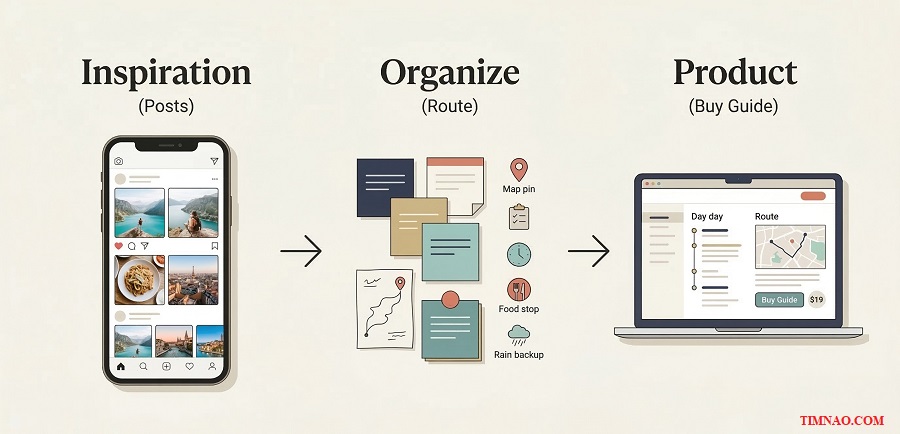
The post that finally led somewhere
Instead of making another general “best places to visit” post, Mia tried a different angle.
She wrote a short, practical post for one very specific person: a first-time visitor with only two days in the city, limited budget, and no interest in rushing across ten tourist spots just to say they had “done” the city.
That one post felt less glamorous than her usual travel content.
It was more useful.
She broke the trip into a realistic order. Morning market. Walkable lunch stop. One easy viewpoint before sunset. A backup indoor option in case of rain. One note on what to skip if the traveler was tired.
Suddenly, the replies changed.
Instead of “pretty place,” people asked things like:
- “Do you have the full plan?”
- “Is this okay for solo travelers?”
- “Can you make one for food lovers?”
- “Do you have a version for someone arriving late on Friday?”
That is the difference between content people scroll past and content that opens the door to a product.
Pretty travel content gets attention.
Useful travel content gets questions.
Clear travel products get paid.
What changed when she stopped posting for everyone
Mia did not suddenly become an expert because she downloaded a new tool or copied a trendy business model.
She simply changed what she was trying to do.
Before, her goal was to post something attractive.
After, her goal was to make one traveler’s decision easier.
That sounds small, but it changes everything.
When you think like a poster, you ask:
- What photo looks best?
- What caption sounds clever?
- What angle will get more engagement?
When you think like someone building a product, you ask:
- What problem keeps coming up?
- Where do people get stuck?
- What would save them time, stress, or money?
- What would make them say, “I’d pay for that”?
That second set of questions is where online earnings begin.
A beginner usually does not need a giant audience first. They need one useful offer that solves one clear travel problem better than random posts do.
Her first product was intentionally simple
Mia did not start with a full website, premium brand package, or a complicated travel service menu.
She built one small product.
It was a short self-guided itinerary for first-time visitors who wanted a calm, food-focused weekend without spending too much or wasting time on overhyped stops.
That worked because it was:
- Easy to understand
People immediately knew whether it was for them. - Easy to test
She could share it with real people, get feedback, and improve it quickly. - Easy to buy
A small digital product feels less risky to a first customer than a big premium service. - Easy to expand later
Once she saw what people liked, she could create related versions for other traveler types.
For beginners, this matters more than most people realize.
You do not need to build “a travel brand” on day one.
You need to build one thing that is useful enough to become the start of a travel business.
Why this matters for someone with no audience
A lot of new writers and creators assume they need to grow a page first and monetize later.
That sounds logical, but it often creates a trap.
They spend months posting destination tips, travel aesthetics, and broad advice with no real path to income. Then when they finally try to sell something, they realize their audience was trained to consume free inspiration, not buy practical help.
Mia avoided that trap the moment she turned her knowledge into an offer.
That is the real lesson here.
If you are a beginner, your early content should not just say, “Look at this place.”
It should quietly answer, “Why would someone trust me to make this trip easier?”
Once you start thinking that way, even your free posts improve. They become more structured, more useful, and more memorable. And more importantly, they begin pointing toward something a reader can actually buy.
A better way to sell travel itineraries online
If you are still in the idea stage, here is the simplest version of the shift Mia made:
- Don’t start with a destination.
- Don’t start with a beautiful photo.
- Don’t start with a giant “travel guide” idea.
Start with one traveler who is likely to say:
“I don’t want more inspiration. I want a clear plan.”
That one sentence is where a lot of small online opportunities begin.
And once you see it, the next question becomes more practical: why does this work so well now, especially for beginners trying to enter the travel space?
That is where the bigger change in travel behavior starts to matter.
Why independent tourism opened a beginner-sized opportunity
Travel is still a huge market, but the interesting part for beginners is not just that people are traveling.
It is how they are traveling and how they are making decisions.
International tourism kept growing through 2025, with UN Tourism reporting more than 1.1 billion international tourist arrivals through September 2025. At the same time, Expedia Group’s 2025 traveler research showed that social media has become a much stronger source of travel inspiration, while trust signals such as reviews and reputation increasingly shape booking decisions. (pre-www.unwto.org)
That combination creates a useful opening for beginners.
People are not only looking for places to go. They are also looking for help deciding what is actually worth doing, what fits their style, and how to avoid wasting time.
That is where independent tourism becomes interesting.
Travelers do not always want a full guide
A lot of people do not want a large package tour.
They do not necessarily want to hand over their whole trip to a traditional agency either.
Many travelers want something in between:
- the freedom to explore on their own
- the confidence of having a plan
- the feeling that someone has already filtered out the bad choices
This is good news for beginners because it lowers the barrier to entry.
You do not need to become a full-service travel operator to create value.
You can start much smaller by helping people make better decisions.
For example, you can help them answer:
- Which area should I stay in for my style of trip?
- What is realistic to do in two days?
- Which places are good, but not worth the queue?
- What is the best order to visit things?
- What should I do if it rains?
- What can I skip without regretting it?
That kind of help is often more valuable than yet another long list of “top things to do.”
This is why it is a beginner-sized opportunity
Traditional travel businesses can be complicated fast.
They involve operations, partnerships, customer service, logistics, legal boundaries, changing prices, and in some cases licensing requirements.
That is a lot to manage when you are just starting.
Independent travel content and digital trip-planning offers are different.
They let you start with assets that are much easier to build:
- a local route
- a niche guide
- a short itinerary
- a planning checklist
- a paid recommendation list
- a custom trip-planning call
These are leaner offers.
They are faster to test, easier to revise, and cheaper to launch.
You are not trying to control the whole trip.
You are trying to remove friction from the planning process.
For a beginner, that is a much more realistic place to begin.
The product is not “travel” — it is relief
This is the part many beginners miss.
People usually do not pay because your itinerary is longer or prettier.
They pay because it gives them relief.
Relief from:
- decision fatigue
- bad timing
- overplanning
- tourist traps
- transport confusion
- mismatched expectations
- wasting money on the wrong area, route, or experience
Once you understand that, your offer becomes easier to shape.
You are not selling “my favorite city guide.”
You are selling a faster, calmer, clearer way to experience a place.
That is why an independent travel product can work even when it is simple.
Where the first money usually comes from
Beginners often imagine income coming from ads, brand deals, or massive traffic.
That can happen later.
But in the early stage, the first measurable wins usually come from smaller, more direct offers such as:
- a downloadable itinerary
- a paid custom trip plan
- a planning call with a written follow-up
- a niche neighborhood guide
- a “what to book, what to skip” shortlist
- a bonus guide attached to a stay or local service
These are good starter offers because they do not require huge scale.
They require clarity.
That matters if you only have a small audience, limited time, or very basic tools.
A beginner with one useful offer and ten interested readers is in a better position than someone with endless generic content and no product at all.
Why this model fits the way people plan now
Travel planning is no longer a straight line.
People jump between search, short videos, maps, reviews, and saved posts. They compare options, look for social proof, and often delay decisions until something feels simple enough to trust. That is exactly why a focused planning product can work: it reduces noise and gives structure to an otherwise messy planning process. (expediagroup.com)
This is also why broad advice underperforms.
When a traveler feels overwhelmed, they do not need more ideas. They need someone to narrow the field in a way that matches their budget, mood, and time.
That is the opening.
Not “be everywhere.”
Not “be the biggest.”
Just “be clearer than the chaos.”
And the easiest way to become clearer is not by writing more tips. It is by getting much more specific about who you are helping.
Choose a micro-segment before you write a single tip
This is where many beginner travel blogs and side hustles quietly lose momentum.
They choose a place, but they do not choose a person.
So they end up writing things like:
- best things to do in Lisbon
- where to eat in Tokyo
- what to see in Bangkok
- perfect weekend in Rome
Those topics sound useful, but they are often too broad to stand out and too generic to sell.
A destination is not a niche.
A traveler type is much closer to one.
A city is too broad, but a traveler problem is useful
Think about the difference between these two ideas:
- “A guide to Seoul”
- “A 3-day Seoul plan for introverts who want quieter neighborhoods, late cafés, and easy subway routes”
The second one feels more human because it was built for someone real.
That is what a micro-segment does.
It narrows the advice so your content becomes easier to trust, easier to remember, and easier to turn into a product.
A good micro-segment changes the recommendations themselves.
It affects:
- where someone stays
- how much walking is realistic
- when they should go out
- what kind of places they will enjoy
- what they should skip
- how much money they need
- how packed or calm the schedule should feel
That is why micro-segmentation matters so much.
It makes your advice feel chosen, not copied.
The easiest way to find a segment that can actually pay
Beginners often choose segments based on what sounds trendy.
A better approach is to choose a segment based on repeated planning stress.
Ask yourself:
- Who gets confused fastest in this destination?
- Who has the least time to figure things out?
- Who has clear constraints?
- Who would benefit from a filtered plan instead of endless options?
Some segments are naturally easier to serve because their needs are obvious.
For example:
- First-time visitors with only 48 hours
They need prioritization. - Solo travelers who want calm, safe routes
They need confidence and clarity. - Budget travelers near a specific transport hub
They need practical trade-offs. - Parents traveling with young kids
They need pacing, breaks, and realistic timing. - Remote workers staying 5 to 7 days
They need a blend of work-friendly and leisure-friendly options.
These groups do not just want inspiration.
They want decisions made easier.
That is why they are more likely to respond to a paid planning offer.
Use real search behavior before you write
Before you write tips, check whether people are already searching and complaining about the same issues.
You do not need expensive tools to do this.
A beginner can learn a lot from:
Google Trends is useful because it shows search interest over time and by location, which helps you spot whether a topic is seasonal, rising, or too broad to be useful on its own. (trends.google.com)
Tripadvisor and comment sections are useful for a different reason.
They show emotional patterns.
You start noticing what people regret, what they say was overhyped, what they loved unexpectedly, and where they got frustrated.
Those patterns are gold for beginners because they help you shape an offer around real problems instead of imagined ones.
A simple micro-segment test for beginners
Before choosing your segment, run it through this quick filter.
Your segment is probably strong enough if you can answer yes to these questions:
- Can I describe this traveler in one sentence?
- Do I know what they are trying to avoid?
- Would my recommendations change because of who they are?
- Could I explain my offer without using vague words like “best” or “ultimate”?
- Can I imagine one small paid product for them?
If the answer is no to most of those questions, the segment is still too broad.
What a good segment sounds like
A weak segment sounds like this:
- tourists in Paris
- people visiting Bali
- food lovers in New York
A stronger segment sounds like this:
- first-time Paris visitors who want a slower trip and hate crowded attractions
- Bali travelers trying to balance coworking, cafés, and weekend exploring
- New York food lovers staying near one subway line with only one free evening
The stronger version gives you something to build around.
That is what makes writing easier too.
You are no longer trying to cover everything.
You are trying to help one kind of traveler make a better decision.
Start smaller than feels comfortable
Most beginners still choose a segment that is too wide because they are afraid a narrow audience means fewer sales.
Usually the opposite happens.
A narrow offer is easier to understand, easier to market, and easier to recommend.
You can always broaden later.
What is harder is fixing a vague offer that never felt useful in the first place.
So if you are unsure, go smaller.
Smaller audience. Smaller promise. Smaller product.
That is often what makes the first sale possible.
And once that segment is clear, the next part gets much easier: building content and offers that make people trust you enough to buy, not just browse.
Build the trust stack: blog, short video, reviews, and one booking path
A lot of beginners think trust comes later.
They assume the order looks like this: make content, get views, then earn trust, then maybe get sales.
In travel, it usually works the other way around.
People may discover you through a reel, a blog post, or a saved pin, but they do not buy because you posted something pretty. They buy when the whole setup feels clear enough, useful enough, and safe enough to try.
That is where your trust stack comes in.
A trust stack is simply the small set of things that make a stranger think, “This person probably understands my kind of trip, and I know what to do next.”
For a beginner, that stack does not need to be big. It just needs to be connected.
Why trust now matters more than reach
The file you uploaded makes an important point: tourism is an information-heavy business. Travelers make decisions based on the information available before they experience the trip itself. That means your content is not just marketing. It is part of the product.
This matters even more today because independent travelers do not move in a straight line. They jump between search, social posts, review platforms, maps, and booking pages. They compare, cross-check, hesitate, and then act when one option feels easier than the rest.
So if your content gets attention but your trust stack is weak, people leave.
Not because your idea is bad.
Because the next step feels unclear.
The four pieces that do the heavy lifting
For beginners selling itineraries, a practical trust stack usually has four parts:
- A blog or home base
This is where your ideas stop looking random and start looking intentional. - Short video content
This helps people discover you faster and feel your style quickly. - Reviews or proof
This reduces fear. Even a few small signals help. - One booking path
This turns interest into action.
If one of these is missing, people may still like your content, but they are less likely to buy.
Your blog should make you easier to trust, not busier to manage
A beginner blog does not need ten categories and thirty posts.
It needs to answer a few simple questions:
- Who is this for?
- What problem does it solve?
- Why should I trust this advice?
- What should I do next?
That is why a simple site on WordPress is enough for most beginners.
You can start with:
- one offer page
- one about section
- two or three useful posts
- one page with a sample itinerary or FAQ
That is a stronger starting point than spending weeks “building a brand” with no actual offer.
Think of the blog as your anchor. Social content may bring attention, but the blog helps people make sense of you.
Short video should prove judgment, not just taste
The file also highlights the role of blogs, online videos, and social media in helping tourism businesses connect with target audiences. But beginners often copy the surface of that idea instead of the useful part.
They post scenic clips.
They share “must-visit” spots.
They make the city look attractive, but not necessarily easier to navigate.
A better short video does one of these things:
- helps someone avoid a mistake
- helps someone choose between two options
- helps someone understand timing, pace, or route
- helps someone see that you think like a planner, not just a tourist
For example, these are stronger than generic travel clips:
- “What I would skip if you only have one evening here”
- “The easiest area to stay in if you hate changing trains”
- “A first-night food route that still works after a delayed flight”
- “One place that looks famous online but wastes too much time in real life”
That kind of content builds trust because it shows decision-making.
And decision-making is exactly what people are paying for when they buy an itinerary.
Reviews do not have to be fancy to be useful
The chapter on virtual communities in your source is especially helpful here. It explains that travelers trust comments, shared experiences, and community-based opinions because they feel more unbiased and help reduce perceived risk.
That is a big clue for beginners.
People do not need a giant review wall to trust you. They need signs that someone else found your help useful.
Early proof can look like this:
- a screenshot from someone who followed your route
- a short message saying your plan saved them time
- a beta buyer saying the guide was easy to follow
- a before-and-after example showing how you simplified an overpacked trip
These are small trust signals, but they matter because they lower the fear of being the first buyer.
One booking path beats five half-clear options
This is one of the most common beginner mistakes.
The page says:
- DM me for details
- email me if interested
- message for custom pricing
- link in bio
- ask me for the full guide
That sounds flexible, but it creates friction.
A beginner offer should usually have one main next step.
For example:
- buy the itinerary
- book a planning call
- request a custom version
- join the waitlist for the next route
That is it.
If you want to sell a digital itinerary, a tool like Gumroad is enough. If you want to sell planning calls, Calendly can handle scheduling. If you need simple visuals, route covers, or printable pages, Canva is enough for your first version.
The important thing is not the tool. It is the clarity.
When the next step is obvious, more people follow through.
A simple trust stack you can build without overthinking
If you are starting from zero, build this first:
Your home base
- one page explaining the offer
- one short sample section
- one FAQ
- one clear button or booking link
Your discovery layer
- three short videos from the same traveler angle
- one useful blog post
- one social post built around a common mistake
Your proof layer
- two or three quotes, screenshots, or mini testimonials
- one line about who the itinerary is for
- one example of how your route saves time or confusion
Your action layer
- one checkout
- or one booking form
- or one scheduling link
That is enough to begin.
Not massive. Not polished to death. Just functional and believable.
And once people trust the setup, the next job is making sure the itinerary itself feels worth buying.
Make your itinerary feel bookable, not just informative
This is where many beginner travel products fall flat.
They are helpful, but they do not feel like something a person should pay for.
Usually that happens because the itinerary reads like a list of tips instead of a guided decision.
The file touches on this in a few ways. It talks about tailor-made products, personalized schedules, online suppliers, and the idea that technology has pushed tourism toward more customized delivery. That is the key shift.
A generic list is easy to find.
A plan that feels fitted to a traveler is what becomes bookable.
Information is everywhere, but filtering is still valuable
A traveler can already find:
- blog posts
- TikToks
- map lists
- review threads
- “top 10 things to do” articles
So your paid itinerary should not try to beat the internet by being longer.
It should beat the noise by being clearer.
That means your itinerary should help the reader answer:
- what is actually worth doing for my kind of trip?
- what should I skip?
- what order makes sense?
- what is realistic with my time and energy?
- what backup option do I have if the day goes wrong?
That is the difference between useful information and a product.
A beginner-friendly itinerary needs these parts
You do not need to create a giant travel document.
You need to make a traveler feel guided.
A strong first itinerary usually includes:
- Who it is for
First-timers, solo travelers, parents with kids, budget food lovers, remote workers. - The trip window
One evening, two days, a weekend, three slow days, rainy-day backup. - A route that makes sense
Not just places, but sequence. - Timing notes
Where to start early, where to avoid peak hours, where people underestimate travel time. - Budget clues
Enough to shape expectations, not enough to overwhelm. - Energy-aware decisions
Where to rest, what to cut, how to avoid doing too much. - A “skip this if…” layer
This is where your judgment becomes obvious.
That last point matters a lot.
People often pay not for more recommendations, but for fewer bad ones.
Write it like a real person is about to use it tomorrow.
That means replacing generic notes with practical decision support.
Weak version:
- Visit the market in the morning.
- Have lunch nearby.
- Then go to the museum.
Stronger version:
- Start at the market before 9:30 a.m. if you want the lively atmosphere without the heavy crowd.
- Skip the second market unless food shopping is a big part of your trip, because it adds transport time without changing the experience much.
- If your energy drops after lunch, do the river walk and move the museum to the next morning.
That sounds more human because it reflects trade-offs.
It feels more valuable because it saves the traveler from making every small decision alone.
A bookable itinerary always has one clear promise
Before you publish, you should be able to finish this sentence:
This itinerary helps ___ have a better trip by ___
For example:
- This itinerary helps first-time visitors have a calm weekend by removing the need to overplan.
- This itinerary helps solo travelers feel safer by giving them a realistic route with clear timing.
- This itinerary helps food-focused travelers avoid tourist traps by narrowing the trip to a few worthwhile stops.
If you cannot say the promise clearly, the buyer will feel that confusion too.
Add a next step inside the product
Do not let the itinerary end like a school worksheet.
A good beginner product can naturally lead to one next move:
- upgrade to a custom version
- book a call for a personalized route
- buy the family-friendly version
- join your list for future city guides
This matters because one good itinerary often becomes the starting point for your next offer.
A happy buyer is easier to sell to than a cold audience.
A five-minute self-check before you publish
Ask yourself:
- Can a beginner follow this without messaging me for every detail?
- Have I made choices for the reader, not just listed options?
- Does this sound lived-in, not copied?
- Does the route feel realistic in time and energy?
- Is the next step obvious?
If yes, you are much closer to a sellable product than most beginners.
The next improvement does not come from guessing harder. It comes from listening better.
Use traveler research and virtual communities before you guess
One of the smartest ideas in the book is also one of the most practical: pay attention to what travelers are already saying in blogs, online communities, and digital platforms.
That advice is even more useful now than when the chapter was written.
Why?
Because travelers leave clues everywhere.
They tell you what confused them, what annoyed them, what they regret booking, what they wish they had known sooner, and what made them feel good about a trip.
If you learn to read those clues, your content gets sharper fast.
Research is easier than beginners think
You do not need expensive tools.
You need a repeatable habit.
Start with places where travelers speak in plain language:
The file describes virtual communities as spaces where people exchange comments, opinions, and personal experiences, and where trust grows through shared experience. That is exactly why these spaces are so useful.
They show you the gap between what tourism marketing promises and what travelers actually experience.
What to collect before you write anything
Do not just collect attraction names.
Collect friction.
Look for repeated issues such as:
- too much travel time between stops
- places that were overhyped
- confusing transport steps
- neighborhoods that sounded good but felt inconvenient
- safety concerns at certain times
- long queues that ruined the schedule
- activities that were not worth the cost for certain traveler types
This is where beginner content becomes genuinely useful.
You stop writing from imagination and start writing from pattern recognition.
Communities help you write like a person, not a brochure
This is important if you want the article to feel human.
Community language is rarely polished.
It is usually more honest.
People say things like:
- “Honestly, this was not worth crossing the city for.”
- “Great area, but I would not stay there if you want quiet nights.”
- “Perfect if you only have half a day.”
- “Looks cute online, but not worth the queue.”
- “Wish I knew this closed earlier than Google said.”
That language teaches you two things:
- what travelers actually care about
- how they describe those concerns in real life
When you write using that kind of real-world logic, your itinerary feels more grounded and more trustworthy.
A simple research routine you can actually keep
Use this:
- Pick one traveler type.
- Search three public platforms.
- Save 20 repeated questions or complaints.
- Group them into themes.
- Build your itinerary around those themes.
That is enough.
You do not need a giant spreadsheet. You need a clear sense of what keeps repeating.
Use research to improve both content and offers
Research is not only for writing blog posts.
It helps you:
- choose better itinerary angles
- spot demand earlier
- avoid weak content topics
- shape better product promises
- write copy that sounds closer to the reader’s real problem
It also helps you avoid a common beginner trap: writing broad content because it feels safer.
Broad content sounds like everybody else.
Researched content sounds like someone who pays attention.
And that difference matters when the next part of the article moves into practical selling paths, beginner models, and the first version of a travel offer that can earn without becoming too complicated too soon.
Three beginner ways to sell travel itineraries online
There is no single “best” way to start.
The right model depends on what you already have: local knowledge, time, confidence talking to people, or a small audience. What matters is choosing a model simple enough to launch, clear enough to explain, and small enough to improve after real feedback.
For most beginners, these three paths are the easiest to test without turning the whole thing into a heavy travel business too early.
Start with one small downloadable itinerary
This is usually the easiest entry point.
You create a focused digital product for one kind of traveler, then sell it through a simple page instead of trying to build a huge travel site first.
A good first product might be:
- a 2-day first-timer city plan
- a calm solo-traveler evening route
- a food-first weekend itinerary
- a kid-friendly half-day plan
- a rainy-day backup guide
This works well because the offer is easy to understand.
A stranger should be able to look at it and immediately know:
- who it is for
- what problem it solves
- whether it fits their trip
If you choose this path, do not make the first version too big.
A beginner does not need a 40-page “ultimate guide.” A tight, useful itinerary often sells better than a giant document full of options.
Here is a simple starting setup:
- Draft the itinerary in Notion or a plain document.
- Turn it into a clean PDF using Canva.
- Put it on a simple sales page on WordPress or a basic product page on Gumroad.
- Create two or three short videos that lead into the same offer.
- Sell a small beta batch first.
Your first measurable win here is not “go viral.”
It is something smaller and more useful, like:
- first 3 sales
- first 10 email signups
- first 2 messages asking for a custom version
That is enough proof to keep going.
Sell custom planning before you build a product library
Some beginners are better at conversation than packaging.
If that sounds like you, custom planning may be the smarter first move.
Instead of guessing what kind of itinerary people want, you let real buyers show you.
This is especially useful if you:
- know a city well
- enjoy giving recommendations
- want faster feedback
- are not yet sure which segment will pay
The simplest version is a paid planning session plus a written route.
For example:
- 30-minute planning call
- short intake form before the call
- personalized itinerary after the call
- one follow-up message for questions
This path works because it teaches you faster than content alone ever will.
When people explain their actual trip, you hear the real constraints:
- “We land too late for a full first day.”
- “My parents cannot walk that far.”
- “We only care about food, not museums.”
- “We want a safer first night.”
- “We need everything near one train line.”
That information is valuable twice.
First, it helps you serve the client better.
Second, it shows you what repeatable product you should create next.
If the same patterns show up again and again, you are looking at product demand.
To keep this model beginner-friendly, keep the offer narrow.
Do not say:
- custom travel planning for any destination
- full trip support
- complete concierge service
That is too broad.
Say something like:
- custom weekend route for first-time visitors to Lisbon
- one-night arrival plan for tired travelers in Tokyo
- food-focused city planning for couples in Seoul
The narrower the offer, the easier it is to explain and deliver.
If you sell calls, use Calendly for booking and a very short form before the session. Do not build a long intake process. A beginner offer should feel easy to buy.
Your first measurable win here is usually:
- first paid planning call
- first testimonial
- first repeated request for the same type of trip
That is how a service starts turning into a product.
Use itineraries to strengthen another local offer
This path is underrated.
A lot of beginners already have something adjacent to travel, but they do not realize an itinerary can increase the value of what they already sell.
This model fits people like:
- local hosts
- guesthouse owners
- Airbnb operators
- photographers
- food tour providers
- small activity businesses
- creators with a niche local audience
In this case, the itinerary is not always the main product.
Sometimes it is the trust-builder, booking booster, or upsell.
For example:
- a host offers a free neighborhood guide for direct bookings
- a photographer bundles a half-day route with a photo session
- a food business adds a “one evening in the area” guide
- a local creator gives a paid route that leads to affiliate-free direct recommendations and future paid planning
This model works because it helps people make decisions faster.
It also reduces repetitive questions.
If guests keep asking the same things, that is a sign your itinerary should exist.
Questions like:
- Where should we eat on the first night?
- What can we do nearby without a taxi?
- What is actually worth booking early?
- What can we skip?
Those repeated questions are not annoying. They are product clues.
A useful itinerary here can improve more than revenue.
It can also improve:
- direct bookings
- customer satisfaction
- perceived value
- repeat recommendations
- time saved answering the same messages
If you already have a local offer, this model is often the fastest to monetize because people already trust the first thing you sell.
Which beginner model should you choose first?
Use this quick rule:
- Choose the downloadable itinerary model if you want something scalable and low-touch.
- Choose custom planning if you want faster feedback and more direct contact with buyers.
- Choose the supporting-offer model if you already serve travelers in another way and want to increase value without starting from zero.
The key is not choosing the perfect model forever.
It is choosing the simplest model you can test this month.
That is enough to move you from “I think this could work” to “I now have proof this can earn.”
The simple workflow that turns local knowledge into income
A lot of beginners overcomplicate this stage.
They think they need a full brand, complicated automations, and ten offers before they can make their first sale.
You do not.
You need a simple workflow that turns what you know into something clear, useful, and easy to buy.
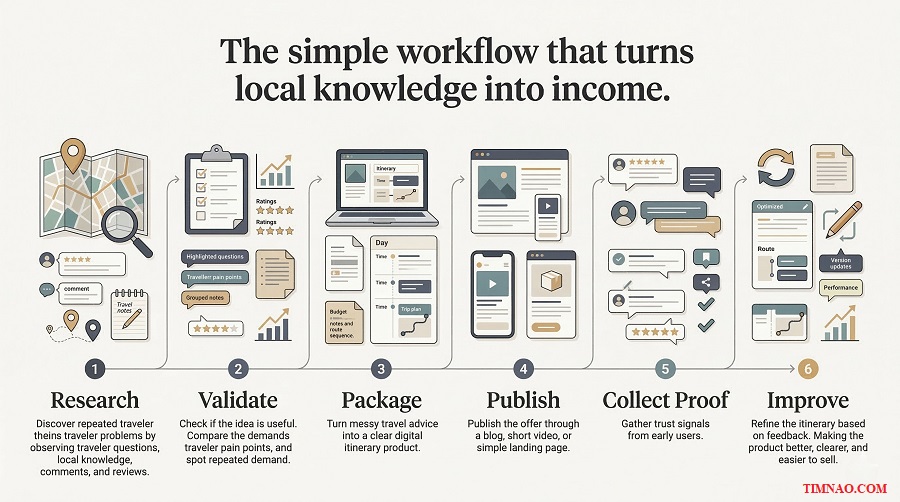
Step 1: Start with one repeated traveler problem
Do not begin with, “What product should I make?”
Begin with, “What keeps confusing travelers here?”
That question is better because it forces you toward real demand.
Maybe visitors always get stuck on:
- where to stay
- how much they can realistically do in one day
- what neighborhood fits their trip style
- what is overhyped
- what to do on the first evening
- how to plan a calm trip instead of an overpacked one
That repeated confusion is your entry point.
If you are not sure, check:
You are not looking for perfect research.
You are looking for repetition.
Step 2: Turn that problem into one narrow promise
A problem becomes sellable when it turns into a promise.
Not a vague promise like “best city guide.”
A useful promise like:
- a calmer first weekend in the city
- a food-first route that avoids wasted time
- a one-night plan for late-arriving travelers
- a family-friendly route with fewer meltdowns and less walking
- a solo-traveler guide built around ease and confidence
A good beginner promise has three parts:
- who it is for
- what outcome it creates
- what frustration it removes
If you cannot explain the offer in one sentence, it is still too broad.
Step 3: Create one sample and one paid version
This is where many people freeze because they think they need the finished product first.
You do not.
Build two versions:
- a free sample that proves your thinking
- a paid version that goes deeper and saves more decisions
For example:
Free sample
- one neighborhood route
- one short checklist
- one blog post showing how you plan a day
Paid version
- full route
- timing notes
- budget guidance
- backup options
- what to skip
- one upgrade path
This setup works because it lets people experience your usefulness before buying the full thing.
It also makes your content easier to create. One itinerary idea can become:
- a blog post
- a reel
- a carousel
- an email
- a paid guide
That is much easier than inventing new ideas every day.
Step 4: Connect content, proof, and payment
A lot of early travel content fails because the pieces do not connect.
The content exists.
The offer exists.
But they are not joined together in a way a beginner buyer can follow.
A working setup looks like this:
Content
A video, post, or article solves one small problem.
Proof
A testimonial, example, or clear explanation shows this is practical, not generic.
Payment path
A button, product page, or booking form tells people exactly what to do next.
If one of those pieces is missing, people drift away.
The workflow does not need to be fancy.
A simple version could be:
- a short video about one first-day mistake
- a blog post expanding on it
- a product link to the full itinerary
That is enough to start.
Step 5: Improve from buyer feedback, not endless brainstorming
Once the first version is live, most beginners do the wrong thing.
They start planning five more products.
A smarter move is to improve the same offer using real buyer reactions.
Ask:
- What almost stopped you from buying?
- What part was most helpful?
- What still felt unclear?
- What would make this more useful?
- What other version would you want next?
Those answers are much more valuable than random brainstorming.
They tell you what to fix, what to expand, and what product should come after this one.
A beginner workflow you can repeat every time
Here is the simplest repeatable formula:
- Spot one repeated traveler problem.
- Choose one micro-segment.
- Create one narrow promise.
- Publish one free sample.
- Sell one paid version.
- Collect proof.
- Improve before expanding.
That is how local knowledge starts acting like a business asset instead of staying as scattered advice in your phone notes.
Mistakes that quietly kill a new itinerary business
Most itinerary businesses do not fail because the person has no knowledge.
They fail because the offer stays vague, the setup stays messy, or the creator keeps doing work that feels productive but never gets anyone closer to buying.
These mistakes look small at first, which is why they are dangerous.
Trying to help everyone
This is probably the biggest one.
When your offer is for “anyone visiting this city,” it becomes much harder to trust.
It sounds broad, but broad is not the same as valuable.
A narrower offer is easier to understand and easier to recommend.
If someone can say, “This is exactly for people like us,” the product becomes easier to buy.
Writing like a guidebook instead of making decisions
A long list of places is not the same as an itinerary.
If your guide keeps saying:
- maybe try this
- you could also go here
- here are ten more options
then the buyer is still doing too much work.
People are paying for judgment.
That means you need to say things like:
- start here first
- skip this if you are short on time
- this is not worth crossing the city for
- do this only if your trip is built around food
- this backup works better if it rains
That is what makes the offer feel human and useful.
Overbuilding before validating
Some beginners spend weeks setting up:
- logos
- colors
- website menus
- automations
- fancy PDFs
- five product ideas
before one real buyer ever appears.
This usually delays learning.
A plain but useful product with real feedback is more valuable than a polished brand with no demand.
Build light first.
Proof first. Polish later.
Having no clear next step
A surprising amount of travel content dies at this point.
The reader finishes the post or video and thinks:
“Okay, now what?”
You should not make them guess.
Each content piece should point toward one next step:
- buy
- book
- sign up
- request
- join the waitlist
Not all five at once.
Just one.
Underestimating the power of proof
A beginner often thinks, “I only have one or two messages from people who liked this. That is not enough.”
Actually, it is enough to start.
People do not need a giant wall of testimonials. They need some reason to believe your advice works in the real world.
Small proof still counts:
- kind messages
- screenshots
- beta feedback
- repeat questions
- examples of time saved
Early proof reduces hesitation more than most creators expect.
Blurring the line between itinerary help and regulated travel services
This one matters.
A self-guided itinerary, planning guide, or recommendation product is not always the same as acting as a licensed guide, travel agent, or package seller.
Rules vary by country and service type.
So keep your offer clear.
If you are selling planning help, say exactly what is included and what is not. Do not casually promise services that move into legal or operational territory you have not checked.
This is not about fear. It is about protecting your business early.
Ignoring follow-up and repeat value
A lot of people treat the first sale like the end.
It is usually the beginning.
A buyer who had a good experience may want:
- a second route
- a custom version
- a neighborhood add-on
- a family edition
- a seasonal update
If you do not offer a next step, you leave value on the table.
A small itinerary business grows faster when each sale opens a natural second offer.
Your 7-day sprint to first paid itinerary
You do not need six months to test this.
You need one focused week.
The goal is not perfection. The goal is proof.
Day 1: Choose one traveler and one pain point
Write one sentence:
“I help ___ plan a ___ trip in ___ without ___.”
Examples:
- I help first-time visitors plan a calm 2-day Kyoto trip without rushing across the city.
- I help solo travelers plan an easier first evening in Seoul without safety stress or transport confusion.
- I help tired weekend visitors plan a food-first Lisbon trip without wasting time on overrated stops.
If the sentence sounds blurry, keep narrowing.
Day 2: Collect 25 real questions
Go where real travelers talk.
Look at:
- review pages
- comment sections
- Reddit threads
- saved questions in your DMs
- Google autocomplete
Write down repeated frustrations, not random tips.
You are building around what people struggle with, not what you personally feel like talking about.
Day 3: Build the route skeleton
Now sketch the trip.
Do not design yet.
Just outline:
- where the route starts
- what order makes sense
- how long each stop needs
- what can be skipped
- what backup option fits if something changes
Keep it realistic.
If the route looks exhausting on paper, it will feel worse in real life.
Day 4: Turn it into something readable
Now create the first version.
Keep it simple.
Use clean headings, short notes, and practical language. A neat document in Canva is enough.
Focus on clarity:
- who it is for
- what is included
- how the day flows
- what the buyer should decide early
- what they can ignore
This is not the day for perfectionism.
This is the day to make it usable.
Day 5: Set up the buying path
Create one place where people can act.
That could be:
Add:
- the promise
- who it is for
- what they get
- one preview or sample
- one clear button
If the page needs a long explanation to make sense, the offer is still too complicated.
Day 6: Publish three traffic pieces
Now create three small pieces that all point toward the same offer.
For example:
- one blog post answering a common planning question
- one short video showing a route decision
- one carousel or post about what to skip
Do not spread yourself across ten platforms.
Use a small number of pieces tied to one product.
Day 7: Sell a beta batch
Offer the first version at a beta price or as a limited early release.
Your goal this day is not massive revenue.
It is one of these:
- first 1 to 3 sales
- first useful feedback
- first buyer question that improves the product
- first proof that the angle resonates
Then improve immediately.
Do not disappear for a month and make version 2 in secret. Learn while people are responding.
What counts as success after seven days?
Any of these count:
- someone buys
- someone asks for a custom version
- someone signs up because the angle feels specific
- someone says, “Do you have this for another kind of traveler?”
Those are strong signals.
They mean you are no longer guessing in the dark.
FAQs: Beginner Questions About Sell Travel Itineraries Online Answered
A lot of beginners get stuck for the same reasons, so it helps to answer the practical questions directly.
Do I need to be a travel expert to start?
No.
You need to be useful, specific, and honest.
A beginner can absolutely start if they know one place, one traveler type, and one planning problem well enough to make the trip easier.
You do not need to know everything about a destination.
You need to know enough to reduce confusion for a specific kind of trip.
What if I do not live in a famous tourist city?
That is not a dealbreaker.
A smaller or less obvious destination can actually be easier because the content competition is lower and the traveler’s confusion may be higher.
You can also focus on:
- neighborhoods
- day trips
- first-night routes
- food clusters
- quieter alternatives
- niche traveler types
Specificity often beats popularity.
Should I sell a PDF or a service first?
If you want something simpler and more scalable, start with a PDF itinerary.
If you want faster learning and more direct feedback, start with a planning service.
If you already have another travel-adjacent offer, use the itinerary to support that first.
The best choice is the one you can test quickly.
How much should I charge at the beginning?
Charge enough that the buyer sees it as a real product, but not so much that you create huge pressure on version one.
A beginner usually does better with:
- a lower beta price for the first digital itinerary
- a clear but modest fee for custom planning
- a slightly higher price only after proof, testimonials, and smoother delivery exist
The exact number depends on your niche, but the bigger rule is this:
Do not price like a giant company. Price like an early useful specialist.
What if people can find similar travel tips for free?
They can find information for free.
That is not the same as finding a route that saves decisions.
People pay for:
- filtering
- structure
- realism
- confidence
- time saved
- mistakes avoided
Free content inspires.
A good paid itinerary reduces friction.
That is the difference.
Do I need a big audience first?
No.
A small but well-matched audience is enough to start.
In many cases, a focused offer plus a clear booking path matters more than follower count.
A thousand random viewers are less useful than fifty people who clearly match the trip you are solving for.
How do I know whether my itinerary is too broad?
Ask yourself:
- Would my recommendations change for a different traveler?
- Can I explain the buyer in one sentence?
- Can I name the frustration I am removing?
- Can someone tell immediately whether this is for them?
If the answer is no, narrow it again.
Can I use AI to help create the itinerary?
Yes, but carefully.
AI can help you:
- organize notes
- improve structure
- rewrite messy sections
- generate version ideas
- draft simple product copy
But it should not replace real local judgment.
If your final itinerary sounds generic, overloaded, or detached from real traveler experience, people will feel it.
Use AI as an assistant, not as the brain of the product.
What is the smartest next step after the first sale?
Improve the same offer before building five new ones.
Add:
- better timing notes
- clearer formatting
- stronger proof
- one related upsell
- one variant for a nearby traveler type
That is usually the fastest path to more revenue.
At that point, you are no longer just posting travel ideas online. You are building a small asset people can actually use, trust, and buy.
Disclaimer:
This article is for educational and informational purposes only. It is intended to help beginners understand how travel itineraries can be packaged and sold online, but it does not guarantee income, sales, clients, or business results. Any earnings mentioned are examples only and will vary based on factors such as niche, experience, pricing, market demand, consistency, and the quality of your offer. Readers should do their own research before starting any travel-related business activity, verify local laws and licensing requirements where relevant, and independently check travel details such as pricing, availability, policies, routes, and safety information before publishing or selling any itinerary. References to third-party tools, platforms, or trademarks are for identification and educational use only, and all rights remain with their respective owners.
Enjoyed this guide and found it helpful? ☕✨ If you’d like to support my work and help me create more practical content like this, you can buy me a coffee here. Your support means a lot 💛