

Competitive Business Drivers: A Refreshing, Powerful 4-Part Fix for Profit 💡
Competitive business drivers can turn a “busy but broke” side hustle into a clean, repeatable system—without more hustle, more posting, or more random tweaks. In this guide, you’ll learn a simple 4-part map (Why, What, Where, How) to spot what’s actually leaking profit, tighten your offer, and run quick tests that lead to clearer sales, better-fit customers, and steadier income.
When tactics win and profits lose: a painfully common “growth” story
Mia didn’t start her business to become a “content machine.” She started it because she wanted a simple, repeatable way to earn online without begging for clients every week.
Her first product was clean and beginner-friendly: a digital “content calendar kit” for busy creators. It included prompts, posting schedules, and a few swipe files. Early buyers loved it. A handful even messaged her, “This saved me so much time.”
So when sales slowed down, Mia did what most of us do: she doubled down on effort.
The month that looks like growth (on the outside)
She made a plan that sounded responsible:
- Post every day for 30 days
- Refresh her landing page
- Add testimonials higher on the page
- Run a small ad test
- Improve her email sequence
And it worked—at least on the surface.
Her traffic climbed. Her email list grew. Sales came in more frequently. She felt that familiar rush: “Okay… it’s working again.”
Then she opened her bank app.
Not her Stripe dashboard. Not her Shopify analytics. Her bank.
And the number didn’t match the story she was telling herself.
The “profit gap” nobody warns beginners about
Mia wasn’t imagining it. She was experiencing the profit gap: when the business metrics that feel like progress don’t translate into money you keep.
Here’s what changed behind the scenes:
- She started discounting more often to convert “warm” leads
- She answered more pre-sale DMs (“Will this work for real estate? For fitness? For Etsy?”)
- She spent more hours on support after purchase (“Where do I start?” “Can you check my niche?”)
- She spent money on ads before knowing what an “okay” result looked like
- She kept tweaking, which meant less time building the next asset
Nothing here is dramatic. That’s the problem. It’s death by a thousand “small” costs.
When Mia finally did a quick back-of-the-envelope check, the truth was obvious:
- A sale at $29 feels good
- A sale at $29 after a 20% discount feels less good
- A sale at $29 after fees, ads, and 45 minutes of support is… not really a sale
She wasn’t failing at marketing. She was accidentally building a business that created busyness faster than it created profit.
Why tactics feel like the right lever (even when they aren’t)
Tactics are the easiest thing to change because they’re visible:
- new hooks
- new posts
- new ads
- new email subject lines
- new landing page sections
You can do them today. You can see numbers move tomorrow. So your brain learns: “If I’m stuck, I just need better tactics.”
But tactics are like polishing the outside of a car while ignoring the engine light. You can make it look faster without making it run better.
Mia’s turning point came from one simple question:
“What exactly am I optimizing for right now?”
If the answer is “views,” “followers,” or “traffic,” it’s very easy to win tactically and still lose financially.
A beginner-friendly reality check (no spreadsheets needed)
If you want a quick way to spot the same pattern, ask yourself these three questions:
- Do I know my rough profit per sale?
Not perfectly. Roughly. If you don’t, you might be scaling a leak. - Do customers buy and succeed… without me stepping in?
If every sale creates a support conversation, your “digital product” is secretly a service. - Am I attracting the right buyers—or just more buyers?
More leads isn’t always better. “Wrong-fit” buyers eat time, cause refunds, and force discounts.
If any of these feel shaky, pushing tactics harder usually makes the problem louder.
What Mia needed wasn’t a new posting schedule. She needed a way to diagnose the business before she touched another tactic.
That’s where the next idea comes in.
The four competitive business drivers in one picture
Imagine your business as a house. Tactics are the furniture: you can move it around quickly. But if the foundation is cracked or the walls are in the wrong place, rearranging furniture won’t fix the feeling that something is “off.”
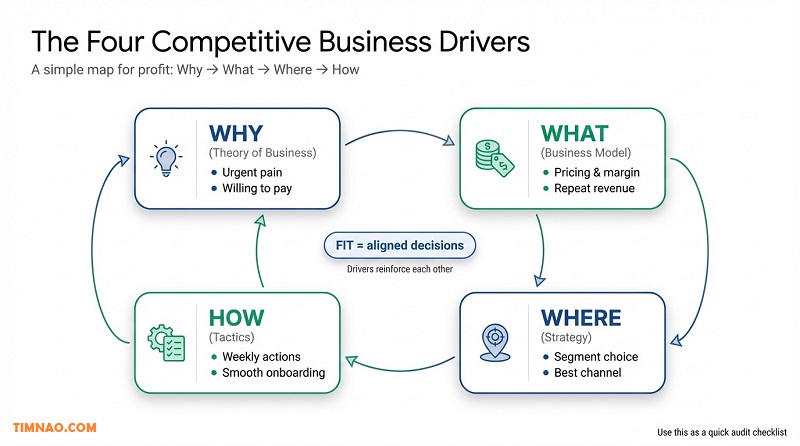
The four competitive business drivers are a simple map that keeps you from rearranging furniture forever. They split your business into four different questions:
- Why does this business make sense in the real world?
- What turns customer value into money you can keep?
- Where do you choose to compete (which market/segment)?
- How do you execute day-to-day?
If you’ve been stuck in “do more marketing,” this map is a relief. It shows you that not every problem is a marketing problem.
The picture (without the jargon)
Here’s a plain-English way to remember it:
- WHY = your assumptions about what customers want and what they’ll pay for
- WHAT = the way your offer and pricing create profit (not just revenue)
- WHERE = the specific arena you’re choosing (so you aren’t competing with everyone)
- HOW = the actions and systems you run every week
Notice what’s missing: “work harder.”
This framework doesn’t reward hustle. It rewards clarity.
How the map prevents wasted effort
The biggest beginner mistake isn’t making the wrong decision. It’s making decisions in the wrong order.
When people jump straight to HOW (tactics), they often:
- create content for the wrong audience
- spend money on ads before the offer is clear
- keep lowering prices instead of fixing the offer
- add complexity (funnels, tools, platforms) to compensate for confusion
The four-driver map gives you a clean sequence:
- Start by making sure your WHY is real (not wishful thinking)
- Make sure your WHAT can produce profit (not just sales)
- Choose a WHERE that makes your message land
- Then pour fuel on it with HOW
You don’t have to master all four at once. You just need to stop using tactics as a rescue mission.
A tiny “map it out” exercise you can do in 10 minutes
Open a note and write four short lines. Keep each line under 12 words.
- WHY: People buy because ______________________
- WHAT: We earn when __________________________
- WHERE: We focus on __________________________
- HOW: This week we will _______________________
Now read it out loud.
If you stumble on a line, that’s a signal—not shame. It usually means you’ve been trying to execute before you’ve decided.
This is exactly what happened to Mia. Her HOW was busy, but her WHERE was fuzzy. Her WHAT wasn’t designed for profit. And her WHY was too broad (“creators want calendars”) to guide good decisions.
Once she could see the four questions separately, she stopped “fixing” the wrong thing.
And that’s the whole point of this part: you’re not behind. You’re just missing the map.
In the next section, we’ll start with the first driver—Theory of Business (WHY)—and turn your assumptions into simple, testable statements you can validate fast.
Driver 1 — Theory of Business: your assumptions about reality (and what you’re paid for)
Mia thought she had a marketing problem. In reality, she had an assumption problem.
That’s what the Theory of Business is: the beliefs you’re betting your time, money, and focus on. If those beliefs are fuzzy, you’ll keep “optimizing” forever—because you’re trying to win a game you haven’t clearly defined.
What it means in normal language
Think of it as three statements:
- Who you help
- What they’re trying to achieve (or avoid)
- Why they’ll pay you instead of doing it themselves
If any of those are wrong, tactics won’t save you. They’ll just help you run faster in the wrong direction.
The assumptions beginners rarely write down
Most people operate on silent assumptions like:
- “They care enough to pay, not just like it.”
- “They trust a small brand if the product looks professional.”
- “They’ll implement without lots of hand-holding.”
- “My solution is meaningfully better than DIY or free options.”
- “My buyers will look like me.” (This causes a lot of mis-targeting.)
Mia’s early assumption was “people want a calendar.” Her best buyers were actually paying for “consistency without thinking.” That subtle shift changes what you sell, how you sell, and who you target.
Turn vague beliefs into testable sentences
A good assumption is something you can prove or disprove.
Bad: “People love my content.”
Better: “Busy salon owners will pay $49 for a 4-week posting plan.”
Use this formula:
- “_____ will pay _____ for _____ because _____.”
When you can write that sentence, you can test it.
Build a clear “Why” in 10 minutes
Open a note and write four short lines:
- Customer snapshot: “I help ____ who ____.”
- Pain trigger: “They struggle because ____.”
- Outcome: “They want ____ so they can ____.”
- Payment reason: “They’ll pay because it saves them ____.”
Now add a proof line:
- Proof plan: “I’ll know I’m right when I see ____ (payments / repeat patterns / referrals).”
If you can’t write the proof line, you’re not ready for tactics yet.
How to test your assumptions fast (even with no audience)
You don’t need followers. You need signals.
Test 1: 10 short conversations
Ask:
- “What have you tried so far?”
- “What did it cost you (time, money, stress)?”
- “What would a real win look like in 30 days?”
- “What’s the biggest reason you haven’t solved it yet?”
Listen for repeated wording and repeated priorities.
Test 2: Forced choice
Instead of “Would you buy this?”, ask:
- “Template or done-with-you?”
- “Speed or lower cost?”
- “Would you pay more to avoid mistakes?”
Forced choice reveals what they value most.
Test 3: Tiny survey that doesn’t lie
If you can reach a small community, ask one question:
- “If you could fix one thing about ____ this month, what would it be?”
Then DM 5–10 people who respond and ask one follow-up. This turns “likes” into real insight.
Test 4: Paid pilot
Charge for a tiny version of the outcome ($29–$199 depending on scope). Payment is the cleanest proof your “Why” matches reality.
Red flags your theory is off (and the simplest fix)
Common signals:
- Interest but no payments: the pain isn’t urgent or the outcome isn’t clear.
- Payments but high refunds: your promise and delivery don’t match.
- Too many “does this work for me?” questions: your “who” is too broad.
- Customers succeed only with your help: your format is too advanced.
Simplest fix:
- Narrow the customer snapshot.
- Define one clear first win (“In 7 days you’ll have X done.”).
- Add one repeatable support layer (onboarding checklist + FAQ + short tutorial).
What you’re really selling: time, certainty, or status
Most offers sell one primary value type:
- Time: saves hours every week
- Certainty: removes confusion and mistakes
- Status: helps the buyer look credible/professional
Knowing which one you sell makes your messaging and product format much easier.
Driver 2 — Business Model: how you turn value into cash (not just sales)
A business model is not a website or “I sell online.” It’s your profit logic—how customer value becomes money you can keep.
Two people can sell the same thing and get totally different outcomes because their models create different costs, margins, and repeat sales.
Sales vs profit (the beginner trap)
Revenue is what came in. Profit is what stays after:
- delivery costs (your time, tools, support)
- acquisition costs (ads, outreach time, content production)
- overhead (subscriptions, contractors, refunds)
If you celebrate revenue but never check what’s left, you can scale a leak.
A one-page business model snapshot
Write this on one page:
- Offer: what you sell
- Pricing: one-off, package, subscription, tiers
- Delivery: how you fulfill (and how much time it takes)
- Acquisition: how customers find you
- Retention: why they buy again (or don’t)
Then add one line that upgrades your decisions instantly:
Rough profit per customer
= (price − delivery cost) − acquisition cost
A quick example calculation (copy the method)
Say you sell a $49 digital kit.
- Fees: $3
- Ads per sale: $12
- Support time: 20 minutes
(If your hour is $30, that’s $10)
Rough profit:
- $49 − ($3 + $12 + $10) = $24
Now you can see why discounting and “extra support” can quietly erase profit.
Two quick guardrails that protect your margins
If you only adopt two business model rules, make them these:
- Discount with a reason, not a feeling.
Example: only discount for first-time buyers during a launch window, or for bundles—not randomly in DMs. - Set a support boundary.
Decide what “included support” means (FAQ + email within 48 hours, or one 15-minute call for premium).
Unlimited support quietly turns a product into a low-paid service.
Three beginner-friendly business model shapes (choose one)
You don’t need a complex model. You need a model you can run.
- Product-first
- You sell a repeatable asset (template, kit, course).
- Best when onboarding is strong and support is low.
- Service-first
- You sell speed/certainty (setup, audit, implementation).
- Best when you need cash quickly and can deliver consistently.
- Hybrid (smart for many beginners)
- A product for scale + a small service layer for higher-margin buyers.
- Best when your audience has mixed needs.
Mia started product-first but accidentally became service-first through constant DMs. Hybrid fixed that: product for most buyers, higher-tier setup for those who want help.
Packaging: the fastest profit lever for beginners
Before you create more content, try packaging the same value better:
- Bundle by outcome: “a 4-week plan” beats separate templates.
- Tier by support/speed: DIY → guided → done-with-you.
- Remove options: fewer choices often increases conversions.
- Add a clear deliverable: “You’ll leave with X completed.”
Pricing that feels fair (to you and the buyer)
Anchor price to outcomes, not effort:
- cost of delay (what staying stuck costs monthly)
- cost of alternatives (tools/freelancers/ads)
- value of speed (“done this week”)
Rule of thumb: charge more when you remove more effort and uncertainty.
Free vs paid (keep it clean)
If you use a free lead magnet or free tier, give it one job:
- Free helps them start
- Paid helps them finish
If free helps them finish, you’ll attract collectors who don’t convert.
Retention: the stability engine
New customers feel exciting. Repeat customers feel stable.
Pick one retention angle:
- monthly refresh packs (templates/prompts by niche)
- a next-step offer after the first win
- lightweight reviews (one monthly check-in)
Keep it sustainable. “Consistency” is part of the model.
Driver 3 — Strategy: where you choose to compete (and win)
Strategy sounds big, but here it’s practical: where you decide to play.
If you don’t choose a “where,” you end up competing with everyone—and that usually means generic messaging and price pressure.
What “where” actually includes
Your “where” is a set of choices:
- Segment: who you serve (role, situation, budget)
- Arena: templates, coaching, services, software
- Channel: search, social, partnerships, outreach
- Optional geography: local vs global
You’re not choosing forever. You’re choosing the next focused window (30–90 days).
Pick a winnable segment using three filters
Use this quick test:
- Urgency: they feel the pain weekly.
- Ability to pay: they already spend money/time trying to solve it.
- Reachability: you can consistently find them.
If a segment fails one filter, it becomes a grind.
Choose one wedge so you’re not competing on price
You don’t need to be different in everything. Choose one:
- faster, simpler, more specific, more certain, or more complete
Then build your message around it:
- “For X, I help you achieve Y in Z time.”
Match your channel to your segment (so you’re not shouting into space)
A simple pairing rule:
- If your buyers research before paying, lean toward search and evergreen content.
- If your buyers buy on trust and personality, lean toward short video and community.
- If your buyers are busy professionals, lean toward outreach and partnerships.
Beginners often pick a channel based on what’s trendy, not what their segment actually uses.
Strategy also means what you refuse
Refusals create focus:
- “I won’t compete on the lowest price.”
- “I won’t target people who aren’t already trying.”
- “I won’t use three channels at once.”
Refusals protect you from drifting back into “everyone.”
A 30-day strategy statement that guides action
Write this and commit:
- “For 30 days, I serve ____.”
- “I show up on ____ (one channel).”
- “My promise is ____ (one outcome).”
- “I measure ____ (one metric).”
If the plan is simple, you’ll actually do it.
Driver 4 — Tactics: execution across the functional areas (only after the other three)
Once your Why, What, and Where are clearer, tactics stop feeling random. They become a multiplier.
Before that, tactics are often noise—and noise is expensive.
Think in functions, not random tasks
Most tactical work fits into five functions:
- Marketing: reach the right people
- Sales: convert attention into buyers
- Operations: deliver the outcome consistently
- Finance: track profit and costs
- People: contractors/collabs if needed
If a task doesn’t support a function, it’s probably a distraction.
A simple tactical stack for beginners
Keep it repeatable:
- One acquisition lane (choose one)
- One conversion asset (offer page + proof)
- One onboarding flow (start-here + checklist/tutorial)
- Optional retention loop (follow-up or next-step offer)
Helpful tools (only if you need them):
Pick one tool per job. Keep the stack light.
Tactics by function (so you always know what to do next)
If you feel stuck, pick one action from the function you need most:
Marketing
- answer one buyer question in public (“how do I…?”)
- share one niche-specific checklist or template
Sales
- simplify your offer page (one promise, one price, one CTA)
- add 3 FAQs that handle objections
Operations
- create a “Start Here” page
- add a 5-minute quickstart tutorial
Finance
- track profit per sale weekly
- cut one unused subscription
A weekly rhythm that prevents tactic-churn
Adjust volume, not structure:
- 2 blocks: acquisition
- 1 block: conversion
- 1 block: delivery improvement
- 20 minutes: finance check (profit per sale, refunds, spend)
One metric so tactics don’t lie
Choose one metric for your stage:
- validating: payments
- selling: conversion rate
- scaling: profit per sale
- stabilizing: repeat purchases
A simple rule for using AI without losing your voice
Use AI to speed up execution (drafts, summaries), but keep your judgment in charge. If you haven’t heard a pain from real people, don’t build an offer around it.
The Fit Test: do these drivers reinforce each other?
Most beginner businesses don’t fail because the founder is lazy. They fail because the business is “miswired.” Each part is doing its own thing, and the whole machine wastes energy.
The Fit Test helps you spot that miswiring—fast—so you stop fixing symptoms and start fixing the system.
Fit means your four drivers—Why (Theory), What (Model), Where (Strategy), How (Tactics)—pull in the same direction. When they do, your marketing feels clearer, customers succeed more often, and your profit stops leaking in weird places.
Misfit feels like this:
- You attract people who love your content but never buy.
- You sell, but fulfillment drains you and margins vanish.
- You get buyers, but they’re the wrong buyers.
- You keep changing tactics because nothing “sticks.”
A fast mental image: the shopping cart test
Picture your customer pushing a shopping cart through your business:
- WHY gets them to think, “This is for me.”
- WHERE gets them into your aisle (your niche/segment).
- WHAT gets them to put it in the cart (offer + pricing makes sense).
- HOW gets them to checkout and succeed (delivery + onboarding).
If any step is confusing, they abandon the cart—either before purchase (no conversion) or after purchase (refunds, churn).
Fit signals you can actually notice in real life
You don’t need fancy dashboards to see fit. Look for these practical signals:
- Your DMs get shorter. People ask fewer “is this for me?” questions because your WHERE is clear.
- Support gets quieter. New buyers can start without you, which means your HOW matches your promise.
- Sales feel less emotional. You don’t need last-minute discounts to close, because your WHAT makes sense.
- Testimonials mention outcomes. Not “nice,” but “this helped me do X,” which means your WHY is real.
- One channel starts compounding. Your efforts stack instead of resetting weekly.
When those signals show up, your business starts feeling “simpler,” not “harder.”
Five common misfits (and the simplest fixes)
Misfit #1: Premium WHY, bargain WHAT
You speak “premium,” but your model relies on discounts and low prices.
Fix: price around speed/certainty—define one outcome, attach clear deliverables, and stop discounting in DMs.
Misfit #2: Narrow WHERE, messy HOW
You target a clear segment, but onboarding is chaotic (files everywhere, unclear start).
Fix: one “Start Here” path + one quick-start checklist + fewer choices.
Misfit #3: Strong WHY, weak WHAT
People want the outcome, but the way you sell it doesn’t match how they succeed.
Fix: adjust packaging (bundle by outcome, add a higher tier, or a next step offer).
Misfit #4: Clear WHAT, wrong WHERE
Good offer, fair pricing—wrong crowd or wrong channel.
Fix: change segment/channel before rewriting another hook.
Misfit #5: Strong HOW, shaky WHY
You execute hard without validating assumptions.
Fix: do 10 interviews and one paid pilot before “optimizing” again.
The one-question sanity check
If you’re not sure where the misfit is, ask this:
“If I doubled my traffic next week, would my life get better or worse?”
- If the answer is “worse,” your WHAT/HOW is leaking (support, delivery, margins).
- If the answer is “it wouldn’t matter,” your WHERE/WHY is off (wrong audience or unclear promise).
- If the answer is “better,” you’re likely close to fit—and tactics might be the right lever now.
The Fit Scoreboard (a tool you can reuse)
Score 1–5 on each driver:
- WHY: Do I know the urgent problem and who feels it?
- WHAT: Do I know roughly what I keep per customer and why it works?
- WHERE: Am I clear on my segment and the channel that reaches them?
- HOW: Do I have a repeatable weekly rhythm and smooth delivery?
Now read the pattern:
- One driver at 1–2 = your bottleneck.
- Strong HOW but weak WHY/WHERE = “busy but stuck.”
- Strong WHY/WHERE but weak WHAT = “sales but no profit.”
- Strong WHAT but weak WHERE = “good offer, no traction.”
A mini-case: how Mia found her real bottleneck
Mia’s scores looked like this:
- WHY: 3 (a hunch, not proof)
- WHAT: 2 (discounts + support time ate margin)
- WHERE: 2 (too broad)
- HOW: 4 (consistent execution)
The temptation was to “improve tactics,” but HOW was already her strongest driver. The win came from fixing WHERE and WHAT—choosing a clearer segment and packaging the offer so success didn’t require endless DMs.
Make it usable: a Four-Drivers Audit checklist + decision rules
A framework only matters if it changes what you do on Tuesday.
Run this audit anytime results stall for a few weeks, before you spend on ads, or before you add a new offer. The goal is not perfection. The goal is one clear next move.
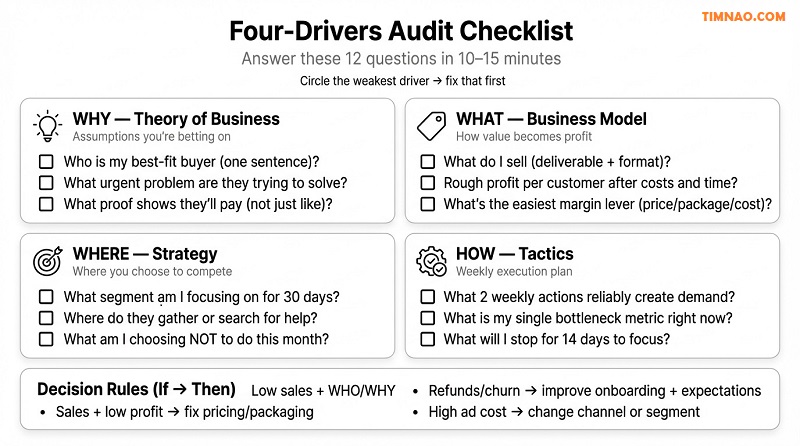
Step 1: The 12-question audit (20–30 minutes)
Answer in short sentences. If you start writing paragraphs, you’re usually avoiding the hard truth.
WHY — Theory of Business
- What situation is my customer in right now?
- What do they want 30 days from now?
- What proof do I have they’ll pay (not just like it)?
WHAT — Business Model
4) What exactly do I sell (deliverables + format)?
5) What’s my rough profit per customer after fees, time, and acquisition?
6) What’s the simplest margin lever: price, packaging, retention, or delivery cost?
WHERE — Strategy
7) Who is my best-fit segment (and who is a bad fit)?
8) Where do they gather or search when they need help?
9) What am I choosing to NOT do for 30 days (channel, segment, offer)?
HOW — Tactics
10) What are my two weekly actions that create demand?
11) What is my one bottleneck metric (conversion, profit per sale, retention, refund rate)?
12) What will I stop doing for 14 days to protect focus?
Step 2: Turn it into one “Audit Card” (5 minutes)
- Best-fit customer: ________
- Core promise (one sentence): ________
- Primary offer + price: ________
- Primary channel (30 days): ________
- Bottleneck metric: ________
- One thing to stop: ________
If you can’t fill this in cleanly, your business is drifting.
Step 3: Decision rules (so you don’t panic-pivot)
These are “if-then” rules you can follow when emotions are high.
- Low conversion + high interest: fix WHERE/WHY (narrow buyer, sharpen outcome, talk to 10 targets).
- Sales but tiny profit: fix WHAT (raise price, bundle by outcome, cap support, add a higher tier).
- High refunds/churn: fix fit between WHY and HOW (expectations + onboarding).
- Expensive acquisition: fix WHERE (channel) or HOW (repeatable system) before “more content.”
- Everything feels okay but flat: don’t change five things. Choose one lever and run it for 14 days.
Step 4: After the audit, choose one experiment (not five)
This is where most people slip. They discover 12 problems and try to fix all 12.
Instead, pick the smallest experiment that improves your bottleneck metric.
Examples:
- Bottleneck is conversion → rewrite your offer page headline + add 3 FAQs.
- Bottleneck is profit per sale → remove discounts for 14 days + add one higher tier.
- Bottleneck is refunds → create a “Start Here” page + tighten your promise.
- Bottleneck is acquisition cost → switch to one channel where buyers already search.
Keep the experiment tiny, measurable, and time-boxed.
Optional setup (keep it lightweight)
- One-page audit doc in Notion
- A weekly metric tracker in Google Sheets
- Or a simple board in Trello
Pick one. If you spend more time choosing tools than running the audit, that’s also a signal.
Practical earning paths: 3 beginner personas using the framework
Below are three paths that match how beginners actually start: limited time, limited proof, and a desire to earn without chaos.
Persona 1: Beginner with no audience (wants the first paid win)
Goal: get your first paying customer in a way you can repeat.
Do this in order
- Pick a segment you can reach this week.
- Write a one-sentence WHY: “They pay because ____ is urgent.”
- Create a starter offer that delivers one visible result (60–120 minutes).
- Price it simply and cap spots (3–5).
- Start conversations: 2 community posts + 10 DMs to matched people.
A simple DM script that doesn’t feel spammy
- “Hey ___, quick question—are you trying to fix ____ this month?”
- “I’m testing a small offer that helps with ____ in about ____.”
- “If you want, I can send the details. No pressure.”
If they say yes, ask one qualifier:
- “What have you tried so far?”
Micro-actions
- Use a 3-question intake form so you stop repeating yourself.
- After delivery, ask for one testimonial focused on results.
First measurable win: 1 paid pilot + 1 testimonial + 1 clearer offer sentence.
Persona 2: Freelancer/creator (has skill, wants steadier income)
Goal: earn more per client without doing more custom work.
Do this in order
- Review your last 5 projects: which were profitable and enjoyable?
- Choose one “where” for 30 days (one industry or one job-to-be-done).
- Productize the offer: deliverables, timeline, boundaries.
- Build one proof asset (a short case study or teardown).
- Run one outreach loop for 10 days: 10 targeted messages/day.
A quick outreach message you can adapt
- “Saw you’re a ___—quick idea: I help ___ get ___ without ___.”
- “If you want, I can send a 3-point teardown of your current ____.”
Keep it light. The goal is a conversation, not a pitch deck.
Micro-actions
- Put boundaries in writing (what’s included, what costs extra).
- Track profit per project, not just revenue.
First measurable win: 3 discovery calls from one niche angle.
Persona 3: Small business owner (wants profit, not constant promos)
Goal: improve profit without endlessly chasing new customers.
Do this in order
- Identify your best customers (top 20% by profit).
- Tighten WHERE: market to the segment that already buys well.
- Adjust WHAT to reward repeat buying (bundles, memberships, maintenance plans).
- Improve HOW with one “return loop” (welcome + quick-start + reminder).
- Track one metric weekly (repeat rate or profit per customer).
Micro-actions
- Add a referral trigger (simple reward, clear timing).
- Remove one offer that creates disproportionate support.
First measurable win: 10 repeat customers in 30 days (or a visible repeat-rate lift).
If you’re unsure which path fits, choose the one that matches your immediate constraint: proof (Persona 1), stability (Persona 2), or retention (Persona 3). Next, we’ll turn your chosen path into a short sprint you can actually run—even if you have a job and limited time.
A 7-day sprint to redesign your offer without quitting your job
You don’t need a “big rebrand” or a 3-month strategy retreat to improve your offer. You need a short window where you make a few high-leverage decisions, test them in the real world, and ship a cleaner version of what you already know.
This 7-day sprint is built for people with a job, family, and limited energy. Aim for 45–75 minutes per day. If you can only do 30 minutes, still do it—just keep the deliverables small.
What you’ll have by Day 7
By the end, you should have:
- A clearer “who this is for” sentence (so you stop attracting wrong-fit buyers)
- A simplified offer page or offer message (one promise, one price, one next step)
- A delivery plan that reduces support and refunds
- One small experiment running (so you get proof, not just opinions)
Day 1 — Pick one buyer and one job-to-be-done
Your mission today is focus, not perfection.
Do this:
- Choose one segment you can actually reach this month (community, coworkers, friends-of-friends, existing followers).
- Write a “job-to-be-done” sentence:
- “They hire/buy this because they want ____ without ____.”
Examples:
- “Salon owners want consistent posts without staring at a blank screen.”
- “New freelancers want a portfolio that converts without spending weeks guessing.”
Deliverable (5 minutes):
- One sentence: “This is for ____ who want ____.”
If you’re stuck:
Pick the segment that already asks you for help. That’s usually the closest-to-cash path.
Day 2 — Rewrite the promise as one measurable first win
Beginners often promise a big transformation. Big promises create confusion, extra support, and refunds.
Today you’ll design a first win that is:
- visible (they can see it)
- fast (within 7–14 days)
- specific (not “grow your business”)
Do this:
- Write 3 versions of your promise using this frame:
- “In __ days, you’ll have __ (deliverable) so you can __ (benefit).”
Examples:
- “In 7 days, you’ll have 12 niche-specific posts scheduled, so you stop skipping weeks.”
- “In 10 days, you’ll have a client-ready portfolio page, so you can pitch with confidence.”
Deliverable:
- Choose the best promise and underline the deliverable (the thing they can point to).
Day 3 — Repackage what you already have (don’t create new content)
Today is about turning existing work into a cleaner offer.
Do this:
- List everything you currently “include” (templates, calls, support, bonuses).
- Group items into 3 buckets:
- Must-have (creates the first win)
- Nice-to-have (helps, but not required)
- Noise (adds confusion)
Beginner-friendly packaging moves:
- Bundle by outcome (one complete path) instead of “lots of stuff”
- Reduce choices (fewer options = fewer questions)
- Add a “Start Here” order so buyers don’t get overwhelmed
Deliverable:
- A simple outline of your offer in 5 bullets max:
- What they get
- What they do first
- When they see the first win
- What support is included
- Who it’s not for
Day 4 — Choose a pricing logic you can defend (and stop random discounts)
Pricing is emotional when your offer is unclear. It becomes calmer when the deliverable is clear.
Do this:
- Pick a pricing style:
- One-time (simple)
- Tiered (DIY vs guided vs done-with-you)
- Subscription (if you can deliver ongoing value)
- Choose one of these pricing anchors:
- Speed (done faster)
- Certainty (done correctly)
- Convenience (done with less effort)
Set one boundary today:
- Write one sentence that defines what’s included support.
- “Support includes email replies within 48 hours for 14 days.”
- “One 15-minute onboarding call is included on the guided tier.”
Deliverable:
- One price + one boundary sentence.
Day 5 — Build your “offer message” (even if you don’t have a website)
You don’t need a perfect landing page to sell. You need a clear message you can paste into a DM, email, or post.
Write this (copy/paste template):
- Who it’s for: “If you’re a ____…”
- Problem: “and you’re stuck with ____…”
- Promise: “I’ll help you get ____ in ____ days…”
- What they receive: “You get ____ (3 bullets)…”
- Proof: “Here’s why it works: ____ (one sentence).”
- Next step: “Want the details? Reply ____.”
Tool options (only if helpful):
Deliverable:
- One offer message you can send today.
Day 6 — Run a tiny test that creates proof (not vanity metrics)
Today is not “launch day.” It’s test day.
Pick one of these low-stress tests:
Test A: 10 conversations
- Post one question in a community:
- “What’s your biggest struggle with ____ this month?”
- DM 10 people who respond:
- “Mind if I ask 2 quick questions? I’m building a small solution.”
Test B: 5 paid pilots
- Offer 5 spots at a simple price.
- Keep it small and time-boxed.
- Collect feedback and a result-focused testimonial.
Test C: one buyer keyword post
- Write one helpful post that answers one buyer question.
- End with your offer message.
Deliverable:
- One test chosen + one success metric defined.
- Example: “2 calls booked” or “1 paid pilot.”
Day 7 — Tighten the delivery so customers succeed without you
If you want profit, you need buyers to succeed without constant hand-holding.
Today you create a “first week success path.”
Do this:
- Create a Start Here checklist (7 steps max).
- Create a Quick-start guide:
- “Do these 3 things first.”
- Write 5 FAQs that prevent support tickets:
- who it’s for / not for
- how long it takes
- what to do if they’re stuck
- what results to expect (realistically)
- how to get help
Tools that make this easy:
- A checklist doc in Google Docs
- A tracker in Google Sheets
- A simple onboarding email in Mailchimp
Deliverable:
- One onboarding checklist + 5 FAQs.
When you finish Day 7, don’t immediately rewrite everything again. Run the same offer for 2 weeks and watch the bottleneck metric you chose on Day 6.
Key takeaways you can use immediately
- Stop “optimizing” tactics when profit is unclear. First clarify your buyer, promise, and basic profit per sale.
- Make your offer about a first win, not a life change. Beginners buy clarity and momentum.
- Package for simplicity. Fewer options, a clear Start Here path, and a support boundary reduce refunds and burnout.
- Pick one “where” for 30 days. One segment + one channel beats scattered effort across five platforms.
- Measure one bottleneck metric at a time. Conversion, profit per sale, refund rate, or repeat purchases—choose one and improve it.
- Run tiny tests for proof. A paid pilot or 10 targeted conversations beats weeks of guessing.
FAQs: Beginner Questions About Competitive Business Drivers Answered
“Do I need all four drivers if I’m just starting?”
Yes—but not at the same depth.
If you’re starting, you don’t need a full strategy document. You need:
- A testable WHY (who + problem + willingness to pay)
- A simple WHAT (one offer + one price + rough costs)
- A narrow WHERE (one segment you can reach)
- A lightweight HOW (two weekly actions)
Think of it like building a bike: you need all the parts, but you don’t need racing upgrades on day one.
“What if my business is small—does ‘strategy’ still matter?”
Yes, maybe more.
Small businesses don’t have the budget to compete everywhere. Strategy is what prevents you from spending months talking to people who will never buy.
A beginner strategy can be as simple as:
- “I serve dentists in my city”
- “I post weekly on LinkedIn”
- “My offer is a done-in-a-day website refresh”
That’s strategy: choosing where to play.
“How do I know whether my problem is business model or tactics?”
Use this shortcut:
- If you’re getting leads and sales but you feel broke → it’s likely business model (pricing, costs, support boundaries).
- If you can’t get attention or buyers at all → it’s likely tactics or where (channel/segment mismatch).
- If people say “interesting” but don’t buy → it’s often why (wrong problem or unclear outcome).
When in doubt, calculate rough profit per sale and check whether delivery is eating your time.
“Can I use this framework for services, not just products?”
Absolutely.
In services, the drivers show up like this:
- WHY: the client’s urgent pain and why they trust you
- WHAT: your package, timeline, scope, and margins
- WHERE: the industry or job-to-be-done you target
- HOW: delivery process, communication, and client management
Service businesses often leak profit through scope creep, so the “WHAT” driver (boundaries) becomes especially important.
“I have multiple niches. Should I pick one?”
For now, yes.
Multiple niches can work later. Early on, it usually creates vague messaging and inconsistent results.
A practical approach:
- Pick one niche for 30 days
- Run the 7-day sprint
- Measure your bottleneck metric
- Decide whether to keep, adjust, or switch
This keeps you focused without feeling trapped forever.
“What’s the simplest way to apply this weekly?”
Use a 15-minute weekly check:
- What driver feels weakest right now?
- What is my one metric this week?
- What two actions will move it?
- What will I stop doing to protect focus?
Write the answers somewhere visible. If you can’t answer quickly, you’re drifting.
“Where does AI fit in here?”
AI is a tool inside HOW (tactics), not a replacement for WHY/WHAT/WHERE.
Use AI to speed up execution:
- draft posts
- outline emails
- simplify onboarding docs
But don’t let AI choose your market, promise, or pricing. That still comes from real people, real buying behavior, and real results.
If you want a safe rule:
- Use AI to produce drafts faster.
- Use customers to tell you what matters.
Disclaimer
This article is for educational and informational purposes only. It does not provide business, financial, legal, tax, or investment advice, and it isn’t a substitute for professional guidance tailored to your situation.
Any examples, numbers, pricing ideas, or scenarios mentioned are illustrative—not guarantees of income, profit, or results. Your outcomes will depend on factors such as your market, skills, effort, costs, timing, and execution.
You are responsible for your own decisions and actions. Before spending money on ads, tools, contractors, or making major business changes, consider validating assumptions with small tests and, if needed, consult qualified professionals.
If this article helped you, you can support my work by buying me a coffee ☕😊
Your support keeps these beginner-friendly guides coming (and ad-free!) 🙌✨
👉 Buy me a coffee 💛






)