
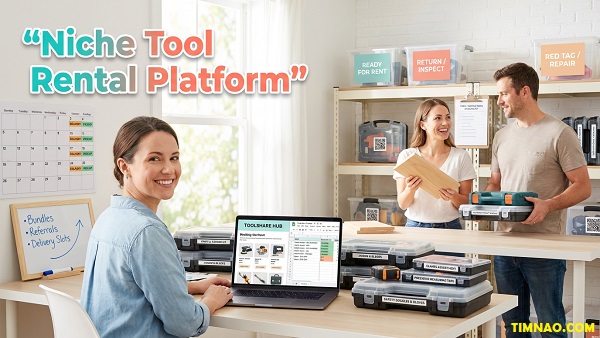
Niche Tool Rental Platform Founder Story Case Study: An Honest Build 🛠️
Niche tool rental platform businesses are quietly becoming the “missing link” for DIYers who want to build things without buying a garage full of tools. In this tool rental platform case study, you’ll follow Linh’s realistic 90-day journey—how she validated demand, launched weekend kits, and built a DIY tool rental business that works with limited time, space, and budget. If you’re a beginner, this story is designed to feel doable: clear steps, practical numbers, and systems you can copy without sounding like a robot.
Linh’s constraint: $3,000 budget, no garage, weekends-only schedule
Linh didn’t start with a grand “startup founder” identity. She started with a calendar that was already too full.
She was a UX designer with a steady paycheck, a small apartment, and the kind of life setup that makes most physical businesses feel impossible. No garage. No driveway. No “extra room” that could magically become a workshop. Her only open slots were Friday night, a chunk of Saturday, and a careful slice of Sunday afternoon—because Mondays still mattered.
And then there was the money constraint. Linh gave herself a firm rule: $3,000 total, and she wanted that to cover everything—tools, storage, basic software, cleaning supplies, and the “oops” moments that always happen when real customers touch real equipment.
Why the constraints mattered (and why they were secretly an advantage)
When you’re building a DIY tool rental business, constraints force clarity. Linh couldn’t afford to “try a little bit of everything,” so she had to choose a lane early. That ended up shaping the business in a way that made it easier for customers to understand.
She wrote her constraints on a sticky note and taped it above her desk:
- Time: weekends only (6–10 hours/week at most)
- Space: apartment living (no messy storage at home)
- Cash: $3,000 all-in for the first test
- Energy: must be simple enough to run without burning out
That last point was the most important. Linh wasn’t trying to build a company that looked impressive on paper. She wanted something she could actually operate.
The “weekend operating system” she designed from day one
Instead of dreaming about daily deliveries and 24/7 availability, Linh designed the business around how she realistically lived.
Her first operating plan looked like this:
- Friday evening: prep tools + pickup window
- Saturday morning: delivery/pickup window (limited radius)
- Sunday evening: return window + quick inspection
- One weekday evening (optional): admin, repairs, messages
That structure wasn’t glamorous, but it was dependable. It also created a helpful kind of scarcity: if people wanted tools for weekend projects, they had to book within Linh’s windows. Clear boundaries made the business more predictable—and surprisingly, customers respected that.
What Linh refused to do (and why that saved her)
A lot of founders make early decisions based on pride. Linh made hers based on survival.
She refused to:
- Rent a retail space (too expensive, too much commitment)
- Build an app (too slow, too distracting)
- Offer every tool under the sun (inventory chaos)
- Promise same-day convenience (she’d miss a delivery once and lose trust)
Instead, she aimed for “small and reliable.” Her internal goal wasn’t to impress the internet. It was to make the first 10 customers feel like, “Wow—this is easy.”
The beginner-friendly takeaway
If you’re reading this and thinking, “I don’t have time or space either,” that’s the point.
Start by writing your own constraint list. Then build your version of a rental business that fits your life, not a fantasy.
A simple template:
- I can operate on: (days + hours)
- I can store tools in: (home corner, storage unit, partner space)
- I can invest upfront: (number you won’t panic about)
- I will offer: (one niche + 10–15 items max)
When your business model matches your reality, you’re far more likely to keep going past the first few weeks.
The starter-tool trap: the apartment DIY pain that made demand obvious
Linh didn’t “discover a market trend.” She stumbled into a frustration that kept repeating.
It started with a basic home project: refinishing a small tabletop. She assumed it would be a simple Saturday task—sand, stain, seal, done. But within an hour, she was deep into tool research and regret.
The project itself wasn’t expensive. The tools were.
That’s the starter-tool trap in one sentence: DIY looks affordable until you try to do it properly.
What the starter-tool trap looks like in real life
Linh began noticing the same story in her own behavior and in the people around her:
- Someone wants to build a shelf → realizes they need a saw, a level, clamps, bits
- Someone wants to refinish a chair → realizes sanding by hand is miserable
- Someone wants to patch or redo a corner of flooring → needs a specialty cutter they’ll never use again
Beginners don’t mind learning. What they hate is buying a tool that becomes clutter by next month.
In an apartment, that pain doubles:
- Storage is limited
- Noise matters (neighbors)
- Dust control matters (tiny living space)
- Transport is harder (not everyone has a car)
So the “cost” isn’t just dollars. It’s friction.
The moment Linh realized the demand was already visible
One night, Linh scrolled through local community posts—DIY groups, neighborhood boards, and casual forums. She saw the same phrase again and again:
- “Does anyone have a ____ I can borrow?”
- “I only need this for one day.”
- “Where can I rent ____ without a hassle?”
It wasn’t theoretical interest. It was people actively stuck in the middle of a project.
That’s an important distinction for beginners building any business:
- Interest sounds like: “Cool idea!”
- Demand sounds like: “I need this by Saturday.”
Linh started saving screenshots—not to prove she was right, but to understand what people were actually trying to do.
She noticed three patterns that later shaped her offer.
Pattern #1: People rent outcomes, not equipment
Most posts weren’t “I want to rent a router.” They were:
- “I’m trying to make a floating shelf.”
- “I’m building a planter box.”
- “I want to fix a wobbly table.”
Tools are just the path. The job is the goal.
That meant Linh didn’t want to market “a list of tools.” She wanted to market “a finished project.”
Pattern #2: Most renters are anxious beginners
The people asking weren’t always handy. They were often nervous.
They didn’t just need access. They needed confidence. They needed:
- “Is this tool safe for me?”
- “What else do I need?”
- “How do I not ruin my project?”
Linh realized early that a tool rental business for beginners isn’t only about tools. It’s about reducing uncertainty.
Pattern #3: Convenience beats price for apartment DIYers
If someone has to drive across town, wait in line, and figure out confusing rental rules, the “cheap rental” stops being cheap. It becomes an annoying errand.
Apartment DIYers tend to value:
- easy booking
- clear pickup windows
- predictable deposits
- simple instructions
- clean tools that work
Convenience isn’t a premium add-on. It’s the core product.
The beginner-friendly takeaway
If you want to validate your own version of this business, don’t start by asking, “Would you rent tools?”
Start by asking questions that reveal real projects:
- “What are you building or fixing this month?”
- “What tool is slowing you down?”
- “What did you do last time—buy, borrow, give up?”
- “What would make renting feel easy enough to actually do?”
Write the answers down word-for-word. Those phrases become your marketing later.
And one more practical tip: if you want honest validation, listen for deadlines. “Someday” doesn’t count. “This weekend” counts.
Niche choice: woodworking weekend kits instead of a “rent-any-tool” marketplace
At this point, Linh had enough signal to believe the problem was real. The next question was the one that makes or breaks early businesses:
What exactly am I offering—and to whom?
The tempting idea was obvious: build a big marketplace where anyone could list any tool, and renters could browse hundreds of options. It sounds scalable. It also sounds like chaos when you’re running it from an apartment on weekends.
Linh did what she always did as a designer: she mapped the user journey. Then she mapped the failure points.
Why “rent-any-tool” marketplaces look good and break fast
On paper, a marketplace model can feel safer because you don’t buy inventory. But Linh saw the hidden costs immediately:
- Trust problems: renters worry if tools are clean, working, and safe
- Quality variance: one bad rental can destroy reputation early
- Coordination headaches: owners respond late, schedules clash, handoffs get messy
- Support burden: when things go wrong, the platform gets blamed
The real issue wasn’t technology. It was consistency.
Linh didn’t want to build a giant catalog. She wanted to build a service people could rely on.
So she flipped the question:
Instead of “What tools should we list?”
She asked, “What projects do apartment DIYers repeatedly attempt?”
The answer led her to woodworking and small home projects.
Why woodworking kits were the right wedge (for her constraints)
Woodworking sits in a sweet spot:
- The projects are common (shelves, small tables, repairs, decor builds)
- The tool needs are real but often occasional
- Beginners feel the starter-tool trap sharply
- Tools are durable enough to rent repeatedly if maintained
And kits solved multiple problems at once.
A kit:
- makes renting simpler (“I need the shelf kit,” not “I need 7 items”)
- increases average order value without feeling pushy
- reduces support questions because the kit includes the “what else do I need?” pieces
Most importantly, a kit helps a beginner get to a result.
The first three kits Linh sketched (and why kits sell better than lists)
Linh didn’t build 20 kits. She designed three that matched what she kept seeing in local posts:
- Refinish Kit
For tabletops, chairs, dressers
Includes: sander, sanding assortment, dust control basics, quick-start instructions - Shelf & Wall Mount Kit
For shelves, hooks, wall panels
Includes: drill bits, level, stud finder (optional), anchors, simple guide - Simple Build Kit
For planter boxes, basic frames, small repairs
Includes: jigsaw, clamps, measuring tools, beginner cut guidance
She kept the promise clear: weekend projects, weekend rentals.
That phrasing wasn’t just marketing. It was operational truth.
“Inventory-led first” wasn’t a moral choice—it was a control choice
Once Linh committed to kits, the next decision was how to deliver them.
She chose inventory-led rentals first: she would own the core tools so she could guarantee:
- tool condition
- what’s included
- consistency in handoff
- predictable availability
The marketplace version could come later, but only after she had:
- inspection checklists
- deposit rules
- a way to verify and rate tool condition
- clear policies for damage and late returns
She wasn’t saying “marketplaces are bad.” She was saying, “I’m one person. I need control before I need scale.”
How Linh defined her niche in one sentence
This was the sentence that made everything click:
“Weekend woodworking tool kits for apartment DIYers who want to build without buying.”
That sentence did three jobs:
- Niche: woodworking + small home projects
- Customer: apartment DIYers (beginners welcome)
- Outcome: build without buying (remove the starter-tool trap)
If your niche statement doesn’t fit in one sentence, it’s usually too broad.
The beginner-friendly takeaway (your niche decision framework)
If you’re stuck between “broad marketplace” and “focused niche,” use this simple scoring test:
Pick 2–3 niches and rate each from 1–5:
- Repeat demand: will people need this again?
- Clarity: can you explain it in one sentence?
- Operational control: can you guarantee quality?
- Storage/logistics fit: can you run it within your space/time?
- Beginner friendliness: will customers need support you can provide?
The best niche is often the one that feels slightly boring—but easy to run and easy to explain.
And if you’re running this as a side hustle, one more rule helps:
Choose a niche that fits your weekends. Not your ego.
By the end of the first month, Linh wasn’t trying to “launch a startup.” She was trying to answer one simple question: Will real people actually rent tools from a tiny, weekends-only niche tool rental platform… or is this just a fun idea in her head? The next 12 weeks were her way of turning curiosity into proof—without blowing her budget or her schedule.
Weeks 1–4: validating demand via Facebook + Nextdoor + a 10-tool poll
Linh treated validation like a scavenger hunt. She wasn’t looking for compliments. She was looking for specific projects, specific timelines, and specific tools people needed soon.
Her rule: If I can’t find “this weekend” demand, I’m not buying inventory yet.
Week 1: choosing the right rooms to walk into (where demand actually shows up)
Instead of posting everywhere, she picked three “rooms” where apartment DIYers already hang out:
- Local Facebook DIY / home improvement groups
- Neighborhood community boards (Nextdoor-style)
- Smaller maker communities (Slack/Discord, if you have access)
She avoided broad audiences like general marketplace groups at first. Broad groups bring noise: people who want freebies, people who bargain aggressively, people who aren’t actually building anything.
Her target was simple: people mid-project.
Week 1: the 10-tool poll that made people reveal their projects
Linh wrote a poll that was intentionally plain and practical. She didn’t include fancy items. She included tools beginners consistently hesitate to buy.
Her list looked like this:
- Orbital sander
- Jigsaw
- Compact router
- Clamp set (mixed sizes)
- Shop vac (compact)
- Drill + bit set
- Stud finder + level kit
- Hole saw + specialty bits
- Multi-tool (oscillating)
- “Project kit” (you tell us what you’re building)
Then she added the most important line:
“Comment what you’re building and when you want to start.”
That one sentence did two jobs:
- It gave her the “jobs to be done” (projects, not tools)
- It exposed urgency (this weekend vs. someday)
The post format that got answers (copy/paste-friendly)
She used a conversational post, not a “business announcement.” Something like:
- A quick context line (“testing a local weekend tool rental idea for apartment DIYers”)
- The poll (10 items max)
- A call to comment with the project + timing
- A promise (“I’ll DM early access pricing to people who respond”)
The tone mattered. If it reads like an ad, people scroll.
Week 2: short interviews that turned strangers into early customers
Once people voted and commented, Linh followed up with quick questions. She aimed for 10-minute chats, not coffee meetings.
Her interview script was beginner-friendly and direct:
- “What are you building or fixing?”
- “What tool is blocking you right now?”
- “What did you do last time—buy, borrow, improvise, or stop?”
- “If you could rent a kit for a weekend, what would make it feel easy?”
- “Would pickup work for you, or do you need delivery?”
She wrote down the exact phrases people used. Those phrases later became her landing page copy and her DM messaging.
Here’s what she listened for most:
- “I don’t want to buy this for one project.”
- “I don’t have storage.”
- “I don’t have a car.”
- “I’m nervous I’ll use it wrong.”
That last one was gold. It meant her competitive edge wasn’t just tools—it was confidence.
Week 2: building a “demand map” instead of guessing inventory
After 8–12 interviews, Linh made a simple table:
- Project type (refinish table, mount shelves, build planter)
- Tool needed (sander, clamps, jigsaw, level/stud finder)
- Deadline (this weekend, next weekend, next month)
- Preferred handoff (pickup vs delivery)
She didn’t need a spreadsheet masterpiece. She needed proof that demand clustered around a few repeatable projects.
Her first insight: clamps and sanding tools were requested far more than “cool” tools. It was boring in the best way—boring demand is dependable demand.
Week 3: a landing page that sold the result, not the tool list
Linh made a one-page site in a single evening. She didn’t obsess over design. She focused on clarity:
- Who it’s for: apartment DIYers + beginners
- What it is: weekend woodworking tool kits (pickup/delivery)
- What’s included: a short list of the first kits (not 40 tools)
- Early list form: “Get launch pricing + first access”
She built it with a basic site builder (anything works), then used a simple form to collect names and emails.
If you want a low-friction setup, her “boring but effective” toolkit was:
- Shopify: https://www.shopify.com
- Stripe: https://stripe.com
- Airtable: https://airtable.com
- Notion (for guides/checklists): https://www.notion.so
- Google Forms (optional check-in/check-out): https://forms.google.com
She didn’t need all of these in week 3. But she designed the validation work so it could flow into a real MVP later.
Week 3: testing pricing without asking “would you pay?”
Linh avoided the classic validation trap: asking “Would you pay $X?” People say yes to be polite.
Instead, she asked a forced-choice question:
“If a weekend kit was $25 / $45 / $75, which feels most realistic for your project?”
This doesn’t give perfect pricing. It gives range and psychology. In her case, the middle option often won, and the higher option was acceptable when delivery was included.
Week 4: the “founding list” that created commitment
Instead of “subscribe to updates,” Linh offered something concrete:
- Founding members get first pick of weekend slots
- Founding members get a small launch discount
- Founding members get priority on delivery windows
Then she asked for a micro-commitment:
“Can I text you when we open the first weekend bookings?”
Text opt-ins are not for everyone, but they’re powerful because they signal real intent. If someone gives you a phone number for a DIY tool rental business, they’re not casually browsing.
Definition of done (Weeks 1–4)
Linh ended week 4 with a simple “go/no-go” checklist:
- At least 20 sign-ups (email or text)
- At least 5 people with a real project planned within 30 days
- A clear “top 10–12 tools” list based on actual requests
- One niche sentence that still felt true after talking to strangers
If she hit those, she could spend money confidently. If she didn’t, she would either narrow the niche more or change the offer format.
Measurable checkpoint (Weeks 1–4)
Her checkpoint wasn’t revenue. It was near-term demand:
- How many people needed tools soon?
- How many asked follow-up questions unprompted?
- How many wanted delivery?
Common pitfall + fix
Pitfall: Getting excited by likes and comments.
Likes don’t equal rentals.
Fix: Track only two things:
- how many people described a specific project, and
- how many gave you a way to contact them directly.
That’s validation you can build on.
Weeks 5–8: MVP launch with Shopify, Stripe, and Airtable (no app needed)
Week 5 was the moment Linh stopped being “a person with a good idea” and became “a person who has to deliver on Friday.”
She kept the MVP intentionally simple: a tiny catalog, weekend-only slots, and a process she could run without panic.
Week 5: buying the first tools without wasting the $3,000 budget
Linh didn’t buy everything. She bought what her validation data demanded, and she left room for mistakes.
Her buying rules were practical:
- Start with 10–12 items max
- Buy one backup unit for the most requested tool (downtime is brutal)
- Avoid high-maintenance specialty tools until the workflow is stable
- Prefer durable mid-range brands over ultra-cheap tools that die fast
- Budget for consumables (sandpaper packs, bits, cleaning supplies)
She also planned for replacement and wear. A DIY tool rental business isn’t just inventory—it’s maintenance.
Week 5: solving the “no garage” problem with one decision
Linh stopped trying to fit tools into her apartment.
She rented a small storage unit close enough to visit on weekends. That unit became her mini-warehouse:
- one shelf for “ready to rent”
- one shelf for “returned, needs cleaning”
- one bin for “maintenance / red tag”
It wasn’t fancy, but it made the business possible.
Week 6: the “no app needed” booking trick that actually worked
A lot of founders get stuck here. They think they need a custom rental app with calendars and availability rules.
Linh chose a workaround that was simple and surprisingly effective:
- Each tool had a Weekend Rental product listing (Fri–Sun)
- Inventory quantity was set to how many units she owned
- She listed limited pickup/delivery slots as clear options in the product description
- She kept weekday rentals off the menu at first (because weekends-only schedule)
This reduced complexity. Her customers didn’t need infinite flexibility—they needed clarity.
Week 6: taking payment + deposit without making it complicated
Linh used Stripe through her Shopify setup so checkout was smooth. For deposits, she started with a straightforward approach:
- Deposit collected at checkout as a separate line item
- Deposit refunded after return and inspection
- Clear policy written in plain English (no legal-sounding paragraphs)
Was it perfect? No. But it matched her early stage.
The key was transparency. Deposits feel fair when:
- the amount is visible upfront
- the return conditions are clear
- refunds happen quickly after inspection
Week 7: Airtable as the brain (inventory, rentals, maintenance)
Linh built one Airtable base with three simple tables:
- Tools (ID, name, condition, last maintenance date, notes)
- Rentals (customer, tool ID, pickup/delivery, due date, deposit status)
- Maintenance log (tool ID, issue, fix, cost, date)
She added a “status” field to tools:
- Available
- Reserved
- Out
- Returned (needs inspection)
- Maintenance (red tag)
This is the kind of “unsexy system” that prevents disasters.
Week 7: the check-in/check-out process that reduced chaos
Every rental had two checklists:
- Checkout checklist (before handoff)
- Return checklist (after return)
She didn’t overdo it. Each checklist was one page.
Checkout checklist included:
- Quick functional test (turn on, basic operation)
- Confirm accessories included
- Quick photo (especially for higher-risk tools)
- Customer receives quick-start guide link
Return checklist included:
- Functional test again
- Inspect for obvious damage
- Count accessories
- Clean basics (wipe-down, dust removal)
- Mark status in Airtable
It’s boring, but it protects you. Most tool rental problems aren’t malicious. They’re misunderstandings.
Week 8: soft launch to early sign-ups (not public ads yet)
Linh didn’t “launch” to the whole city. She invited the early list first.
Her soft launch plan:
- Send a simple email/text: “First weekend bookings are open.”
- Offer a small founding discount (limited to the first weekend)
- Keep delivery radius tight (so she could deliver reliably)
- Aim for 5 rentals completed end-to-end before expanding
She also set expectations clearly:
- pickup window times
- what happens if a tool isn’t available
- how deposits/refunds work
- how to contact her during the rental
Definition of done (Weeks 5–8)
The MVP was “done” when:
- Someone could book online in under 3 minutes
- Payment + deposit could be collected cleanly
- Pickup/delivery happened on time
- Tools returned, inspected, and were ready for the next rental
- Linh could do it without wrecking her weekend
Measurable checkpoint (Weeks 5–8)
She tracked three beginner-friendly metrics:
- On-time handoffs: % of pickups/deliveries done as promised
- Turnaround time: how long from return → ready-to-rent
- Support load: how many “how do I use this?” messages per rental
If support load was high, it wasn’t a problem—it was a clue that her guides needed improvement.
Common pitfall + fix
Pitfall: Expanding tool selection before the workflow is stable.
More tools = more edge cases.
Fix: Keep the catalog tiny until you can handle returns smoothly.
Reliability is your early advantage in a niche tool rental platform.
Weeks 9–12: repeat rentals with bundles, referrals, and delivery slots
By week 9, Linh had proof the service could work. Now she needed the thing that makes a DIY tool rental business feel real: repeat behavior.
Not everyone repeats quickly. But the business becomes far easier when a portion of customers come back without you chasing them.
Week 9: bundles that made renting feel simpler (and increased order value)
Instead of adding more random tools, Linh packaged what she already had into “project bundles.”
Her rule: a bundle should match a real weekend outcome.
Three bundles that performed well early:
- Refinish Bundle
- Sander + sandpaper assortment + dust-control basics
- Quick-start guide: “How to refinish without gouging the surface”
- Shelf Mount Bundle
- Level + stud finder + drill bits + anchors (as appropriate)
- Guide: “Avoid the 3 rookie shelf mistakes”
- Simple Build Bundle
- Jigsaw + clamp set + measuring tools
- Guide: “Straight cuts when you’re a beginner”
Bundles helped beginners choose without overthinking. People don’t want to “rent tools.” They want to “finish the shelf.”
Week 10: referral credits that didn’t feel cheap
Linh didn’t ask for referrals in a generic way. She made it simple:
- “Give $10 credit, get $10 credit when your friend completes their first rental.”
Then she followed up at the right moment: right after a successful return, when the customer felt relief and pride.
She tracked referral credits in Airtable and issued simple discount codes manually at first. The goal wasn’t automation—it was learning what offers people actually share.
Week 10–11: delivery slots that protected her weekends
Linh learned quickly: delivery is attractive, but it can consume your entire day if you don’t set boundaries.
So she created a small number of delivery slots:
- Saturday: 2 windows
- Sunday: 1 window (returns only)
- Friday evening: optional local drop-offs if time allowed
She limited delivery radius to protect time and reliability. Most customers preferred predictable windows over endless flexibility.
A simple principle emerged:
If you can’t deliver reliably, don’t offer delivery widely yet.
Week 11: the follow-up message that turned one-time renters into repeat renters
Linh added one small habit that made a big difference: a short follow-up message after return.
It was friendly, not salesy:
- “How did the project go?”
- “Anything confusing about the tool?”
- “Want the checklist for the next step?”
Sometimes she asked for a photo (optional). DIY people love sharing progress, and those photos became marketing assets later (with permission).
Week 12: a “weekend reservation rhythm” that made demand predictable
Instead of leaving booking open-ended, Linh leaned into a rhythm:
- Book by Thursday for the weekend
- Friday pickup window
- Sunday return window
This made the business feel like a routine, not a scramble. It also trained customers to plan—without Linh having to beg them.
Definition of done (Weeks 9–12)
This phase was “done” when:
- She had repeat rentals (not just first-timers)
- Bundles made up a meaningful portion of bookings
- Referrals produced at least a few new customers
- Her weekend schedule still felt manageable
Measurable checkpoint (Weeks 9–12)
Linh looked for these signals:
- At least 8 repeat customers
- At least 2 inbound inquiries per week (not counting her own outreach)
- Bundles accounting for a noticeable share of rentals (even 20–30% is meaningful early)
The exact numbers will vary. The point is the direction: from “founder chasing demand” to “customers pulling demand.”
Common pitfall + fix
Pitfall: Buying more tools too fast because rentals are happening.
Early traction can trick you into over-investing.
Fix: Add inventory only when:
- you get 3 separate requests for the same tool, and
- that tool fits into a bundle that sells repeatedly.
That keeps you from building a tool museum.
A natural bridge to what comes next
By day 90, Linh had something most people never reach: a tool rental platform case study that actually includes real operations, real customers, and real constraints. The machine wasn’t perfect, but it ran.
The next step wasn’t “scale aggressively.” It was to tighten the parts that determine whether this stays a fun side hustle or becomes a durable business: pricing logic, operational discipline, marketing channels that compound, and risk policies that protect your time and inventory.
Pricing logic: weekend rates, deposits, and a simple membership test
By week 9, Linh had enough rentals to learn the uncomfortable truth: pricing isn’t just “what customers will pay.” Pricing is also how you protect your time, your tools, and your sanity.
She also realized something helpful: most customers weren’t shopping her like a bargain hunter. They were shopping her like a convenience service. The comparison in their heads wasn’t “your rate vs. a big store’s rate.” It was:
- “Do I buy this tool and store it forever?”
- “Do I bother a friend again?”
- “Do I give up on the project?”
That’s why Linh priced around relief and outcomes, not around being the cheapest.
Step 1: start with one clean rate structure (don’t invent 12 options)
Linh wanted people to understand the pricing in 10 seconds. Her starter structure was:
- Day rate (simple anchor)
- Weekend rate (Friday–Sunday = the main product)
- Week rate (for people who want less pressure)
A beginner-friendly setup that worked well for her:
- Weekend rate = 2× the day rate
- Week rate = 3× the day rate (or 2.5× if you want to be more aggressive)
Why this works: it feels fair, it’s easy to remember, and it nudges people toward the weekend option that matches your workflow.
Step 2: price kits around “project completion,” not tool value
Linh didn’t want customers picking individual tools like a buffet. She wanted them booking kits that matched real jobs.
So she priced the kit like a completed outcome:
- Refinish Bundle (sander + accessories + guide)
- Shelf Mount Bundle (level + bits + stud finder option)
- Simple Build Bundle (jigsaw + clamps + measuring basics)
Her internal logic was simple: kits should cost slightly less than renting items separately, so customers feel smart for choosing the bundle.
A practical beginner formula:
- Add the individual weekend rates
- Discount the bundle by ~10–15%
- Include a guide + checklist (that’s your “service” layer)
Step 3: deposits aren’t about distrust—they’re about behavior
Linh used deposits from the beginning because she learned early that deposits reduce two major headaches:
- late returns
- careless handling
She didn’t set deposits as a punishment. She set them as a clear, predictable rule.
A simple tier system (illustrative):
- Low-risk tools: $50 deposit
- Mid-risk tools: $100 deposit
- Higher-risk tools: $150–$200 deposit
She also wrote the policy in plain language. Something like:
- Deposit is refunded after return + inspection
- Normal wear is fine; damage is assessed case-by-case
- Missing accessories may reduce deposit refund
- Late returns after a grace window trigger a late fee
The key is tone. If your policy sounds like a threat, people feel defensive. If it sounds like a standard process, they accept it.
Step 4: add one “painkiller” fee, not a pile of fees
Linh avoided nickel-and-diming. But she did add one fee that protected her weekends:
- A late return fee that starts after a clear grace window
This wasn’t about money. It was about protecting the next renter and avoiding stressful Sunday night scrambling.
A beginner-friendly approach:
- Give a reasonable grace window
- Send a reminder text the day before
- Offer an extension option if the tool isn’t booked next
People are usually reasonable if you communicate early.
Step 5: the membership test (small, reversible, and data-driven)
Linh didn’t launch membership as a “big program.” She treated it like an experiment.
Her goal was to answer: Will some customers pay for ongoing access and priority?
So she designed a simple membership with three benefits:
- A small discount on rentals
- Early access to weekend booking windows
- A delivery/pickup credit (limited)
She priced it low enough to feel tryable, not life-changing. The point wasn’t maximum revenue. The point was commitment.
Here’s the trick that made it work: she offered it first to people who already had a successful rental. That’s when the value is obvious—right after someone finishes a project and thinks, “I’ll do this again.”
A beginner checklist for setting your first prices
If you’re starting from scratch, do this in one evening:
- Pick 6–10 tools/kits you’ll launch with
- Decide a day rate that feels “worth it” but still cheaper than buying regret
- Set weekend = 2× day, week = 3× day
- Create 2–3 bundles and discount them slightly
- Assign deposit tiers (low/mid/high risk)
- Write policies in plain English
- Ask 5 early leads: “Does this feel fair and clear?”
If the price is fair and your process is smooth, customers will often choose convenience over saving a few dollars.
Ops system: storage unit workflow, QR labels, and inspection checklists
Once Linh had pricing that made sense, she faced the part most people underestimate: operations.
A niche tool rental platform lives or dies on one thing:
Does the tool show up clean, complete, and working—every time?
You don’t need a warehouse. You need a repeatable system.
The storage unit layout that made weekends manageable
Linh’s storage unit wasn’t big. It just had structure.
She divided it into three zones:
- Ready Zone: tools clean, tested, and packed with accessories
- Return Zone: tools just returned, waiting inspection
- Red Tag Zone: anything that needs repair or deep clean before renting again
This prevented the classic mistake: mixing “ready” tools with “returned” tools. That one mistake causes most rental chaos.
She also used labeled bins:
- One bin per rental order (customer name + return date)
- A small bin for common accessories (extra clamps, spare cords)
- A cleaning caddy (microfiber cloth, brush, compressed air, wipes)
The “tool passport” idea (simple tracking without fancy software)
Every tool got a “passport” record in Airtable (https://airtable.com). It included:
- Tool ID
- Purchase date + cost
- Current condition notes
- Last maintenance date
- Accessories list
- Total rentals count (rough estimate is fine at the start)
This wasn’t bureaucracy. It was memory. Tools blur together fast when you’re handling multiple orders.
QR labels that reduced support questions instantly
Linh noticed something early: beginners ask the same questions repeatedly.
So she put a small QR code on each tool case that linked to a single page guide (she hosted these in Notion: https://www.notion.so).
Each guide had:
- 60-second “what this tool is for”
- 5-step quick start
- “Don’t do this” mistakes
- What’s included checklist
- How to pack it back for return
- A short troubleshooting section
The QR code did two powerful things:
- reduced “how do I…” messages
- made the business feel professional and safe
Inspection checklists: boring, essential, and surprisingly fast
Linh created two checklists:
- Checkout checklist (before the tool leaves)
- Return checklist (when it comes back)
She kept them short. The goal wasn’t perfection; it was consistency.
A strong checkout checklist looks like:
- Power on test (10 seconds)
- Visual check (cord, casing, switches)
- Accessories count
- Photo (optional, for higher-risk tools)
- Confirm guide link + safety note shared
A strong return checklist looks like:
- Power on test
- Basic function test (quick spin / quick cut check where safe)
- Accessories count
- Dust cleanup
- Condition note + “ready / needs maintenance”
For speed, Linh sometimes used Google Forms (https://forms.google.com) on her phone to capture returns. A form forces consistency and timestamps everything.
The “red tag” rule that protected her reviews
Linh made one strict rule:
If a tool feels even slightly off, it goes to Red Tag.
It’s tempting to push a tool back out because you have a booking. But one broken rental can cost you multiple future rentals.
Red Tag tools weren’t a failure. They were prevention.
She also kept one backup of her most rented tool. That “duplicate” often paid for itself not through extra revenue, but through reliability.
Handling damage without drama (a calm script)
When something came back damaged, Linh avoided accusing language. She used a standard process:
- Document the issue with photos
- Compare to checkout photo (if she had it)
- Decide: minor wear, repairable damage, or replacement needed
- Communicate clearly and neutrally
A calm message template:
- “Thanks for returning the kit—quick update: during inspection we noticed [issue].”
- “This tool will need [repair/replacement]. Here’s what that typically costs.”
- “We’ll apply the deposit according to the policy and refund the remainder by [time].”
- “If you want to share what happened, it helps us improve the guide for beginners.”
This keeps it professional. Most people aren’t trying to cheat you—they just don’t realize what caused the damage.
A beginner ops checklist you can copy
If you’re building your first ops system, start with this:
- Storage setup: Ready / Return / Red Tag zones
- Tool passports (Airtable or a spreadsheet)
- QR label on every tool → guide page
- Checkout checklist
- Return checklist
- Cleaning routine (same steps every time)
- Deposit + late fee policy written in plain English
That’s enough to run your first 20–30 rentals without chaos.
Marketing that worked: the exact posts, DMs, and partner deals
Linh didn’t win on “marketing genius.” She won on being present where demand already existed—and responding with a clear, helpful offer.
Her best marketing wasn’t ads. It was context + timing.
The three channels that actually produced bookings
- Local Facebook DIY groups
- Neighborhood boards (Nextdoor-style communities)
- Micro-partnerships (classes, workshops, small community spaces)
She tried Instagram briefly, but early on it created more work than results. Social content can help later, but Linh needed bookings fast with limited time.
The post style that consistently pulled leads (copy/paste)
Her best posts had three ingredients:
- A relatable DIY pain
- A specific kit/tool available this weekend
- A simple next step (comment or DM)
Example post template:
- “Apartment DIYers: if you’re refinishing furniture this weekend, I have a small refinish kit available (sander + sandpaper bundle + quick guide).”
- “Pickup Friday evening or Saturday morning. Limited slots.”
- “Comment what you’re working on and I’ll send the booking details.”
It worked because it matched how people actually plan DIY: last-minute weekend energy.
The DM that converted without feeling spammy (copy/paste)
Linh’s most effective DMs were replies to people already asking for tools.
When someone posted: “Does anyone have a sander I can borrow?” she responded like this:
- “Hey! I saw your post about refinishing the table.”
- “I run a small weekend tool-rental service for apartment DIYers—clean tools, quick guide included.”
- “I have a refinish kit available Fri–Sun with pickup or local delivery.”
- “Want me to send what’s included + the booking link?”
Notice what’s missing: pressure.
The message is specific, helpful, and permission-based. That’s why it worked.
The “reply to intent” rule (the beginner marketing shortcut)
Linh didn’t blast messages. She searched groups for keywords:
- “borrow”
- “rent”
- “need a”
- “anyone have”
- “this weekend”
Then she replied only when the person clearly needed something.
This is a beginner-friendly tactic because:
- it costs $0
- it finds people with real urgency
- it doesn’t require a big audience
Partner deals that were small but powerful
Linh’s first partnership wasn’t a brand deal. It was a relationship.
She approached a beginner woodworking instructor with a simple pitch:
- “Your students want to keep building after class.”
- “I can provide weekend kits so they don’t have to buy everything immediately.”
- “I’ll give them a discount code, and I’ll offer you a referral credit or sponsor one class project kit.”
The instructor liked it because it made students more likely to continue the hobby. Linh liked it because it created warm leads who already trusted the instructor.
Other partner ideas that fit this business:
- A local makerspace that doesn’t offer take-home rentals
- A small DIY community group organizer
- Property managers who want residents to do simple upgrades responsibly
- Craft or home improvement classes that create “post-class tool needs”
A simple “first 10 customers” plan you can run this week
If you want results quickly, follow Linh’s playbook:
- Join 3 local DIY communities
- Post one “weekend availability” offer with a poll
- Search posts with “borrow/rent/need” and respond to 5 of them
- Offer one bundle for one project (refinish or shelf mount)
- Ask every renter for one photo + a short review (with permission)
Your first customers don’t come from perfect branding. They come from showing up at the right time with a clear solution.
A natural bridge to what comes next
At this point, Linh had more than a clever idea. She had a repeatable machine: pricing that protected her weekends, operations that prevented chaos, and marketing that reliably found renters without ads. The next challenge was the part every physical business meets sooner or later—risk control and realism: what happens when tools break, returns run late, or demand gets seasonal, and how you set expectations without killing the friendly vibe.
Risk control: damage, late returns, and safety basics without overkill
By the time Linh crossed a couple dozen rentals, she stopped thinking of “risk” as a scary legal concept and started seeing it as a daily operations habit.
Most problems weren’t dramatic. They were tiny: a missing hex key, a worn sanding pad, a tool returned dusty and half-packed, a renter who forgot the return window because their project ran long. The trick was building a system that catches these issues without turning your business into a rigid bureaucracy.
Damage control starts before the tool leaves
Linh learned this the hard way: once a tool is out, your leverage is mostly gone. So she built three layers of prevention that didn’t feel heavy to customers.
Layer 1: Rent beginner-safe tools first
She avoided starting with tools that create high injury risk or require advanced technique. Not because she didn’t trust people—but because she didn’t want her early reputation tied to scary experiences.
Beginner-friendly inventory tends to be:
- easier to explain in a one-page guide
- more forgiving of mistakes
- less likely to create catastrophic damage in one rental
Layer 2: “What’s included” is non-negotiable
Every kit had an accessory checklist. If a clamp set includes 6 clamps, the renter sees “6 clamps” on pickup. On return, the checklist makes it obvious what’s missing.
This single detail reduced conflict. Most missing items weren’t theft—they were “I didn’t realize that tiny part mattered.”
Layer 3: A 60-second handoff ritual
Linh kept it short and consistent:
- “Here’s the guide (QR code).”
- “Here’s what’s included.”
- “If anything feels off, text me before you push through.”
That last line saved tools. Beginners tend to keep going even when something feels wrong, because they assume it’s user error. Giving permission to pause is protective.
Deposits + damage categories: make it feel fair, not scary
Linh didn’t want deposit conversations to feel like a courtroom. So she created simple categories and explained them upfront.
Her internal damage categories looked like:
- Normal wear (no charge)
- dust, minor scuffs, typical use marks
- Consumables (charge only if clearly beyond normal)
- sanding pads, bits, disposable accessories
She often avoided charging for small consumables and instead baked those costs into pricing. It kept customers happy and simplified disputes.
- Repairable damage (partial deposit used)
- cracked case, bent accessory, damaged cord guard
She documented it with photos and a short note, then shared a plain-English update.
- Replacement-level damage (deposit used, possible additional charge if extreme)
- motor burnout from misuse, water damage, missing tool
The fairness principle was simple: customers can handle bad news if the rules feel consistent and the communication is calm.
A message template she used (neutral, not accusatory):
- “Quick update after inspection: we found [issue].”
- “This typically requires [repair/replacement].”
- “We’ll apply the deposit based on the policy and refund the remainder by [time/day].”
- “If you want to share what happened, it helps us improve the beginner guide.”
Late returns: the goal is reliability, not punishment
Late returns were the fastest way to ruin Linh’s weekends. One late return can domino into:
- a delayed next handoff
- a disappointed customer
- a stressful Sunday night
- a negative review
So she tackled late returns like a product design problem.
1) Reminder system (low effort, high impact)
- Day before return: “Return window is tomorrow 5–7 pm. Need an extension?”
- Day of return (morning): “Quick reminder—return is today 5–7. Reply ‘EXTEND’ if needed.”
She kept it friendly and gave people a way out. Many renters aren’t irresponsible; they’re optimistic.
2) Extensions with rules
Linh allowed extensions only when:
- no one else had booked the tool next
- the renter asked before the return window ended
- the extension fee was clear
This avoided the awkward “ghost extension” where someone just keeps the tool and hopes you won’t notice.
3) Buffer inventory where it matters
Instead of duplicating every tool, Linh duplicated her top bottleneck tool. This wasn’t “growth spending.” It was “protect the schedule” spending.
If you’re starting out, duplicating the #1 rental item is often worth more than buying a new category.
4) Late fees that exist mainly to prevent future lateness
Her late fee wasn’t huge. It just needed to be real enough to change behavior.
The key: publish it clearly, enforce it consistently, and keep the tone calm. Inconsistent enforcement creates more conflict than any fee.
Safety basics without overkill (and without pretending you’re a training academy)
Safety is sensitive territory. Linh didn’t want to scare beginners away. But she also didn’t want to be casual about risk.
She used “lightweight safety”:
- a one-page guide with a short safety block at the top
- a required checkbox acknowledging basic safety steps
- tool selection that avoids high-risk items early
- a “stop and text me” instruction when something feels wrong
She avoided long waivers with dense legal language in the customer-facing flow. (Depending on your region, you may still need proper terms—her point was: keep the customer experience simple, and get professional help if you need it.)
If you’re building your own DIY tool rental business, the practical takeaway is:
- choose safer tools first
- teach the first 60 seconds of safe usage
- create a clear “what to do if…” path
- don’t rely on hope as a safety system
At this stage, Linh wasn’t trying to eliminate risk. She was trying to make risk predictable and manageable, so she could keep saying yes to new renters without anxiety.
Reality check: costs, time, and what early numbers don’t prove
Once the business started “working,” Linh noticed a psychological trap: it’s easy to confuse momentum with certainty.
A few good weekends can make you feel like you’ve cracked the code. Then one broken tool or one slow month arrives, and you realize you were standing on a smaller foundation than you thought.
So Linh did something smart: she wrote a reality check for herself—costs, time, and the story the numbers were actually telling.
The cost picture (what a beginner can expect in ranges)
Linh’s business was intentionally modest. But even modest physical businesses have real expenses.
1) Upfront costs (initial setup)
These ranges vary by niche, city, and used/new strategy, but the categories stay consistent:
- Initial inventory (6–12 tools + accessories): ~$1,500–$3,500
- Storage solution (optional but common): ~$80–$200/month
- Cleaning/maintenance basics: ~$50–$150
- Cases, labels, QR stickers, bins: ~$30–$120
Her biggest early lesson: the hidden money sink isn’t buying the first tool. It’s buying tools that don’t rent.
2) Ongoing costs (monthly reality)
- Storage unit
- Payment processing fees (via your checkout provider)
- Platform fees (if you use a storefront like Shopify: https://www.shopify.com)
- Consumables and minor repairs
- Occasional replacements
A beginner-friendly habit: set aside a small “maintenance reserve” from every rental. Even $3–$8 per rental adds up into a repair buffer that keeps you calm.
Time costs (the part founders misjudge)
Linh expected deliveries and cleaning. What surprised her was the context switching.
A realistic weekly time shape (illustrative):
- Customer messages + scheduling: 1–3 hours
- Prep + packing: 1–2 hours
- Handoffs + driving: 2–6 hours (depends on delivery)
- Cleaning + inspection: 1–3 hours
- Maintenance/admin: 0–2 hours
The time is manageable if you protect windows. It becomes chaos if you promise “anytime pickup.”
That’s why her weekend-only schedule was not a limitation—it was a filter. It forced her to design a business she could actually run.
The “unit economics” sanity check (simple version)
Linh didn’t build a complex spreadsheet at first. She asked three questions per tool:
- How many rentals to break even?
Tool cost ÷ net profit per rental (after cleaning time, consumables reserve, fees) - How often does this tool realistically rent?
If it rents once every two months, it’s probably not a great early tool. - How fragile is demand?
Some items are seasonal. Some are always needed. She favored steady.
This helped her avoid buying “cool” inventory that didn’t return cash.
What early numbers can tell you (and what they can’t)
When Linh looked at her first 90 days, she saw a few meaningful signals:
Early numbers that mattered:
- repeat renters (proof of satisfaction)
- on-time handoff rate (proof of operational reliability)
- bundle adoption (proof you’re selling outcomes)
- inbound inquiries (proof your marketing is reaching intent)
Early numbers that didn’t deserve confidence yet:
- one great weekend of revenue
- a spike from a single viral post
- “I got 100 likes”
- “Everyone says it’s a great idea”
Then she wrote a paragraph she wished every beginner would read:
What early numbers don’t prove (say this out loud)
Early traction does not prove:
- that demand will stay consistent across seasons
- that your current prices cover long-term replacement costs
- that your ops system will survive 5× the volume
- that you’ve found the best niche (you may still refine)
- that customer quality will remain high without better screening
Early traction proves one thing: some people, in your area, will pay for this if you deliver reliably.
That’s not small. It’s just not a guarantee.
The practical realism Linh adopted (the “working point” definition)
Instead of chasing big claims, Linh defined a “working point” she could feel proud of:
- predictable weekend rhythm
- enough rentals to justify the inventory
- clear policies that prevent drama
- improving guides that reduce support
- steady growth without burnout
That’s the level where a side hustle becomes a stable system. And it’s also the level where you can decide, calmly, whether to scale.
Real-world models: tool libraries, Library of Things, and Hygglo lessons
Linh didn’t build her business in a vacuum. Once she had the first version working, she studied other models—not to copy them exactly, but to steal what was timeless.
She found three broad “schools” of tool access:
1) Community tool libraries (the trust-first model)
Tool libraries usually operate like a membership or community service:
- borrow tools like you borrow books
- fixed hours and locations
- often supported by volunteers or public funding
- community education and workshops as a core feature
Linh respected the model because it proved something important: people are willing to borrow tools if the system feels trustworthy.
But she also saw the gap her niche tool rental platform could fill:
- weekend-first convenience
- delivery/pickup for people without cars
- curated beginner kits rather than a huge catalog
- tight quality control
Lesson Linh borrowed: membership logic.
Tool libraries normalize “pay a little to access a lot.” That’s why her membership test felt intuitive to renters.
2) Library of Things (modern borrowing, designed like a service)
Library of Things (https://www.libraryofthings.co.uk) popularized a more modern feel:
- online booking
- clear item listings
- community pickup hubs
- a brand that makes borrowing feel normal and even stylish
Linh didn’t replicate their hub model. But she borrowed two ideas:
Idea A: Borrowing should feel convenient, not scrappy
Clean listings, clear rules, and consistent availability are part of the product.
Idea B: Access beats ownership messaging
The story isn’t “tools are expensive.” It’s “you can make things without accumulating clutter.”
That’s an important marketing shift for beginners: you’re not selling frugality. You’re selling freedom.
3) Hygglo-style peer-to-peer (the platform trust model)
Peer-to-peer rental platforms like Hygglo (https://www.hygglo.se) highlight the other end of the spectrum:
- broader catalog
- less owned inventory
- trust and verification layers
- standardized policies and support
Even if Linh wasn’t building full peer-to-peer, she learned from how platforms reduce friction:
- clear identity verification
- deposits/guarantees
- simple dispute handling
- consistent listing standards
Her takeaway was blunt: trust is expensive, so design it intentionally.
If you ever plan to add peer-to-peer listings later, Linh’s advice is:
- don’t open the floodgates
- start with a vetted “owner cohort”
- enforce listing standards
- treat inspection and condition notes as mandatory
The beginner-friendly conclusion Linh drew from all three
After studying these models, Linh wrote a simple positioning statement:
- Tool libraries prove community trust works.
- Library of Things proves borrowing can feel modern and convenient.
- Hygglo proves platforms must formalize trust to scale.
Her niche tool rental platform sat between them:
- small inventory + high reliability
- beginner kits + clear guides
- convenience designed around weekends
If you’re building a tool rental platform case study of your own, this is a helpful mental shortcut:
Pick your lane:
- Community-first (membership + education)
- Convenience-first (kits + delivery + reliability)
- Platform-first (peer-to-peer + trust layers)
Then design everything around that lane. Mixed messaging is what makes tool rental businesses feel confusing.
Your next move: 7-day proof checklist + 30-day traction test
At the end of Linh’s first 90 days, her biggest win wasn’t revenue. It was clarity: she knew what to do next because she had proof and a system.
So if you’re reading this thinking, “Okay, but what should I do?”—here’s the path Linh would recommend, because it forces you to earn confidence step by step.
The 7-day proof checklist (no inventory spending yet)
Goal: confirm near-term demand and define a niche clearly enough to launch.
- Pick one niche and one customer
Example: “apartment DIYers doing weekend woodworking projects.” - Write a list of 10 items people might rent
Keep it boring. If you’re not slightly bored, you’re probably listing fantasy tools. - Find 2–3 communities where those people already ask for help
Local DIY Facebook groups, neighborhood boards, maker spaces, class communities. - Post a 10-tool poll + ask for the project + timing
Your best validation data is the comment that says, “I need this by Saturday.” - DM/interview 5–10 voters for 10 minutes each
Ask what they’re building, what’s blocking them, and what “easy rental” means. - Create a one-page landing page with a waitlist
Keep it simple: niche, 2–3 kits, how it works, sign-up form. - Define your first operating boundary
Example: Friday pickup + Sunday return. Or Saturday pickup + Monday return. Pick what fits your life.
Definition of done:
- 10+ sign-ups
- 3+ people with a project planned within 30 days
- clear “top tools” list based on repeated requests
If you don’t hit this, don’t force it. Refine the niche or change the offer format and test again.
The 30-day traction test (the smallest real version of the business)
Goal: complete 5–10 rentals end-to-end with reliability.
- Buy only 6–12 tools max
Start with what you know will rent. Leave budget for fixes and upgrades. - Choose a simple booking + payment setup
If you want a clean storefront quickly, Shopify (https://www.shopify.com) + Stripe (https://stripe.com) is a common pairing. The key is not the tools—it’s that customers can book in minutes. - Create tool guides and QR labels
Notion (https://www.notion.so) works well for quick pages. Put a QR code on each case. - Set up your storage workflow
You need three zones: Ready / Return / Red Tag. - Use two checklists
Checkout checklist and return checklist. Keep them short. Consistency beats detail. - Set deposits and a late return policy from day one
Write it in plain English. Enforce it calmly. - Soft launch to your early list first
Do not chase the whole internet. Invite people who already raised their hand. - Track three metrics only
- on-time handoffs
- turnaround time
- repeat intent (“Would you rent again?”)
Definition of done:
- 5 rentals completed with no chaos
- at least 2 repeat renters or referrals (even small is meaningful)
- you still feel capable of doing it next weekend
The “don’t skip this” habit: after every rental, improve one thing
Linh’s growth wasn’t magical. It was iterative.
After each rental, she asked:
- What confused the customer? (update the guide)
- What caused friction? (simplify the process)
- What broke or wore fast? (adjust pricing/reserve)
- What did they wish was included? (bundle improvement)
Over 30 days, these tiny upgrades compound.
Closing takeaways (story-specific, not hype)
- Pick a narrow niche so your operations stay sane. Broad catalogs create broad chaos.
- Treat trust as the product. Clean tools, clear rules, and calm support are what people actually pay for.
- Use deposits and checklists to prevent problems, not to punish people. The tone matters as much as the policy.
- Bundles sell outcomes, and outcomes sell themselves. Beginners don’t want “tools,” they want “finished.”
- Early traction is proof, not prophecy. Let your numbers guide you, not seduce you.
If you’re on the fence, don’t wait for confidence. Run the smallest experiment that earns it. The world is full of people who want to make things—your job is to make access feel easy enough that they actually start.
Disclaimer:
This article is for educational and informational purposes only. It reflects a fictionalized founder-style case study built to illustrate practical business concepts and does not represent a guarantee of results. Any numbers, timelines, costs, or revenue examples are illustrative and may not match your situation. You are responsible for your own decisions and outcomes, and you should do your own research before acting. This content is not legal, financial, tax, or insurance advice—please consult qualified professionals for guidance on regulations, liability, safety requirements, contracts, and coverage in your location.
If this case study helped you take a real step forward, consider supporting my work with a coffee ☕💛 It keeps these founder-style breakdowns coming—more practical playbooks, fewer fluffy theories.
👉 Buy me a coffee here: https://timnao.link/coffee 🚀








)