

Sell With Confidence the Human Way: A Calm, Powerful Beginner Roadmap 🧭
Sell with confidence—even if you hate pitching, freeze on calls, or feel like “sales” just isn’t you. This guide is for beginners who want a human-centered, low-pressure way to start conversations, build trust, and turn relationships into real next steps.
You’ll choose the path that fits your personality (expert, connector, coach, or structured builder), then follow a simple 30-day plan to get quick wins without sounding pushy or fake.
Why “sell with confidence” feels hard for smart people (and what to do instead)
If you’re smart, capable, and good at what you do… why does selling feel so uncomfortable?
Because most “smart people” try to sell in a way that rewards the opposite of how they naturally operate.
The real problem: you’re trying to perform, not connect
When people say “I’m bad at sales,” they usually mean one of these:
- “I don’t want to pressure anyone.”
- “I hate sounding scripted.”
- “I’m afraid I’ll look desperate.”
- “I don’t know what to say when they push back.”
- “I’m great at delivery… but getting the work feels awkward.”
That’s not a skill issue. It’s a definition issue.
Most beginners define selling as:
- convincing
- persuading
- pushing
- “closing”
But a more human definition is:
Selling = guiding a helpful conversation toward a clear next step.
When you use that definition, confidence becomes easier, because you’re not trying to “win.” You’re trying to help someone think and decide.
The confidence trap: over-preparing instead of practicing
Smart people love preparation. It feels safe.
- more research
- more slides
- more polishing
- more “once I’m ready…”
But confidence doesn’t come from polishing. It comes from reps.
A simple mindset shift:
- Old goal: “I need them to say yes.”
- Better goal: “I need to learn what’s true.”
When your goal is truth, your nervous system calms down. You stop performing. You start listening.
What to do instead: use a “human-first” sales loop
Here’s a beginner-friendly loop you can run in almost any situation (freelancing, consulting, services, B2B, even internal stakeholder work):
- Show up well (your energy and presence matter more than your perfect words)
- Understand the person (what they want, what’s blocking, what success looks like)
- Mindset check (notice your fear stories, then return to curiosity)
- Act + adapt (small next steps, follow-ups, keep it moving)
- Next steps (a clear decision, not vague “let’s stay in touch”)
You’re not “selling harder.” You’re selling cleaner: clearer intent, cleaner questions, cleaner next steps.
A tiny example (3 minutes of courage beats 3 hours of prep)
Instead of writing a perfect pitch, try this message to someone you already know:
“Hey — quick one. I’m taking on 1–2 projects this month helping [who] with [result].
If you know anyone dealing with [problem], I’d love an intro. No pressure.”
That message works because it’s honest, specific, and easy to act on.
What to do next
- Write your new definition: “Selling means ______.” (Keep it under 12 words.)
- Do one tiny rep today: send 1 reconnect message or ask 1 person for a quick call.
Fit check: who this roadmap is for (and when to skip it)
This roadmap is designed for beginners who want confidence without pretending.
Good fit if you’re in these situations
- You sell expertise: services, consulting, coaching, freelancing, B2B solutions
- You’re a builder/thinker and prefer depth over hype
- You want repeatable habits, not random bursts of networking
- You’re tired of “scripts” that don’t sound like you
- You want to build relationships that turn into opportunities over time
Not the best fit (or you’ll need to adapt) if…
- Your role is high-volume transactional sales (where speed + volume is the main game)
- You want a magic phrase that instantly “closes” people
- You refuse follow-ups (confidence grows through consistent contact)
- You’re not willing to ask for next steps (even gently)
Mini self-test: choose your main constraint
Pick the one that feels most true right now:
- Words: “I don’t know what to say.”
- Nerves: “I get anxious and overthink.”
- Structure: “I’m inconsistent; I forget to follow up.”
- Target: “I’m talking to the wrong people.”
- Worth: “I’m not confident I’m worth the price.”
This matters because the solution changes depending on your constraint:
- Words → practice a small question set (not a pitch)
- Nerves → improve how you show up (state > script)
- Structure → use a weekly rhythm (cadence beats motivation)
- Target → refine who you reach out to and why
- Worth → shift from “prove myself” to “help them decide”
What result to expect (realistic)
In the first 7–14 days, you’re not aiming for “lots of sales.”
You’re aiming for:
- more conversations
- clearer conversations
- more second conversations
- less anxiety and more ease
Then revenue follows as a byproduct.
What to do next
- Pick your main constraint (1–5 above).
- Decide your first win: “book 2 conversations” or “get 1 referral intro.”
Path Cards: choose the most natural way to sell (4 beginner profiles)
You don’t need one “perfect” sales personality. You need a style you can repeat.
Pick one Path Card for the next two weeks. Don’t blend yet. Blending too early makes you inconsistent.
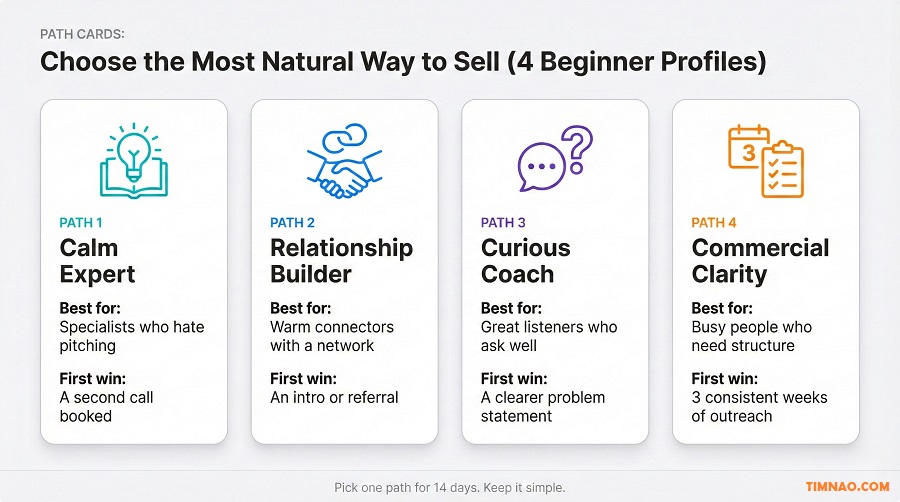
Path 1: The Calm Expert (for people who hate pitching)
Who it’s for
- Specialists, introverts, technical minds, perfectionists
- People who want to feel respected for competence
Core idea
You build confidence by being clear and useful. You win trust through insight + calm presence, then guide next steps.
Upside
- Feels authentic
- Attracts higher-quality opportunities
- Less “selling,” more problem-solving
Tradeoffs
- You may hide behind “expert mode” and avoid asking
- You need to initiate conversations anyway
First measurable win
Someone says: “This was helpful—can we talk again?”
Your 3-step starter plan
- Post or share one useful insight weekly (short, practical, specific) on LinkedIn or email
- Invite a conversation with one sentence: “If you’re dealing with this, happy to compare notes.”
- End every call with a next step: another call, intro, or “pause”
Who it’s for
- People who enjoy checking in and staying connected
- Anyone with an existing network (even if small)
Core idea
Confidence comes from consistent contact. You turn light relationships into real trust through regular, meaningful touchpoints.
Upside
- Referrals become natural
- Less cold outreach
- Works well long-term
Tradeoffs
- Easy to stay “friendly” but not commercial
- You must learn to ask for next steps (gently, but clearly)
First measurable win
A contact says: “You should talk to ___.”
Your 3-step starter plan
- Make a short A-list (10 people) you’ll nurture for 30 days
- Send 10 reconnect messages this week
- Ask one simple question: “Is there anyone you know who’s dealing with ___ right now?”
Path 3: The Curious Coach (for strong listeners)
Who it’s for
- Leaders, consultants, coaches, facilitators
- People who naturally ask good questions
Core idea
You “sell” by helping people think. Your confidence comes from curiosity and clarity, not convincing.
Upside
- Creates deep trust quickly
- You uncover real needs (not surface requests)
- Your calls feel human, not transactional
Tradeoffs
- You can get stuck in endless discovery
- You still need to offer a point of view and next steps
First measurable win
Someone says: “You helped me see this differently.”
Your 3-step starter plan
- Run a 15–20 minute discovery call using questions (not a pitch)
- Reflect back what you heard in one clean summary
- Offer two next-step options: small step vs deeper engagement
Path 4: The Commercial Clarity Builder (for busy people who need structure)
Who it’s for
- Anyone juggling delivery + growth
- People who procrastinate because selling feels messy
Core idea
Confidence comes from a system: weekly rhythm, simple targets, consistent follow-up. You stop relying on motivation.
Upside
- Predictable progress
- Lower anxiety (“I know what to do next”)
- Easier to measure what’s working
Tradeoffs
- Requires calendar discipline
- Feels “too structured” at first (until it starts working)
First measurable win
You complete 3 weeks of consistent outreach + follow-up.
Your 3-step starter plan
- Block two 30-minute “relationship sessions” weekly
- During each session: send 3 messages + do 2 follow-ups
- Track one thing only: conversations booked
A simple rule to choose your card (no overthinking)
- If you love insight → Calm Expert
- If you love people → Relationship Builder
- If you love questions → Curious Coach
- If you love systems → Commercial Clarity Builder
What to do next
- Choose one Path Card for 14 days (write it down).
- Create your first “micro-commitment”: “This week I will book 1 conversation.”
How You Show Up: the fastest confidence lever you can control
Most beginners chase confidence by trying to find the perfect words.
But confidence is often a state, not a sentence.
When you show up calmer, more grounded, and more curious, you automatically sound more confident—without forcing it.
The “Say it → Believe it → Become it” effect
A practical truth: you often don’t feel confident before you act.
You feel confident after you act consistently.
So instead of waiting for belief, you do this:
- Say the clear version of what you do (even if it feels new)
- Believe grows as you see it land with real people
- Become happens when it turns into your normal way of showing up
This is why tiny reps matter. Your identity catches up to your actions.
A 60-second reset before any sales conversation
Do this right before a call, meeting, or message sprint:
- Breathe low and slow for 3 cycles
- Ask: “What is my job here?” → Answer: “Help them get clarity.”
- Pick 3 words you want to embody (examples: calm / curious / direct)
- Decide one simple outcome:
- book a next call
- ask for an intro
- clarify if there’s a fit
This gives your mind a job. Anxiety drops when your brain knows the plan.
Upgrade your introduction (without sounding like a robot)
Avoid job titles. Use a simple benefit statement.
Formula (beginner-friendly):
- “I help [who] get [result] by [approach].”
Examples:
- “I help early-stage founders clarify their offer and pricing so they can sell without discounting.”
- “I help teams reduce customer churn by improving onboarding and success workflows.”
If you feel awkward, shorten it:
- “I help ___ with ___.”
The “spotlight shift” that makes you instantly more confident
A lot of nerves come from being self-focused:
- “Do I sound smart?”
- “What if I mess up?”
- “What if they say no?”
Shift the spotlight:
- “What do they need to decide?”
- “What’s unclear for them?”
- “What would help them move forward?”
Confidence becomes a side effect of service.
A tiny confidence habit you can do daily (5 minutes)
At the end of the day, write three lines:
- One moment you showed up well
- One moment you avoided discomfort
- One rep you’ll do tomorrow
This builds self-trust fast because you’re proving to yourself: “I do the work.”
What to do next
- Pick your 3 words for your next call (write them on a sticky note).
- Rewrite your intro using “I help [who] get [result] by [approach].”
In the next section of this guide, we’ll go deeper into how trust is built in real conversations—what makes people relax, open up, and actually want a second call.
The Trust Equation: what makes people say “yes” to a second conversation
Most beginners think the “yes” happens when you finally say the right thing.
In reality, the first yes is usually tiny:
- “Sure, let’s talk again.”
- “Send me a quick outline.”
- “Introduce me to your colleague.”
- “Can you show me a rough plan?”
That second conversation is where real momentum starts. And the fastest way to earn it is trust—not hype.
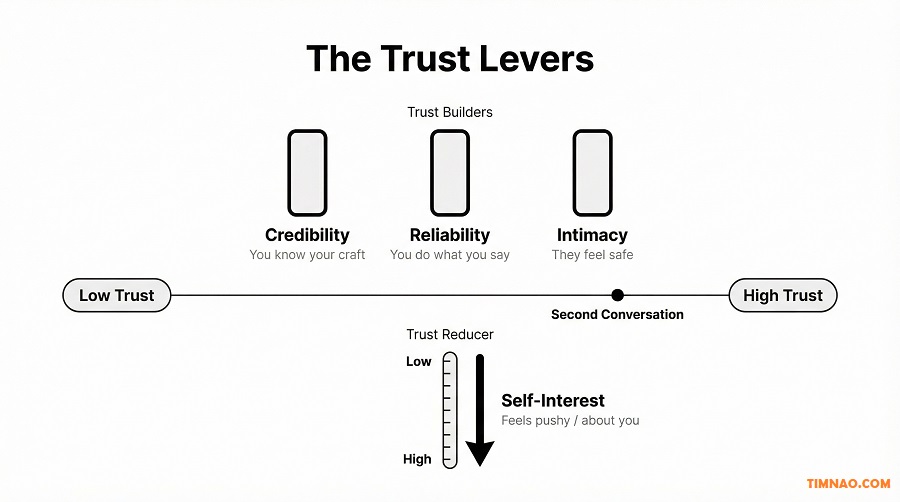
What “trust” actually feels like to a buyer
People say yes to a second conversation when they feel four things (even if they don’t say it out loud):
- You know your stuff (credibility)
- You’ll do what you say (reliability)
- They can be honest around you (comfort / intimacy)
- You’re not just trying to win (low self-interest)
The beginner mistake is to over-invest in only #1:
- “Let me prove I’m smart.”
- “Let me show my portfolio.”
- “Let me explain every feature.”
Credibility matters, but it’s not enough. Most people already assume you’re competent if you got the meeting. What they’re testing now is: Are you safe, clear, and helpful?
A simple “trust ladder” for the first call
Here’s a beginner-friendly way to build trust in the first 15 minutes—without forcing anything.
Step 1: Set safety
- “Quick note: if we’re not a fit, totally okay. Let’s just figure out what you need.”
Step 2: Create clarity
- “What made you take this call now?”
- “What would make this conversation useful?”
Step 3: Show competence lightly
- Share one short insight after you’ve listened:
- “I’ve seen this happen when ___.”
- “Usually the hidden bottleneck is ___.”
Step 4: Offer a clean next step
- “Would it help if I put together two options for next week—one small, one deeper?”
That’s it. Trust doesn’t require a long pitch. It requires a conversation that feels structured and human.
Micro-signals that quietly increase trust (and how to use them)
You can look trustworthy without trying to “sound confident.”
Try these small moves:
- Name what you’re doing: “Let me summarize what I heard so we don’t miss anything.”
- Slow down your pace: confident people don’t rush.
- Ask permission to advise: “Want my take, or do you want to explore a bit more first?”
- Be honest about uncertainty: “I don’t know yet—here’s what I’d need to confirm.”
Counterintuitive truth: being “too polished” can reduce trust. People trust someone who feels real.
A quick self-check: why people don’t book the second call
After a first call, if things go quiet, it’s usually one of these:
- They didn’t feel understood (low comfort)
- You talked too much (low intimacy)
- You didn’t define a next step (low reliability)
- You sounded like you needed the deal (high self-interest)
- You stayed vague about value (low credibility)
The fix is rarely “pitch harder.” It’s almost always: listen better + summarize clearly + propose one next action.
What to do next
- On your next call, aim for one goal: “Earn the second conversation.”
- Add one line early: “If we’re not a fit, that’s okay—let’s just get clarity.”
Understanding Others: the beginner listening stack (Attention → Acknowledge → Pause)
Listening is one of those skills that sounds basic… until you try to do it while nervous.
Beginners usually “listen” while planning what to say next. That creates a weird energy: you’re physically present, but mentally ahead. People feel it.
This stack keeps you grounded.
Step 1: Attention (remove friction, not just distractions)
Attention isn’t “try harder.” It’s environmental.
Before the call:
- Close extra tabs
- Put your phone away
- Open a note doc with 3 lines:
- Their context
- Their goal
- Next step
During the call:
- Don’t write every word
- Capture only:
- numbers/dates
- decision constraints (time, budget, stakeholders)
- emotional signals (“frustrated,” “stuck,” “urgent”)
Beginner tip: if you can’t listen and take notes well at the same time, stop note-taking for 2 minutes. Listening is higher value.
Step 2: Acknowledge (prove you understood—briefly)
Acknowledgement is where trust jumps.
Your job isn’t to repeat everything. It’s to reflect the shape of their situation.
Use any of these:
- Mirror: “So the main issue is ___.”
- Label: “Sounds like the frustrating part is ___.”
- Clarify: “When you say ___, do you mean ___ or ___?”
- Summarize: “Let me check I’ve got it…”
A good acknowledgement is short—one sentence. Two max.
A tiny script you can practice
- “What I’m hearing is ___.”
- “Did I get that right?”
- “What did I miss?”
This does two things:
- It makes them feel understood
- It prevents you from solving the wrong problem
Step 3: Pause (the confidence move most beginners avoid)
Pausing feels scary because silence feels like failure.
But silence is often where the real truth appears.
Use micro-pauses:
- After they share something important → pause 2 seconds
- After you reflect back → pause 2 seconds
- After you ask “what matters most?” → pause longer than you want
If they fill the silence with more detail, you just got gold.
Common beginner listening mistakes (and the fix)
Mistake 1: Jumping to advice too fast
Fix: ask one more “impact” question first:
- “What’s the cost of this staying the same?”
Mistake 2: Getting stuck in details
Fix: pull up one level:
- “What’s the decision you’re trying to make?”
Mistake 3: Trying to sound smart
Fix: replace explanation with curiosity:
- “Tell me more about why that matters.”
A practical listening checklist you can keep on your screen
- Did I speak less than 50%?
- Did I reflect back at least twice?
- Did I ask what success looks like?
- Did I confirm constraints (time, budget, approval)?
- Did we end with a next step?
If you do only two of these, choose:
- reflect back
- end with a next step
What to do next
- For your next conversation, pick one listening goal: “I will reflect back 3 times.”
- Practice a 2-second pause after your next question (yes, it will feel long—do it anyway).
Turn curiosity into commerciality (without rushing to advice)
Curiosity is your superpower—until it becomes a hiding place.
Some beginners stay in “nice conversation mode”:
- lots of empathy
- lots of questions
- zero movement
Commerciality doesn’t mean pressure. It means direction.
The bridge: from “tell me more” to “what do we do next?”
Here’s a clean progression you can follow. Think of it like stepping stones.
- Context
- “What’s happening right now?”
- Impact
- “What does this affect—revenue, time, stress, customers?”
- Priority
- “Why is this important now?”
- Success
- “What does a good outcome look like?”
- Constraints
- “What limits us—time, budget, people, tools?”
- Next step
- “Would it help if we map options?”
That’s commercial curiosity: it naturally ends in a decision.
The “permissioned advice” move (so you don’t sound pushy)
If you’re worried about being salesy, ask permission before offering your take.
Try:
- “Want my honest read?”
- “Can I share a pattern I see?”
- “I have an idea—are you open to it?”
This keeps your advice welcome. And it makes you feel more confident because you’re not forcing anything.
The most beginner-safe way to propose: give two options
Beginners often propose one big solution, then feel rejected when it’s too much.
Instead, propose two levels:
- Option A (small step): “We can do a quick diagnostic and you’ll leave with a plan.”
- Option B (deeper step): “If you want implementation, we can support for X weeks.”
Two options do something powerful:
- the buyer feels in control
- you look structured
- your offer feels less risky
“First measurable win” language (so your next step feels real)
The fastest way to sound professional is to define the first win.
Examples:
- “In week one, we’ll clarify ___ and remove ___.”
- “After the first session, you’ll have ___.”
- “The early goal is to reduce ___ by ___.”
This turns vague interest into a decision-friendly next step.
A short example: curious but commercial
Them: “We’re struggling with onboarding.”
You: “What part—activation, retention, or support load?”
Them: “Activation is low.”
You: “What happens when activation stays low?”
Them: “Churn goes up.”
You: “If this works, what changes in 30 days?”
Them: “Higher activation and less churn.”
You: “Got it. Want a quick diagnostic first, or do you already want an implementation plan?”
No pitch. Just a guided decision.
What to do next
- Write 6 questions using the progression: context → impact → priority → success → constraints → next step.
- Add one phrase to your toolkit: “Would it help if we map two options?”
Explore the system: a simple stakeholder map that prevents wasted effort
A huge amount of wasted selling comes from one mistake:
You build trust with the wrong person.
You may have a great call—and then nothing happens—because the person you spoke to isn’t the decision-maker, or can’t move the system.
A stakeholder map prevents that.
The beginner stakeholder map (4 roles)
For almost any decision, map these four:
- User
Who will actually use the thing or live with the change? - Buyer
Who controls budget, approval, or the final “yes”? - Influencer
Who shapes the decision informally? (often a senior leader, ops, or a trusted advisor) - Blocker
Who might lose power, time, money, or reputation if this changes?
You don’t need perfect answers. You need visibility.
The fastest way to fill the map: ask clean questions
Here are beginner-safe questions that don’t feel political:
- “Who else will be impacted by this?”
- “Who needs to sign off?”
- “What’s the approval process like?”
- “Who will care the most if this succeeds?”
- “If this doesn’t happen, who feels the pain?”
Then one brave question:
- “Is there anyone who might resist this? What would their concern be?”
How to avoid the “single-thread risk”
Single-thread risk = you only have one relationship inside a company or group.
That’s fragile. People change roles. Priorities shift. Your champion gets busy.
A safer approach:
- Build two threads:
- one with the user side (needs and reality)
- one with the buyer/influencer side (decision and budget)
You’re not being manipulative. You’re respecting how decisions work.
A quick mapping exercise (10 minutes, on paper)
Draw four boxes: User / Buyer / Influencer / Blocker.
For each box write:
- name (or “unknown”)
- what they care about
- what they fear
- what would make them say yes
If you can’t fill a box, that becomes your next question in the next call.
What to do when you discover a missing stakeholder
Beginners often feel awkward asking for introductions. Use a service frame:
- “To make this useful and not waste your time, it would help to include the person who owns ___. Who is that?”
- “Would it be helpful if we looped in ___ so we don’t make assumptions?”
This positions you as thoughtful and efficient, not pushy.
When you map stakeholders, you naturally start doing what buyers love:
- reducing risk
- clarifying steps
- preventing surprises
That’s trust-building at a higher level.
What to do next
- Pick one active opportunity and sketch the 4-box map.
- In your next conversation, ask one stakeholder question: “Who else needs to be part of this decision?”
Now that you can build trust, listen well, and navigate the system, the next part is where it starts to feel surprisingly easy: turning all of that into clear next steps, simple negotiation, and a rhythm that keeps opportunities moving without chasing.
From relationship to revenue: “Next Steps” that don’t feel awkward
If you’ve ever had a great conversation… and then nothing happens… this is why.
Most beginners don’t lose deals because they’re “bad at sales.” They lose deals because they don’t land the plane. They end the call with something fuzzy like:
- “Let’s keep in touch.”
- “I’ll send something over.”
- “We’ll see.”
That creates a quiet problem: the buyer leaves with no clear decision to make, and you leave with no clear action to take. Momentum dies in the gap.
Why “asking for next steps” feels awkward (and how to fix the feeling)
Next steps feel awkward when you’re mentally asking for approval.
But they stop feeling awkward when you’re doing this instead:
- protecting everyone’s time
- reducing confusion
- making it easy to move forward (or pause cleanly)
The mindset shift is simple:
You’re not asking for a favor. You’re proposing a clear process.
The “soft close” that works in almost any situation
Here’s a clean, human way to close a conversation without sounding pushy. Think of it as a mini-structure, not a script.
- Recap what matters (30 seconds)
- “Let me quickly check I’ve got this right…”
- Name the goal
- “So the outcome you want is ___ by ___.”
- Offer two paths
- “We could do a small first step (A), or go deeper (B).”
- Ask for a decision
- “Which one feels more useful right now?”
This works because it turns “selling” into helping someone choose.
Two-option next steps (beginner-safe examples)
You can adapt these to almost anything:
Example A: Diagnostic vs Implementation
- “Option 1: a quick diagnostic so you leave with a plan.”
- “Option 2: implementation support over X weeks.”
Example B: Workshop vs Ongoing support
- “Option 1: a focused working session to align the team.”
- “Option 2: a month of support to execute and adjust.”
Example C: Pilot vs Full rollout
- “Option 1: pilot with one team/customer segment.”
- “Option 2: full rollout with checkpoints.”
Your goal isn’t to perfect pricing yet. Your goal is to make the next step feel low-risk and clear.
The “Continue / Pause / Introduce” question (the cleanest way to avoid chasing)
If you hate follow-ups and don’t want to feel needy, use this at the end of calls with warm contacts or early-stage leads:
- “Based on what we discussed, should we continue, pause, or would it make sense for you to introduce me to someone else?”
It’s disarming because it gives them an easy “no” without discomfort—and paradoxically, that makes “yes” more likely.
What to do when they say “send me something”
This request is common, and it’s where beginners often spiral into unpaid work.
Instead of immediately writing a long proposal, ask one clarifying question to protect your time:
- “Happy to. Quick check—what would you like it to include: a one-page summary of approach and outcomes, or options with pricing as well?”
Then set a micro-commitment:
- “Great. I’ll send a one-pager by Thursday. Should we book 20 minutes Friday to walk through it?”
No meeting = your document becomes a dead end. A short follow-up meeting keeps it alive.
A follow-up message that sounds human (not automated)
After the call, keep it tight. One screen. One decision.
- “Thanks again—this was useful. Here’s what I heard: (1–2 lines).
If you want to move forward, I suggest Option A (small step) or Option B (deeper).
Which way should we go? If helpful, I can send a one-page outline before we speak again.”
You’re not “checking in.” You’re making it easy to decide.
What to do next
- Pick one closing style to practice this week: Two options or Continue/Pause/Introduce.
- End your next 2 conversations with a calendar-based next step (date/time), even if it’s just a short follow-up.
Next Steps & Negotiate: keep it fair, clear, and beginner-safe
Negotiation is where many beginners lose confidence—because it feels like judgment.
But negotiation is mostly logistics:
- what’s included
- how fast
- who’s involved
- how decisions get made
- what tradeoffs exist
When you treat it like logistics (not self-worth), you get calmer and clearer.
The beginner negotiation rule: don’t negotiate price before you negotiate clarity
If you quote a number before you understand the decision, you’ll end up discounting to fix uncertainty.
Before pricing, get clear on:
- Outcome: what “success” looks like
- Constraints: time, budget, capacity, tools
- Decision process: who approves, what steps
- Scope: what’s included and what’s not
A simple line that keeps you safe:
- “Before I suggest the right option, can I ask a couple of questions about scope and constraints?”
The three levers you can always trade (instead of discounting)
When someone says “too expensive,” beginners often do the one thing that hurts them long-term: drop the price with no change.
Instead, trade one of these:
- Scope (what you deliver)
- Timeline (how fast it happens)
- Support level (how much access/help they get)
This keeps things fair:
- You respect their constraint
- You protect your energy
- They still get a real choice
Offer options like a grown-up (without feeling salesy)
A simple, beginner-friendly structure is three options:
- Basic: smallest step that still creates a real result
- Standard: most common path (best value)
- Premium: faster timeline or deeper support
You don’t need fancy names. Just make the differences clear.
What this does psychologically
- It makes price feel relative (not random)
- It gives the buyer control
- It positions you as structured and experienced
Questions that prevent painful surprises later
If you only ask one set of negotiation questions, ask these:
- “What matters most here: speed, scope, or budget?”
- “Who needs to approve this?”
- “Is there a deadline we’re working toward?”
- “What would make this a clear yes internally?”
- “If we do nothing for 3 months, what happens?”
These questions are confidence. They make you sound steady because you’re thinking like a partner, not a vendor.
Handling discount requests (without getting defensive)
When they ask for a discount, you don’t need a long speech. Use a calm pattern:
- Acknowledge
- “Totally understand budget matters.”
- Protect the value
- “To keep quality high, I don’t reduce the fee without adjusting scope.”
- Offer a trade
- “We can reduce scope, extend timeline, or shift support—what’s best for you?”
If they keep pushing, go back to constraints:
- “What number did you have in mind, and what would you want to remove to get there?”
That question is polite, and it ends vague bargaining.
A “beginner-safe” negotiation boundary (so you don’t resent the work)
Set one boundary before you negotiate:
- your minimum scope
- your minimum timeline
- your minimum fee
You don’t have to announce it dramatically. Just know it.
If something goes below your minimum, your best move is a calm decline:
- “I don’t think I can do good work within that constraint. If the situation changes, I’d be happy to revisit.”
Confidence skyrockets when you trust yourself to walk away.
The cleanest way to handle “procurement mode”
Sometimes the buyer is friendly, but procurement is strict. Beginners often panic here.
Two moves keep you steady:
- Keep options (don’t collapse into a single rigid number)
- Keep tradeoffs (scope/timeline/support) visible and documented
And a simple sentence:
- “If procurement needs adjustments, I’m open to modifying scope or timeline to fit the constraint.”
That’s cooperative without being a pushover.
What to do next
- Write your 3 trade levers on a sticky note: Scope / Timeline / Support.
- Draft 3 simple options (Basic/Standard/Premium) for your offer, even if rough.
- Practice one line: “I can adjust scope or timeline—what constraint matters most?”
30-day “Sell With Confidence” plan (two intensity options)
This is where confidence becomes real: a simple rhythm you can actually keep.
Pick one intensity for 30 days. Don’t over-engineer it. You’re building a habit, not proving a point.
Option A: 1 hour/day (fast momentum, best for builders who want speed)
If you can give one focused hour a day, you’ll build reps quickly—and reps create confidence.
Your daily 60-minute block
- 10 min — Show up
- Pick your 3 words (calm/curious/direct)
- Write one objective: “Book next call” or “Ask for intro”
- 20 min — Outreach
- Send 2–4 messages (mix of reconnect + warm outreach)
- Keep each message under 5 lines
- 20 min — Conversation or follow-up
- Book calls, confirm next steps, send recap messages
- If you have a call, use the two-option close
- 10 min — Notes
- What did you learn?
- What’s the next step?
- Who else needs to be involved?
Weekly rhythm (so you don’t drift)
- Mon: choose 10 people to contact + 3 follow-ups to finish
- Tue–Thu: book and run conversations
- Fri: send summaries, propose next steps, close loops
Checkpoint (end of week 1)
- You should have at least 2 conversations scheduled or completed.
If not, your fix is simple: shrink the ask. - Replace “Can we talk?” with “Can I ask one quick question?”
Option B: 2–3 hours/week (sustainable, best for busy people)
If you’re busy, consistency matters more than volume.
Your weekly system
- 30 min — List + plan
- A-list (10 people): warm relationships
- B-list (20 people): potential relationships
- Choose 5 names for this week
- 60 min — Conversations
- Two 30-min calls, or one 60-min call
- Your goal: earn the second conversation
- 30–60 min — Follow-up + next steps
- Send 1–2 short recap messages
- Propose two options
- Ask one stakeholder question
- 30 min — Improve one thing
- Rewrite your intro
- Tighten your questions
- Build your 3 offer options
A simple 4-week focus (same plan for both intensities)
Week 1 — Start conversations
- Aim: conversations, not conversions
- Actions: reconnect, invite, book
Week 2 — Build trust
- Aim: better listening and clearer summaries
- Actions: Attention → Acknowledge → Pause
Week 3 — Get next steps
- Aim: end every call with a clear next action
- Actions: two-option close, calendar follow-up
Week 4 — Negotiate cleanly
- Aim: offer options and protect scope
- Actions: Basic/Standard/Premium, trade levers
What to track (so you don’t rely on mood)
Track only four numbers weekly:
- messages sent
- conversations held
- next steps agreed
- proposals/options sent
If you track too much, you quit. Keep it simple.
Quick troubleshooting (when the plan isn’t working)
Problem: no replies
- Fix: make the message smaller and more specific
- “Quick question about ___” beats “Do you want to chat?”
Problem: calls happen, but no second call
- Fix: summarize + propose next step before ending the call
- “Want option A or option B?” is your friend
Problem: people ask for discounts early
- Fix: slow down and clarify constraints first
- “What matters most: speed, scope, or budget?”
What to do next
- Choose Option A or Option B and schedule your first block on your calendar now.
- Decide your first 7-day win: “2 conversations” or “1 proposal with options.”
- Prepare one closing line you’ll use all week: “Should we continue, pause, or introduce someone else?”
Next, we’ll make this sustainable: how to tell if you’re on track, when to pivot, and a few guardrails that keep your selling human—without burning out or sounding scripted.
Signals & checkpoints: when to stay the course vs pivot
When you’re learning to sell, your mood lies to you.
One week you feel confident because someone replied fast. The next week you feel awful because two people ghosted. If you follow feelings, you’ll constantly switch tactics—and never build enough reps for anything to work.
The fix is simple: track a few signals so you can make decisions based on reality.
The two types of signals (don’t mix them up)
Think of your progress like going to the gym:
- Input signals = what you do (you control these)
- Output signals = what happens (the market responds)
Beginners often judge themselves by outputs only. That’s brutal and inaccurate, because outputs lag.
Input signals (pick 3–4 max)
These are enough for most beginners:
- Messages sent (warm reconnects + follow-ups)
- Conversations held (calls/meetings/DM threads that go somewhere)
- Next steps proposed (you asked for a decision)
- Follow-ups completed (you closed loops, not “checked in”)
Output signals (pick 2–3 max)
- Replies received
- Second conversations booked
- Introductions/referrals offered
- Proposals requested (or “send options” requests)
Beginner rule: judge yourself by inputs weekly, outputs monthly.
Your weekly checkpoint (10 minutes, no drama)
Every Friday (or Sunday), answer these four questions:
- Did I do the inputs? (yes/no)
- What got the best response? (one line)
- Where did momentum die? (one line)
- What’s my one adjustment for next week? (one thing only)
That’s it. No long journaling required. The goal is to keep moving.
When to stay the course (even if you feel unsure)
Stay the course for at least 2–3 weeks if:
- You’re doing consistent inputs (messages + conversations + follow-ups)
- You’re getting some replies, even if small
- Conversations feel clearer than before
- You’re learning what people actually care about
Small improvements count:
- replies go from 0 → 2
- second calls go from none → one
- calls feel less awkward
- you end with clearer next steps
That’s progress.
When to pivot (and what “pivot” actually means)
Pivot doesn’t mean “throw everything away.” Pivot means changing one lever while keeping everything else steady.
Pivot after 2–3 weeks if:
- You did the inputs consistently and got close to zero response
- People reply but never book calls
- Calls happen but never lead to next steps
- Everyone says “interesting” but nothing moves forward
Now choose the right lever:
Pivot lever A: Target (who you message)
Symptoms:
- low replies
- polite but cold responses
- “not a priority”
Fix:
- Narrow the audience
- Aim for people with a clear pain + urgency
- Use a smaller, more specific offer
Pivot lever B: Message (how you ask)
Symptoms:
- people don’t respond to “can we chat?”
- vague replies
Fix:
- Make the ask smaller
- Lead with a specific question
- Mention a clear outcome
Example:
- Instead of: “Want to chat sometime?”
- Try: “Quick question—are you still trying to improve ___ this quarter?”
Pivot lever C: Conversation (how you run the call)
Symptoms:
- calls feel friendly but vague
- no second call
Fix:
- Use the listening stack + summarize
- Propose two options at the end
- Ask for a decision (continue/pause/introduce)
Pivot lever D: Offer (what you propose next)
Symptoms:
- “send me something” with no follow-through
- price pushback early
Fix:
- Create a small Step 1 offer (diagnostic/pilot)
- Define the first measurable win
- Present options (basic/standard/premium)
A tiny “pivot ladder” (beginner-safe)
If you’re stuck, pivot in this order (one per week max):
- Message
- Target
- Conversation structure
- Offer options
This prevents you from constantly reinventing everything.
What to do next
- Pick 4 numbers to track weekly: messages, conversations, next steps proposed, follow-ups completed.
- Choose one rule: “I do 3 weeks of consistent inputs before changing my approach.”
Beginner guardrails: stay human, stay consistent, don’t burn out
A human-centered approach only works if you can sustain it.
Burnout usually doesn’t come from “too much work.” It comes from unclear boundaries, emotional chasing, and doing too much unpaid effort.
Here are guardrails that keep you steady and human—without turning sales into your whole personality.
Guardrail 1: Don’t “check in.” Close loops.
“Just checking in” messages feel awkward for a reason: they have no purpose.
Instead, close loops with a decision-friendly message:
- “Want to continue with Option A, pause for now, or should we involve someone else?”
Or:
- “If it’s not a priority this month, no worries—should I circle back in April or close this out?”
This makes you look professional and protects your energy.
Guardrail 2: Keep your follow-up promise tiny
Beginners often over-deliver after the first call:
- long proposals
- free strategy documents
- complex decks
That feels generous—but it’s risky. It trains people to take without committing.
Better: give a small, clear next artifact:
- a 1-page outline
- two options with outcomes
- a short recap with next steps
If someone wants more, ask for a next step first:
- “Happy to expand this—should we book 20 minutes to align before I build it?”
Guardrail 3: Your calendar is your strategy
If selling is “whenever I feel like it,” it won’t happen.
You need two repeating blocks:
- Outreach block (messages + invites)
- Follow-up block (summaries + next steps)
Even 30 minutes twice a week works.
And one boundary:
- “No sales work after ___ pm.”
Confidence grows when you keep promises to yourself.
Guardrail 4: Stay curious, but don’t become their therapist
Being human doesn’t mean absorbing everyone’s stress.
If someone is venting (common in sales calls), you can acknowledge without drowning:
- “That sounds frustrating.”
- “Thanks for being honest.”
- “What would be most helpful to solve first?”
Then steer back to clarity:
- “What’s the outcome you need?”
- “What’s the next decision?”
You’re a guide, not an emotional sponge.
Guardrail 5: Don’t outsource your voice to AI
Tools can help you think, but they shouldn’t erase your personality.
If you use ChatGPT, use it like a writing partner:
- brainstorm questions
- tighten your message
- generate 3 options, then rewrite in your voice
A simple rule:
- AI can draft structure.
- You write the final tone.
People can feel when a message isn’t “you.”
Guardrail 6: Protect your self-trust with “minimum viable courage”
You don’t need massive bravery. You need small consistent courage.
A healthy weekly target for beginners:
- 10 messages
- 2 conversations
- 2 next steps proposed
- 5 follow-ups closed
That’s enough to build momentum without burning out.
What to do next
- Choose a “sales boundary” for this month (time, effort, or unpaid work limit).
- Create two weekly calendar blocks: Outreach + Follow-up (start with 30 minutes each).
Two quick scenarios to make this real
Here are two mini-stories that show how the pieces fit together. Don’t copy them word-for-word—copy the logic.
Scenario 1: “I’m good at what I do, but I freeze when it’s time to ask”
Starting situation
You’re a capable specialist. People like talking to you. But you avoid the moment where you ask for the next step, because it feels pushy.
What’s actually happening
You’re comfortable in “helpful mode,” but you’re missing the final move: turning clarity into a decision.
Best-fit path
- Calm Expert + Two-option Next Steps
What you do (first week)
- Run one call with one clear intention: “Earn the second conversation.”
- Use one summary midway: “What I’m hearing is…”
- End with two options:
- Option A: small diagnostic/pilot
- Option B: deeper support
A simple closing line
- “Would you rather do a small first step to get clarity, or do you already want a deeper plan?”
First measurable win
They choose Option A and book a follow-up date.
Why this works
You didn’t “sell harder.” You made it easy to decide.
Starting situation
You have many connections. People respond. But it turns into endless chatting and “let’s catch up” energy.
What’s actually happening
You’re building relationships, but not creating direction. You’re missing commercial clarity.
Best-fit path
- Relationship Builder + Commercial Clarity habits
What you do (first week)
- Create an A-list of 10 people you genuinely like and respect.
- Send 10 reconnect messages—each with a light, specific prompt:
- “Curious—are you still focused on ___ this quarter?”
- On calls, ask one commercial question:
- “What would make this a priority right now?”
A simple follow-up message
- “Thanks again—super useful. Based on what you said, I suggest we either (A) do a small first step, or (B) pause until it’s a priority. Which fits?”
First measurable win
A warm contact introduces you to a decision-maker because your message is clear and easy to forward.
Why this works
You didn’t abandon relationships. You added structure.
What to do next
- Choose the scenario closest to you and copy one line into your notes.
- For your next call, decide in advance: “Two options” or “Continue/Pause/Introduce.”
If you remember nothing else, remember this
- Do this: Track inputs weekly (messages, conversations, next steps).
Not that: Judge yourself by mood or one silent week. - Do this: Pivot one lever at a time (message, target, conversation, offer).
Not that: Rebuild your whole approach every Monday. - Do this: Close loops with decisions (“continue/pause/introduce”).
Not that: Send awkward “just checking in” messages. - Do this: Keep follow-up artifacts small (1 page, two options, clear next step).
Not that: Write unpaid essays that lead nowhere. - Do this: Protect your energy with calendar blocks + boundaries.
Not that: Sell only when you feel confident (you’ll wait forever). - Do this: Use AI as a helper, then rewrite in your voice.
Not that: Copy-paste “perfect” text that doesn’t sound like you.
What to do next
- Pick one habit for the next 7 days: (1) close loops, (2) two-option next steps, or (3) weekly tracking.
- Put your next Outreach block on the calendar right now.
Disclaimer:
This article is for educational purposes only and reflects general guidance based on common sales, communication, and relationship-building practices. It isn’t professional legal, financial, HR, or business advice, and it doesn’t guarantee specific outcomes or income. Your results will vary depending on your industry, experience, offer, market conditions, and execution. Always use your own judgment, follow applicable laws and company policies, and consult qualified professionals when you need advice for your specific situation.
If this post helped you feel a little more confident (or gave you one idea you can use today), you can support the blog by buying me a coffee ☕✨ It genuinely helps me keep writing practical, beginner-friendly guides like this—thank you!
👉 Buy me a coffee here: https://timnao.link/coffee 🙌💛