AI Business Models for Beginners: A Clear, Practical Guide to Trust, Value, and Growth 🚀
AI business models are not just about adding a chatbot, buying a subscription, or automating a few tasks. They are about changing how a business creates value, delivers it, and turns that value into revenue, savings, loyalty, or long-term advantage. The source material makes that point clearly: AI is reshaping both business models and the trust needed to make them work in real organizations.
This article is for beginners who want to understand the idea without the academic fog. You do not need to be a data scientist. You just need a simple mental model, a realistic rollout path, and a clear sense of where trust fits in. By the end, you should be able to look at your own business and say, “I can see where AI fits, where it does not, and what I should test first.”
What AI business models really change inside a company
When people first hear “AI business models,” they often imagine a company adding ChatGPT to its workflow, installing a chatbot, or using AI to write content faster. Those can be useful upgrades, but they are not always business model changes.
A business model is the logic behind how a company creates value, delivers value, and benefits from that value. So when AI becomes part of the business model, it changes the system, not just the software.
AI changes the operating logic, not just the tool stack
The biggest shift happens here: AI starts affecting how decisions are made, how work moves, and how customers experience the company.
Think of it like this. A normal software tool helps a person do a task. AI often helps a business rethink the task itself.
For example, a traditional team might review customer feedback manually once a month. An AI-enabled version of that business can analyze comments every day, spot patterns quickly, and help the team react sooner. The company is no longer just “using software.” It is operating with a faster feedback loop.
That difference matters because it changes the rhythm of the business:
- decisions can happen faster
- personalization can happen at larger scale
- routine tasks can move with less friction
- managers can focus more on exceptions, strategy, and judgment
In simple terms, AI often moves a company from “doing the same work a bit faster” to “running the business in a different way.”
The biggest changes usually show up in three places
For beginners, it helps to stop thinking about AI as one giant transformation. In practice, the biggest changes often appear in three areas first.
1. Decision-making becomes more data-led
In older setups, many decisions depend on experience, reports, and intuition. Those still matter, but AI can add a new layer by detecting patterns people would miss or would only find after a lot of manual work.
That might mean:
- spotting which leads are most likely to convert
- forecasting demand more accurately
- identifying customer complaints before they become churn
- finding bottlenecks in operations earlier
The point is not that AI replaces judgment. The point is that it changes the quality and speed of information feeding that judgment.
2. Workflows become more adaptive
A non-AI workflow is often fixed. A person follows the same process every time unless someone manually changes the rules.
An AI-supported workflow can become more responsive. It may sort support tickets by urgency, recommend the next sales action, generate a first draft of a report, or adjust content recommendations based on customer behavior.
That is why AI business models often feel more “alive.” The company is no longer relying only on static rules. It can respond to what is happening now.
3. The customer experience becomes more relevant
This is where many businesses first see the real payoff.
Customers do not care whether your internal team feels excited about AI. They care whether the experience becomes better. If AI helps the company respond faster, recommend the right product, reduce waiting time, or tailor the offer more closely to the customer’s needs, then the model is creating visible value.
You can see this clearly on platforms like Netflix, Spotify, or Amazon, where recommendations are not an extra layer anymore. They are part of the experience itself.
A beginner test: has the model changed, or just the task?
Here is a simple test you can use.
Ask this question:
If we removed AI tomorrow, would the business still feel basically the same to customers and staff?
If the answer is yes, then AI is probably still just a tool.
If the answer is no, because the offer would be weaker, the workflow would slow down, the personalization would disappear, or decisions would become much less accurate, then AI is starting to shape the business model itself.
That is the line beginners should watch.
A practical example most people can picture
Imagine a small online education business.
Without AI, the company sells recorded lessons, answers support emails manually, and sends the same email sequence to everyone.
With AI integrated into the business model, several things change:
- students get content recommendations based on progress
- common questions get answered instantly
- weak learning points get flagged earlier
- the team sees which students are likely to drop off
- follow-up content becomes more tailored
The product is no longer just “a course library.” It becomes a more guided learning experience. That is a business model shift because the value is being created and delivered differently.
Why this matters for beginners
Many people start with tools because tools feel concrete. But the better question is not “Which AI tool should I buy first?”
The better question is:
Which part of my company would work differently if AI were built into the model?
That question keeps you focused on value instead of novelty.
Why AI-driven business models feel different from older digital models
To understand AI-driven business models, it helps to compare them with what came before.
Not long ago, “digital transformation” mostly meant taking existing business activities and moving them online. That was already a big deal. Companies built websites, launched ecommerce stores, added cloud software, digitized forms, and improved communication.
But AI-driven business models go further. They do not just digitize the business. They make it more adaptive, predictive, and responsive.
Older digital models were mainly about access and efficiency
A classic digital model improved reach and convenience.
For example, a business could:
- sell online instead of only in-store
- automate orders instead of handling them by phone
- manage customers through a CRM instead of spreadsheets
- offer support through email or live chat
These changes were powerful, but most of the logic stayed fairly linear. The system followed rules that people defined in advance.
That made digital business faster and more scalable, but it did not always make it more intelligent.
AI-driven business models are built around learning and adjustment
This is where the feeling changes.
An AI-driven business model can improve itself through data. It can detect patterns, make predictions, and adjust outputs with much less manual effort.
That may sound abstract, so here is the simplest version:
- a digital business stores data
- an AI-driven business uses that data to make the system smarter over time
That difference affects everything from pricing and customer support to product recommendations and internal planning.
A digital store shows products online.
An AI-driven store can also predict what a customer is likely to want, identify which products should be bundled, and adjust recommendations in real time.
That is why AI-driven business models feel less like static systems and more like responsive systems.
Hyper-personalization changes the customer promise
One reason AI-driven business models feel so different is hyper-personalization.
This simply means tailoring the experience more precisely for different users, often in ways that would be too slow or too expensive to do manually.
For example:
- one visitor sees beginner-friendly guidance
- another sees advanced options
- one customer receives a reminder at the right moment
- another gets a product suggestion based on recent behavior
This changes the customer promise. The business is no longer only saying, “We have a product for you.”
It is also saying, “We can shape the experience around what you need right now.”
That is a much stronger offer when done well.
Cognitive automation changes the work behind the scenes
Another reason these models feel different is cognitive automation.
Traditional automation handles repetitive rule-based work. AI can go further by helping with tasks that involve classification, prediction, summarization, prioritization, or recommendation.
That might include:
- summarizing documents
- ranking leads
- detecting anomalies
- routing requests by context
- generating first drafts for review
This does not mean AI “thinks like a human” in a broad sense. But it does mean the business can automate more than clicks and data entry. It can automate parts of knowledge work.
That is a major leap from older digital models.
Leadership has to change too
This part often gets ignored, but it matters.
Older digital models could often be managed with a fairly traditional structure. Teams added tools, improved systems, and kept moving.
AI-driven business models usually demand more cross-functional work. Data people, operations people, marketers, product teams, and leadership all need to cooperate more closely. That is because AI touches data quality, workflow design, ethics, security, and customer experience at the same time.
In practical terms, leaders have to get comfortable with questions like:
- Do we trust this output?
- Who reviews edge cases?
- Is the data good enough?
- Are we improving the customer experience or just making it look smarter?
- Are we helping employees work better, or just pushing more automation into a weak process?
That is why AI-driven business models do not just change operations. They also change management.
A quick way to remember the difference
If you want a simple shortcut, use this:
- Older digital models made businesses more connected
- AI-driven business models make businesses more adaptive
That one sentence is often enough to help beginners understand the shift.
The three-part engine behind AI value creation
Now that the difference is clearer, the next question is the one that matters most:
Where does the value actually come from?
A useful beginner model is to break AI value creation into three connected parts:
- value proposition
- value creation and delivery
- value capture
This matters because many businesses jump straight to AI tools without knowing where the value should appear. When that happens, they often end up with extra cost, extra complexity, and very little real business benefit.
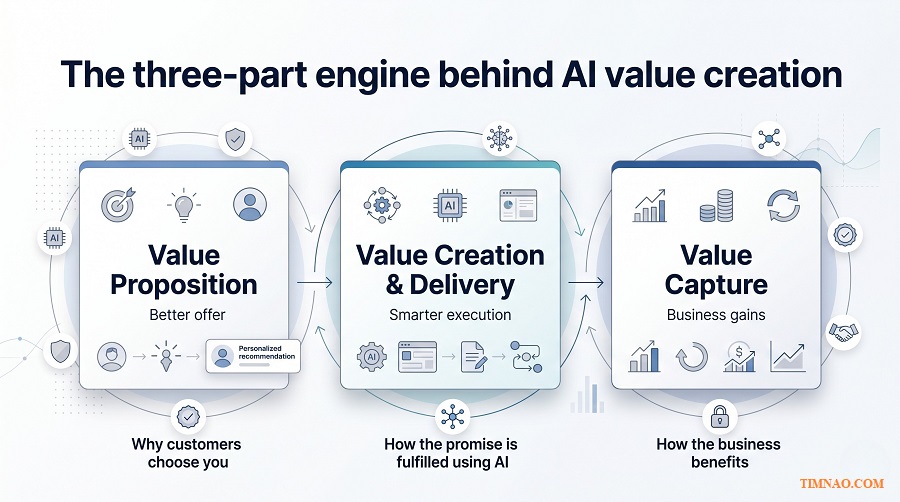
Value proposition: why someone chooses you
This is the front end of the model. It is the promise.
What do customers get from you, and why would they choose you instead of someone else?
AI can strengthen the value proposition in several practical ways:
- better personalization
- faster response times
- smarter recommendations
- more accurate predictions
- new service layers that were previously too expensive to offer
For example, a consulting firm might move from “we provide monthly reporting” to “we provide faster, more tailored insight with earlier warning signals.”
A course business might move from “we sell lessons” to “we guide each learner based on progress and difficulty.”
A support team might move from “we answer tickets” to “we solve simple issues instantly and route complex ones more intelligently.”
The important part is this: AI value creation often starts by making the offer itself more useful or more relevant.
Value creation and delivery: how the promise gets fulfilled
This is the middle of the engine, and it is where many operational wins happen.
Once the company makes a stronger promise, it still has to deliver on that promise. AI can improve this by making work more efficient, more consistent, and easier to scale.
This might show up as:
- process automation
- content or document summarization
- workflow prioritization
- better integration across tools and systems
- faster movement from raw data to actionable insight
Think about a company using Salesforce or other CRM tools. In a normal setup, the platform stores information. In a more AI-driven setup, it can help score leads, suggest follow-ups, summarize account activity, and support next-best-action decisions.
That changes the delivery engine. Work moves with less friction, and employees can focus more on judgment-heavy tasks.
For beginners, this is often the easiest place to start because improvements are visible and measurable. You can often track time saved, fewer errors, shorter response times, or better team capacity.
Value capture: how the company benefits
This is the last part of the engine, and it is where many people oversimplify the story.
Value capture is not just revenue. It is how the company turns the improved model into real business benefit.
That benefit may include:
- higher conversion rates
- stronger retention
- lower service costs
- better margins
- premium pricing opportunities
- improved staff productivity
- the ability to scale without linear hiring
Sometimes the financial gain is immediate. Sometimes it is delayed.
That is important to understand. A business may invest in AI, improve delivery first, and only later see stronger revenue or profit. So beginners should avoid the trap of expecting instant magic.
A smarter question is:
Where should the gain show up first in this business?
In some companies, it will be sales. In others, it will be efficiency. In others, it will be customer loyalty or delivery quality.
Why these three parts need to stay connected
This is where many AI projects break down.
A company improves delivery but never upgrades the offer.
Or it adds a flashy AI feature to the offer, but the operations behind it are weak.
Or it improves both the offer and the workflow, but never builds a way to capture the benefit through pricing, retention, or margin.
That is why the three parts should be treated like an engine, not three isolated boxes.
A stronger value proposition creates pressure on delivery.
Better delivery creates the chance to capture more value.
And better value capture funds better innovation.
When the three work together, the model gets stronger. When one part is ignored, the whole system feels unstable.
A simple checklist before you call it AI value creation
Before you invest too much, ask:
- Has AI made our offer more relevant or more valuable?
- Has AI made delivery better, faster, or easier to scale?
- Can we clearly see where the business benefits will appear?
If you cannot answer at least two of those well, you may still be in the “interesting experiment” stage rather than the “real business model change” stage.
And that is fine. The key is being honest about where you are.
Once these three pieces are clear, the next layer becomes much more important: why people inside and outside the business will trust the system enough to use it well. That is where this topic becomes even more practical, because value alone is rarely enough if trust is weak.
Why trust is the hinge that makes AI business models work
It is easy to talk about trust as if it were a vague emotional issue. In business, it is much more concrete than that.
Trust decides whether employees rely on AI outputs, whether managers use those outputs in decisions, and whether customers feel comfortable with the experience. If trust is weak, adoption stays shallow. And if adoption stays shallow, the business model never fully changes.
Trust turns AI from a feature into a working system
A company can install AI into five workflows and still get very little business value. Why? Because people may ignore it, override it, second-guess it, or only use it when someone tells them to.
That is why trust is the hinge. It is the point where technology becomes actual behavior.
When people trust a system, they are more willing to:
- use it consistently
- give it better inputs
- learn how to work with it
- flag issues instead of abandoning it
- build new processes around it
Without that, the system remains a tool people “have,” not a capability the company truly uses.
In practice, trust usually comes down to three simple questions
Beginners do not need a theory-heavy definition here. In most businesses, trust in AI comes down to three practical tests.
Does it work well enough to be useful?
If the output is clumsy, inconsistent, or obviously wrong, trust disappears fast.
This is why functionality matters so much. People can forgive an imperfect system when it is clearly helpful. What they struggle with is a system that sounds smart but keeps creating extra cleanup work.
Is it reliable enough to depend on?
A one-off good result is not enough. Teams need to know what kind of quality they can expect over time.
Reliability matters because business workflows depend on repetition. A system that performs well on Monday but badly on Thursday does not feel trustworthy, even if the average result looks acceptable in a dashboard.
Does it feel safe and understandable?
People do not need to know every technical detail. But they do need a reasonable sense of what the system is doing, where the limits are, and what happens when it gets something wrong.
That is where trust connects with transparency. If the logic feels too opaque, people hesitate. If the consequences feel risky, they hesitate even more.
Trust has to exist inside the company before it shows up outside
Many businesses think about trust only from the customer side. That is too late.
Trust starts internally. If your team sees AI as a black box, a job threat, or a management shortcut to remove human judgment, adoption becomes defensive. People stop experimenting honestly. They start protecting themselves instead.
That is why employee trust matters first.
A healthier rollout sounds more like this:
- “This will help you work faster on repetitive tasks.”
- “You still own the final judgment on sensitive cases.”
- “We are testing this in a narrow workflow first.”
- “If the output looks weak, challenge it.”
- “We care about accuracy, security, and fairness from the beginning.”
That kind of framing changes the culture around adoption.
Customer trust is different, but just as important
Internal trust gets the system used. Customer trust helps the system create visible value.
If customers feel the AI-driven experience is useful, responsive, and respectful, the business model gets stronger. If they feel watched, manipulated, or trapped in a poor automated flow, trust drops fast.
You can see this difference in support experiences.
A helpful AI assistant can speed up simple requests and reduce friction. But a badly designed one can trap people in loops, hide access to a real person, and make the company feel careless.
So trust is not just about whether the model works. It is about whether the experience feels fair and competent.
Why trust directly affects value proposition, delivery, and capture
This is where the business model angle becomes very practical.
A strong value proposition depends on people believing the offer is useful and credible. If AI is part of the promise, trust shapes whether that promise feels real.
Value creation and delivery depend on employees actually using the system in a confident, repeatable way. If trust is low, delivery becomes inconsistent.
Value capture depends on outcomes such as retention, conversion, margin, and repeat use. All of those become harder if the system feels unreliable, invasive, or hard to explain.
So trust is not a side topic. It touches every part of the model.
What builds trust early
For beginners, the simplest way to build trust is not to talk more about AI. It is to reduce the reasons people distrust it.
Focus on five basics:
- set clear expectations
- define where human review stays in place
- improve output quality before expanding usage
- explain the role of the system in plain language
- protect privacy, security, and accountability from the start
When teams and customers can see those basics in action, trust starts to feel earned rather than forced.
A beginner roadmap from business problem to pilot project
Once trust is on the table, the next challenge is execution. This is the point where many businesses get distracted by tools, trends, or impressive demos.
The better path is much simpler: start with a real problem, build one useful pilot, and prove the value before you scale.
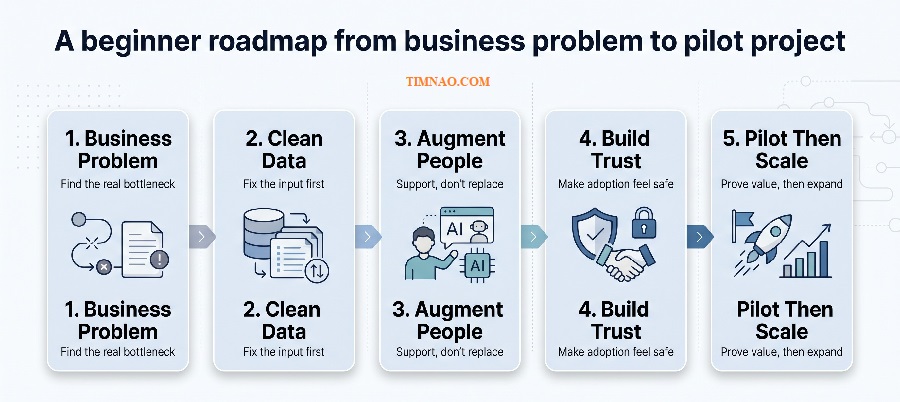
Step 1: Start with the business problem, not the tool
This is the most important step because it prevents almost every beginner mistake that comes after it.
Do not start with:
- “We need an AI strategy”
- “We should use generative AI”
- “Our competitors are doing something with AI”
Start with a measurable business problem instead.
For example:
- support response times are too slow
- sales leads are poorly prioritized
- reports take too long to produce
- onboarding is too manual
- customers are leaving without warning signs
- internal knowledge is hard to find
A good starting problem has three qualities:
- it is specific
- it happens often
- improvement would matter to the business
If the problem is fuzzy, the pilot will be fuzzy too.
Step 2: Check the data before you check the tools
This is the step people love to skip because it feels less exciting than buying software.
But weak data ruins strong tools very quickly.
If your process depends on incomplete records, messy naming, duplicate entries, inconsistent formatting, or disconnected systems, AI will usually amplify that mess instead of fixing it.
For beginners, data readiness does not mean perfection. It means asking:
- where does the information come from?
- is it recent enough?
- is it consistent enough?
- is it accessible enough for one use case?
- do we trust it enough to test with it?
Often, one clean use case is better than ten messy ones. That is how real progress starts.
Step 3: Design for augmentation, not blind replacement
This mindset shift makes rollout smoother and safer.
Businesses often get into trouble when they treat AI as a replacement project too early. That creates fear inside teams and brittleness inside workflows.
A better question is:
How can AI make a person faster, sharper, or more consistent here?
That leads to better design choices.
For example:
- AI drafts, a human approves
- AI prioritizes, a manager decides
- AI summarizes, an expert interprets
- AI flags anomalies, a team investigates
This is especially important in functions where mistakes are expensive, sensitive, or reputational.
Augmentation also helps with adoption because it respects the fact that work quality often comes from context, empathy, and judgment, not just speed.
Step 4: Build trust and ownership before the pilot goes live
A pilot does not fail only because the model performs badly. It also fails when nobody owns it properly.
Before launch, you need clear answers to practical questions:
- who is responsible for this workflow?
- what does success look like?
- what kinds of errors matter most?
- when should a human step in?
- how will feedback be collected?
- how will privacy and security be handled?
This step is where many businesses quietly improve their odds.
The pilot stops being “an AI experiment” and becomes “a controlled business test with owners, rules, and metrics.”
That shift sounds simple, but it changes behavior fast.
Step 5: Run a small pilot with a narrow success metric
Now the business is ready to test something real.
A good pilot is:
- narrow
- measurable
- reversible
- relevant to everyday work
The narrower the first pilot, the better.
Strong beginner examples include:
- first-draft support replies
- lead scoring for inbound sales
- document tagging and summarization
- FAQ search for internal teams
- churn signal detection in customer accounts
Then choose one or two success metrics that actually matter.
Good pilot metrics might be:
- response time reduced by 30%
- reporting time cut from 6 hours to 2
- fewer manual routing errors
- faster onboarding completion
- higher conversion on prioritized leads
Avoid vague goals like “improve innovation” or “increase AI adoption.” They sound strategic, but they are hard to prove.
Step 6: Learn before you scale
A pilot is not just a test of the model. It is a test of the workflow, the team, the data, and the trust level around the system.
So when the pilot ends, do not ask only:
Did it work?
Also ask:
- where did people hesitate?
- what inputs caused weak outputs?
- what required more human review than expected?
- what would make the next version easier to trust?
- do we have enough repeatability to standardize this?
This review stage is where a lot of hidden value appears. Sometimes the pilot “works,” but the bigger lesson is that the process needed redesign first. That is still progress.
A smart business scales only after the workflow is stable enough to deserve expansion.
Where AI value creation usually breaks down
This is the section many beginners need most, because AI business models rarely fail in dramatic movie-style ways. They usually break down in quieter, more familiar ways.
The output looks promising. The pilot gets applause. Then the value never really compounds.
It starts with the tool instead of the problem
This is the most common breakdown point.
A company buys an AI tool because it feels urgent to “do something.” Teams start exploring features. A few demos look impressive. But nobody tied the rollout to a specific bottleneck.
The result is predictable:
- enthusiasm without direction
- scattered experiments
- unclear ownership
- weak measurement
When the business problem is missing, value creation becomes accidental instead of intentional.
The data looks available, but is not usable
Many teams think they have data because they have systems full of records. That is not the same as usable data.
Real problems often include:
- duplicate customer records
- missing context
- inconsistent labels
- outdated entries
- disconnected platforms
- data trapped in PDFs, inboxes, or old workflows
This is where AI value creation often stalls. The promise sounds modern, but the foundation is fragile.
If a company ignores this stage, the system may still produce polished-looking output, but the business cannot rely on it.
Employee resistance is treated like a people problem instead of a rollout problem
When employees resist AI, leaders sometimes assume the team is simply afraid of change.
Sometimes that is true. But often the resistance is more rational than leaders admit.
People resist when:
- the goal is unclear
- the quality is inconsistent
- the system threatens autonomy
- nobody explains what stays human
- new tools arrive without training
- accountability gets blurry
So if adoption is low, the first question should not be, “Why are people resisting?” It should be, “What in this rollout makes resistance reasonable?”
That question leads to better fixes.
The system becomes too opaque to trust
A beginner-friendly way to understand this is simple: people can work with imperfect systems, but they struggle with mysterious systems.
If AI outputs cannot be challenged, traced, or reviewed in any useful way, trust weakens fast. This matters even more in hiring, pricing, finance, compliance, risk, and customer-facing workflows.
Opacity creates two bad outcomes:
- people stop trusting the system
- or worse, they trust it too much because it sounds confident
Neither is healthy.
That is why explainability matters in practical business terms. You do not always need a technical deep dive. But you do need enough clarity for people to use judgment well.
Privacy, security, and ethics show up late
Another common breakdown happens when a company treats ethics and governance as something to worry about after the pilot proves value.
That is backwards.
If the pilot depends on sensitive data, unclear permissions, weak controls, or sloppy access rules, any early success can turn into a bigger problem later. The same goes for customer-facing systems that feel manipulative or invasive.
In other words, value created without trust protections is often fragile value.
Scaling happens before the company is ready
This is where many promising pilots lose momentum.
A team gets one good result and tries to spread AI everywhere at once. Suddenly the business is dealing with uneven data, unclear priorities, multiple tools, inconsistent processes, and training gaps.
Value creation usually weakens at that point because complexity rises faster than maturity.
A more durable path is:
- one pilot
- one repeatable workflow
- one documented success case
- one stronger internal playbook
Then scale.
That approach may feel slower, but it usually creates more lasting business value.
The good news is that these breakdown points are fixable. Once you can spot them early, you stop treating AI as a magic layer and start treating it like what it really is: a business capability that needs structure, trust, and good judgment to pay off over time. From there, it becomes easier to picture what this looks like in real companies and what kinds of AI-driven models are actually realistic for smaller teams.
Three realistic AI-driven business models you can picture today
When beginners hear “AI-driven business models,” they sometimes imagine huge tech companies, giant research teams, or expensive custom software. In reality, the most useful starting point is much simpler.
A realistic AI-driven business model is one where AI changes the way value is offered, delivered, or captured in a way that customers or the business can actually feel. It does not need to be flashy. It needs to be useful.
1. The smarter expert service business
This is one of the easiest models to understand because many small businesses already operate this way without calling it an AI business model yet.
Think about businesses like:
- consultants
- research services
- agencies
- legal support teams
- operations specialists
- financial analysis providers
In a traditional version of this model, the value comes from human expertise. The team gathers information, reviews documents, finds patterns, builds recommendations, and delivers advice or outputs to the client.
In an AI-driven version, the human expertise still matters, but AI improves the engine behind the service.
That may look like:
- summarizing interview notes faster
- turning raw information into structured reports
- spotting anomalies earlier
- drafting first-pass analyses
- identifying patterns across a large body of data
- shortening the time between input and insight
This is powerful because it does not ask the business to become something completely different. It makes the original promise stronger.
A beginner-friendly example is a small research or consulting business. Before AI, a project might require days of reading, tagging, synthesis, and report drafting. With AI woven into the workflow, the team can move faster from raw material to useful insight. That means they can serve more clients, shorten delivery time, or offer a higher-touch service without scaling headcount at the same pace.
Why this model works:
- the value proposition becomes faster and often more tailored
- delivery becomes more efficient
- value capture improves through margin, capacity, or premium positioning
The trap to avoid is over-automating the expertise itself. Clients still pay for judgment, trust, and clarity. AI should support the expert, not flatten the service into generic output.
2. The AI-enhanced operations or software model
This model is especially useful for B2B businesses, software firms, and companies that help other businesses run core processes.
The source material points to firms where AI is not an extra add-on but part of finance, HR, CRM, logistics, document handling, cloud workflows, or connected operational systems. For beginners, the easiest way to understand this is to picture AI as an invisible layer inside the process, not a shiny front-end feature.
For example, a company using tools like Salesforce, SAP, or Microsoft software might move from simply storing and managing business data to using AI for:
- lead prioritization
- document summarization
- anomaly detection
- workflow recommendations
- predictive maintenance
- better routing of requests
- faster internal search
This is a very realistic AI-driven business model because many businesses already have the digital layer. AI becomes the next step when the company wants that layer to become more adaptive and more useful.
A simple example would be a B2B software company that serves HR teams. In the old model, the product stores employee information, tracks processes, and generates reports. In the AI-driven model, the software can also surface hiring bottlenecks, suggest next actions, summarize policy questions, and reduce manual admin work.
The customer is not just paying for a system of record anymore. They are paying for a system that helps them act better.
Why this model works:
- the value proposition becomes more intelligent
- customers feel the benefit in daily operations
- retention can improve because the product becomes harder to replace
- upsell potential often increases as the AI layer becomes more central
The trap here is trying to do too much at once. If the AI layer touches too many workflows before the company has solid data, reliable integration, and clear governance, the system can become messy fast.
3. The personalized membership, learning, or commerce model
This is the model many creators, educators, coaches, and small online brands can understand quickly.
At its core, this model uses AI to make the customer experience feel more relevant and more responsive without forcing the business to manually tailor everything for every person.
That may include:
- personalized onboarding
- better content recommendations
- adaptive product suggestions
- automated first-response support
- behavior-based follow-up emails
- more relevant next-step guidance
You can picture this in an online learning business, a paid community, a coaching membership, or even a niche ecommerce store running on platforms like Shopify.
Let’s take a simple example. A membership business helps beginners learn a skill. In the basic model, everyone gets the same content path, the same reminders, and the same support experience. In the AI-driven version, members get nudges based on behavior, lesson recommendations based on progress, and faster support on repeat questions.
The expert or founder still matters. But the experience becomes more personal and more scalable.
Why this model works:
- the value proposition feels more tailored
- the delivery system becomes less manual
- retention can improve because users feel guided
- premium tiers can become easier to justify
The trap here is making the experience feel artificial, intrusive, or low-quality. Personalization only creates value when it feels helpful. If it feels random or creepy, trust drops and the model weakens.
Which of these models is best for a beginner?
A quick rule helps here:
- if your business sells expertise, start with the smarter expert service model
- if your business runs on workflows, processes, or software, start with the AI-enhanced operations model
- if your business depends on engagement, guidance, or repeat interaction, start with the personalized membership or commerce model
You do not need to choose the most advanced-looking model. You need to choose the one that matches how your business already creates value.
A 7-day plan to start without overbuilding
Most businesses do not fail with AI because they started too small. They fail because they started too vaguely or too broadly.
That is why a 7-day plan works so well. It forces clarity before complexity.
Day 1: Pick one business problem worth solving
Do not start with “we should use AI more.”
Pick one recurring, measurable problem such as:
- support is too slow
- reporting takes too long
- content discovery is poor
- leads are badly prioritized
- onboarding is too manual
- customers drop off without warning
If the problem does not hurt often enough, it is probably not the right starting point.
Day 2: Map the current workflow in plain language
Write down what happens now from start to finish.
Ask:
- what triggers the work?
- what information is used?
- where does time get lost?
- where do errors repeat?
- where does the team rely on copy-paste, manual review, or slow searching?
This step sounds simple, but it usually reveals more than people expect. Many teams discover that the problem is not one task. It is the whole flow around the task.
Day 3: Check whether the data is usable enough
You do not need perfect data. You need usable data for one pilot.
Check:
- is the input clear?
- is the information current?
- is the format consistent enough?
- is the data trapped across too many systems?
- would a weak data source make the pilot misleading?
If the answer is yes, then fix the small foundation first. A focused cleanup now is better than a confusing pilot later.
Day 4: Decide what stays human
This step matters more than most beginners expect.
Write down:
- what AI should do
- what humans should still review
- what kinds of outputs need approval
- what should happen when the system is unsure or wrong
This immediately makes the pilot more trustworthy. It also helps the team understand that AI is being added with judgment, not just excitement.
Day 5: Choose one success metric
If you cannot measure the pilot, you cannot learn from it properly.
Pick one or two metrics at most, such as:
- time saved
- faster response time
- fewer errors
- better conversion on prioritized leads
- lower admin workload
- improved completion or retention
Keep it tight. This is not the stage for a giant scorecard.
Day 6: Run the pilot with a small group or narrow workflow
This is where discipline matters.
Do not launch across the whole company. Use a small workflow, one team, one type of document, or one slice of the customer journey.
The point is not to prove that AI can theoretically help. The point is to see whether it helps in your actual environment.
Watch closely for:
- weak outputs
- hesitation from users
- hidden manual cleanup
- confusion around ownership
- trust issues that did not show up on paper
Day 7: Review honestly before expanding
At the end of the week, ask five questions:
- Did this improve the offer, the workflow, or the business benefit in a visible way?
- Did the team actually want to use it?
- What broke first: data, trust, process, or expectations?
- What would make the next version more reliable?
- Is this worth another iteration, or was it just interesting?
That last question is important. Not every pilot should scale. Some should be dropped quickly. That is a strength, not a failure.
A good 7-day plan does not try to transform the whole business. It helps you earn the right to take the next step.
What to remember before you scale
Scaling is where excitement can become expensive. A pilot that works in one corner of the business does not automatically mean the company is ready to expand AI across products, teams, or customer journeys.
Before you scale, keep these lessons in view.
Do not confuse one good pilot with full business readiness
A successful small test proves potential, not maturity.
Scaling becomes much safer when the business can show:
- repeatable results
- cleaner data habits
- clearer ownership
- enough trust from users
- a workflow that does not collapse under higher volume
If those pieces are missing, the next step should be another controlled rollout, not a giant expansion.
Scale workflows, not just tools
Many teams think scaling means buying more licenses or turning on more features.
Real scaling usually means:
- documenting the use case
- setting rules and review points
- training teams
- improving data handling
- defining who is accountable
- deciding where human judgment remains essential
In other words, scale the operating model around the AI, not just the software.
Keep value capture in view
A lot of businesses get stuck because they improve the process but never decide how the business will benefit clearly.
Before scaling, ask:
- where will this show up financially?
- will it improve margin, retention, conversion, or productivity?
- can we charge more for the improved experience?
- can we serve more customers at the same cost base?
- can we reduce friction in a way that customers actually notice?
If the answer stays vague, the company may be creating activity instead of value.
Protect trust as you grow
Trust can feel stable during a small pilot because the team is paying close attention. At scale, new problems appear:
- outputs vary more
- edge cases increase
- more employees interact with the system differently
- governance gaps become visible
- customers notice flaws faster
That is why scaling should make trust systems stronger, not weaker.
At minimum, keep these in place:
- clear human fallback paths
- transparent rules for sensitive workflows
- security and privacy checks
- quality review loops
- space for employees to challenge bad outputs
A business can recover from a small technical error. It is much harder to recover from a trust problem that spreads across customers or staff.
Grow in stages, not in one leap
One of the most useful ideas from the source material is the maturity path: experimentation, learning and standardization, integration and automation, then scaling and co-evolution. That is a much healthier model than trying to jump straight from curiosity to company-wide dependence.
A practical way to think about it is:
- first prove one use case
- then standardize what worked
- then integrate it into a real process
- then scale only when the business is ready
This may feel slower than the market hype suggests, but it usually creates stronger long-term results.
The final thing to remember
You do not need the most futuristic AI strategy. You need a business model that becomes more useful, more trustworthy, and more effective because AI is built into the right place.
That is the real goal.
For beginners, the smartest path is rarely the boldest-looking one. It is the one that improves a real promise, strengthens how the work gets done, and creates a benefit the business can actually keep. Once you can do that once, clearly and repeatably, scaling becomes a business decision rather than a guess.
Disclaimer:
This article is for educational and informational purposes only. It is intended to provide general insights into AI business models, AI-driven business models, and AI value creation, not legal, financial, investment, or professional business advice. Every business has different goals, data, resources, risks, and regulatory requirements, so results may vary. Before adopting any AI tools, workflows, or strategies, readers should do their own research, test carefully, and seek qualified professional advice where appropriate, especially in areas involving privacy, security, compliance, hiring, finance, or customer data.
Enjoyed this article and found it helpful? ☕✨
If it saved you time, taught you something new, or gave you useful ideas, you can support my work here: Buy me a coffee 💛
Your support helps me create more practical, beginner-friendly content every week 🚀