Critical Thinking Skills for Clearer, Smarter Everyday Decisions 🧠
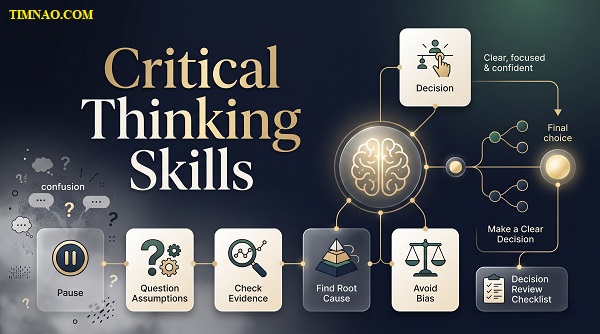
Critical thinking skills can make everyday decisions feel less confusing, less emotional, and much easier to handle. Whether you are choosing what to believe, solving a problem at work, or trying not to overreact in a difficult conversation, clear thinking helps you slow down and see what is really going on.
The good news is that you do not need to be a philosopher, analyst, or “naturally logical” person to think better. You only need a few simple habits: pausing before you react, checking your assumptions, looking for real evidence, and asking better questions.
In this guide, you will learn practical ways to use critical thinking in real life, not just as a theory, but as a skill you can apply today.
Critical Thinking Skills Start With a Better Pause
Critical thinking skills do not begin with complicated logic. They begin with something much simpler: a pause.
That pause is the small space between what happens and what you do next. Someone sends a short message. You feel ignored. A headline makes you angry. A product promise sounds exciting. A friend gives strong advice. Your first reaction may feel true, but it is not always accurate.
The pause gives your mind a chance to catch up with your emotions.
For beginners, this is important because clear thinking is hard when you are rushed, embarrassed, defensive, excited, or afraid. In those moments, your brain wants speed. Critical thinking asks for just enough space to check what is really going on.
You are not trying to become cold or emotionless. You are simply learning to respond instead of react.
The pause is not procrastination
A lot of people confuse pausing with doing nothing.
But a useful pause is active. You are not avoiding the decision. You are creating a cleaner starting point.
Think of it like wiping a foggy window before looking outside. The view may not become perfect, but it becomes clearer. That is what the pause does for your thinking.
A good pause helps you ask:
- What actually happened?
- What am I feeling right now?
- What story am I telling myself about this?
- Do I need to respond immediately?
- What would a calmer version of me notice?
This matters because many poor decisions are not caused by a lack of intelligence. They are caused by moving too quickly from emotion to action.
For example, you receive feedback from a client and immediately think, “They hate my work.” Without pausing, you may reply defensively, over-explain, or feel discouraged for the rest of the day.
But if you pause, you may notice something different: the client did not reject your work. They asked for clearer wording, a stronger example, or a small change in direction. The problem is fixable. Your first emotional interpretation made it feel bigger than it was.
That is the power of a better pause.
A simple 10-second pause you can use anywhere
You do not need a journal, a course, or a long morning routine to start practicing this. Use a short mental checklist.
When something triggers you, silently ask:
- What do I know for sure?
Stick to facts. Not guesses. Not fears. Not what you think someone meant. - What am I adding to the situation?
This is where you notice your interpretation. Maybe you are assuming rejection, danger, failure, disrespect, or urgency. - What is the next useful step?
The next step does not have to be perfect. It just needs to be better than reacting blindly.
Here is how that might look in everyday life.
You send a message and the person does not reply.
Your first reaction may be: “They are ignoring me.”
The pause says:
- What do I know for sure? They have not replied yet.
- What am I adding? I am assuming the silence means something negative.
- What is the next useful step? Wait, or follow up politely later if needed.
This does not mean you ignore patterns. If someone repeatedly avoids you, that is information. But one delayed reply is not enough evidence to build a full story.
That small distinction can save you a lot of unnecessary stress.
What the pause looks like in real life
The better pause is useful in almost every area of life.
At work, it helps you avoid replying too quickly when a message sounds rude.
With money, it helps you slow down before buying something because the sales page made it feel urgent.
In relationships, it helps you listen before defending yourself.
With online content, it helps you avoid sharing something just because it made you angry or excited.
Here is a practical example.
Imagine your manager says, “Can we talk about the report tomorrow?”
Without a pause, your mind may jump to:
“I did something wrong.”
But with a pause, you can separate fact from fear.
The fact: your manager wants to discuss the report.
The fear: you may be in trouble.
The better response: prepare calmly, review the report, and wait for the actual conversation.
That is critical thinking in a very normal situation. It does not look dramatic. It looks like staying steady when your mind wants to run ahead.
The goal is not to pause forever. The goal is to pause long enough to choose your response with more clarity.
The “What Am I Assuming?” Question Changes Everything
Once you learn to pause, the next step is to question the invisible story behind your reaction.
That story usually begins with an assumption.
An assumption is something you treat as true without fully checking it. Sometimes assumptions are helpful. If the road is wet, you may assume it rained. If a deadline is tomorrow, you may assume you should start now.
But assumptions become a problem when they quietly control your decisions.
For example:
- “If I ask for help, people will think I am weak.”
- “If this idea failed once, it will always fail.”
- “If someone disagrees with me, they do not respect me.”
- “If many people believe this, it must be true.”
- “If I feel nervous, I must not be ready.”
These thoughts may feel convincing. But feeling convincing is not the same as being accurate.
The question “What am I assuming?” helps you pull those hidden thoughts into the open.
Once you can see the assumption, you can test it.
Why assumptions feel like facts
Assumptions are tricky because they often come with emotion.
If you are anxious, a neutral situation may look threatening.
If you are excited, a risky opportunity may look safer than it really is.
If you are embarrassed, helpful feedback may feel like personal criticism.
Your brain naturally tries to make meaning quickly. It does not like uncertainty, so it fills in the gaps. The problem is that it often fills those gaps with old fears, past experiences, or incomplete information.
Let’s say you are learning a new skill and someone gives you a correction.
The fact may be simple: “This part could be improved.”
But your assumption may be: “I am bad at this.”
That assumption can make you quit too early.
A more useful thought would be:
“I have one specific thing to improve.”
That version is clearer, kinder, and easier to act on.
Critical thinking is not about being harsh with yourself. It is about being more accurate with yourself.
Turn vague thoughts into testable sentences
One of the best ways to weaken a bad assumption is to write it clearly.
Vague thoughts feel powerful because they stay blurry. Once you turn them into a sentence, you can examine them.
Instead of thinking:
“This is going badly.”
Write:
“I am assuming this project is failing because we are behind schedule.”
Now you can ask better questions:
- Are we truly failing, or are we delayed?
- What caused the delay?
- Is the goal still realistic?
- What can be adjusted?
- What evidence says this can still work?
This moves you from panic to problem-solving.
Here are a few more examples:
“I’m not good at public speaking” becomes:
“I need more practice organizing my points and speaking slowly.”
“Nobody cares about my content” becomes:
“I have not yet found the right topic, format, or audience.”
“This customer is difficult” becomes:
“This customer may need clearer expectations and a simpler process.”
Notice the difference. The first version traps you. The second version gives you something to work with.
That is what good thinking often does. It turns emotional fog into practical language.
Use the “three possible explanations” habit
When you are stuck in one interpretation, force your mind to find two more.
This is simple, but powerful.
If a person seems distant, your first explanation may be:
“They are upset with me.”
Now add two more:
- They may be busy or tired.
- They may be dealing with something personal.
- They may not realize they seem distant.
You do not have to know which one is true yet. The point is to stop acting as if the first explanation is the only explanation.
This habit is especially useful in relationships, teamwork, and decision-making.
For example, if your sales are low, do not jump straight to:
“My product is bad.”
Other possible explanations could be:
- The offer is not clear enough.
- The audience does not understand the value yet.
- The price, timing, or platform may need testing.
Each explanation leads to a different action. If you assume the product is bad, you may quit. If you notice the offer is unclear, you can rewrite the sales page. If the audience is wrong, you can adjust your targeting.
Better assumptions create better options.
And better options usually lead to better decisions.
Evidence Beats Intensity: How to Check a Claim Without Overthinking
A claim is any statement that asks you to believe something.
“This method always works.”
“This investment is safe.”
“This person is wrong.”
“This habit will change your life.”
“This tool is the best option.”
Some claims are true. Some are partly true. Some are exaggerated. Some are designed to make you react quickly.
Critical thinking helps you slow down and ask, “What supports this?”
This is especially important today because intensity is everywhere. People sound certain. Headlines are emotional. Marketing promises are polished. Social media rewards confidence, not always accuracy.
But a claim does not become true because it is loud, popular, urgent, or repeated often.
Evidence matters more than intensity.
Separate the claim from the feeling
The first step is to notice how a claim makes you feel.
Does it make you angry?
Excited?
Afraid?
Hopeful?
Pressured?
That feeling is useful information, but it is not proof.
For example, a post might say, “If you are not using this new strategy, you are already behind.”
That may trigger fear. But fear does not prove the strategy is right for you.
A smarter response is:
“This makes me feel urgent. But what is the actual evidence?”
You can still explore the idea. You can still learn from it. You just do not have to surrender your judgment to the emotion.
This is especially helpful with money, career advice, health claims, productivity trends, and online business promises.
A beginner-friendly rule is:
When a claim makes you feel rushed, slow down.
Urgency is not always bad. Sometimes you really do need to act. But pressure should make you more careful, not less.
Use the claim-reason-proof check
You do not need to become an expert researcher to evaluate a claim. Use this simple three-part check.
- Claim: What are they saying?
Get the statement clear. - Reason: Why do they say it is true?
Look for the logic behind it. - Proof: What supports the reason?
Look for examples, data, experience, clear explanation, or reliable testing.
Let’s use a simple example.
Someone says:
“Everyone should wake up at 5 a.m. because successful people do it.”
The claim: everyone should wake up at 5 a.m.
The reason: successful people do it.
The proof: unclear.
This does not mean waking up early is bad. It may help some people. But the argument is too broad. It ignores different lifestyles, work schedules, sleep needs, family responsibilities, and energy patterns.
A better claim would be:
“Some people work better with an early morning routine, especially if it helps them protect quiet focus time.”
That is more balanced and more useful.
Good evidence usually makes a claim more specific, not more dramatic.
Red flags that deserve a slower look
Some claims deserve extra caution. Watch for these signs:
- Big promises with little detail
“Change your life overnight” sounds exciting, but how exactly? - Only success stories, no limitations
If something truly works, there should still be context, effort, and exceptions. - Pressure to act immediately
“You must decide now” often reduces clear thinking. - Attacking questions as negativity
A strong idea can handle reasonable questions. - Confusing popularity with truth
Many people believing something does not automatically make it accurate. - Using one example as universal proof
One person’s result can be inspiring, but it may not apply to everyone.
These red flags do not mean the claim is automatically false. They simply mean you should slow down and check more carefully.
Critical thinking is not about rejecting everything. It is about refusing to be pushed into belief before the idea has earned your trust.
A beginner-friendly way to respond without sounding argumentative
Some people avoid critical thinking because they do not want to seem difficult.
But asking questions does not have to be aggressive.
You can use calm, simple phrases:
- “That’s interesting. What makes you say that?”
- “Do you have an example?”
- “How would this work for someone just starting?”
- “What are the risks or limitations?”
- “Is there another way to look at it?”
- “What would prove this wrong?”
These questions keep the conversation open. They help you learn without sounding like you are attacking the person.
This is useful at work, in meetings, in online learning, and even in personal conversations.
The point is not to win. The point is to understand.
When you combine the pause, the assumption check, and the evidence check, your thinking becomes much cleaner. You are no longer just reacting to what feels true in the moment. You are building the habit of looking twice, asking better questions, and choosing your next step with more confidence.
From here, the next natural layer is learning how to use these same skills when a real problem needs solving — not just understanding what is happening, but deciding what to do about it.
Use the 5 Whys to Find the Real Problem
Most people do not solve the real problem. They solve the first problem they see.
That is why the same issue keeps coming back with a different face. You reply faster, but communication is still messy. You buy a new planner, but your tasks are still unclear. You work harder, but the project still feels stuck.
The surface problem is usually loud. The real problem is usually quieter.
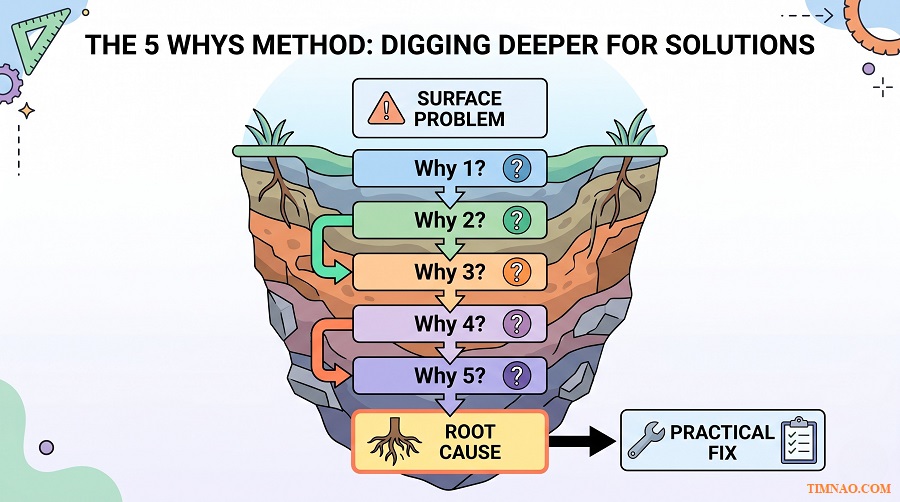
The 5 Whys method helps you slow down and dig underneath the obvious answer. It is simple enough for beginners, but powerful enough to use at work, in business, in personal goals, and even in everyday conversations.
The idea is straightforward: start with a problem, then ask “Why?” several times until you reach a cause you can actually do something about.
You may not always need exactly five questions. Sometimes three is enough. Sometimes you need six or seven. The point is not the number. The point is to stop accepting the first explanation too quickly.
Start with a problem you can describe clearly
Before asking why, write the problem in one clear sentence.
Not:
“I’m bad at managing my life.”
That is too broad and too emotional.
Try:
“I keep missing my weekly writing schedule.”
That gives your brain something concrete to work with.
A useful problem statement should be:
- Specific
- Neutral
- Actionable
- Based on what is happening, not what you fear it means
For example:
Instead of saying, “My team is lazy,” say:
“The team missed the last two project deadlines.”
Instead of saying, “Nobody likes my content,” say:
“My last five blog posts received fewer clicks than usual.”
This small wording change matters. When you describe a problem dramatically, your mind becomes defensive or discouraged. When you describe it clearly, your mind starts looking for solutions.
Ask “why” until the answer becomes useful
Let’s walk through a simple example.
Problem: “I keep missing my weekly writing schedule.”
- Why?
Because I do not start writing until the end of the week. - Why do I wait until the end of the week?
Because I feel unsure about what to write. - Why do I feel unsure?
Because I choose the topic on the same day I write. - Why is that a problem?
Because I spend my writing time trying to decide, not actually writing. - Why does that keep happening?
Because I do not have a simple topic planning system.
Now the real problem is clearer.
The issue is not “I’m lazy.” The issue is that the writing process starts too late. The fix may be simple: choose topics every Friday, outline on Monday, write on Tuesday, edit on Wednesday.
That is the value of the 5 Whys. It turns self-blame into a practical adjustment.
Look for the cause you can influence
A good root cause is not just “true.” It is useful.
For example, if your sales are low, you could say:
“People are not buying because the economy is bad.”
That may be partly true, but it does not give you much control.
A more useful answer might be:
“People are not buying because the offer does not clearly explain who it is for and what result they get.”
Now you have something to improve.
When using the 5 Whys, look for causes that lead to action:
- Can I change this?
- Can I test this?
- Can I improve this?
- Can I ask for better information?
- Can I remove or reduce this obstacle?
If the answer is yes, you are getting closer to the real problem.
Use it without turning every issue into a huge project
The 5 Whys method should make thinking easier, not heavier.
You do not need to use it for every tiny decision. If you are choosing lunch, just choose lunch. But if a problem repeats, costs you energy, or creates the same frustration again and again, it is worth digging deeper.
Use it when:
- The same issue keeps returning
- People disagree about what the problem is
- You feel stuck even after trying several fixes
- You are blaming yourself but do not know what to change
- The solution feels obvious but has not worked before
A helpful rule is this:
If the problem has happened once, solve it simply.
If it has happened three times, look for the system behind it.
That is where critical thinking becomes practical. You stop fighting symptoms and start changing causes.
Analytical and Creative Thinking Work Better Together
Many beginners think critical thinking means being purely logical. They imagine someone cold, serious, and focused only on facts.
But good thinking is not just analytical. It is also creative.
Analytical thinking helps you understand what is happening. Creative thinking helps you imagine what else is possible. One gives you structure. The other gives you options.
If you only use analysis, you may become careful but stuck. If you only use creativity, you may generate ideas that sound exciting but do not solve the real issue.
The best problem-solvers use both.
Use analytical thinking to break the problem into pieces
Analytical thinking is what you use when you slow down and examine the details.
It asks:
- What are the facts?
- What changed?
- What patterns can I see?
- What is causing what?
- What is the most important factor?
- What evidence supports this idea?
Imagine you run a small email newsletter, and your open rate suddenly drops.
A rushed reaction might be:
“My audience is not interested anymore.”
Analytical thinking slows that down.
You might check:
- Did the subject lines change?
- Did the sending time change?
- Did the topic change?
- Did the email list grow with less targeted subscribers?
- Did one email perform badly, or is this a pattern?
- Are people still clicking when they do open?
Now the problem becomes less emotional and more specific.
Maybe your audience is still interested, but your subject lines became too vague. Maybe your best readers still click, but newer subscribers do not understand your content yet. Maybe one weak email made the numbers look worse than they are.
Analysis helps you avoid guessing.
It breaks a messy situation into smaller parts so you can see what deserves attention.
Use creative thinking to find options you would normally miss
After analysis, many people make another mistake: they choose the most obvious fix.
If open rates are down, they only try “better subject lines.”
That might help. But creative thinking asks wider questions:
- What if the newsletter needs a clearer promise?
- What if the first few emails should welcome new readers better?
- What if the format is too long?
- What if readers want more examples and fewer opinions?
- What if the topic is useful, but the angle feels too generic?
Creative thinking does not ignore facts. It uses facts as a starting point.
It asks, “What else could be true?” and “What else could we try?”
This is where better solutions often appear.
For example, instead of only rewriting subject lines, you might test a shorter format, add a reader question section, create a monthly theme, or segment the list by interest.
Creative thinking gives your analytical findings more room to breathe.
A simple two-mode workflow for beginners
When you face a problem, do not try to be analytical and creative at the exact same moment. That can feel confusing.
Use two separate modes.
Mode 1: Understand the problem
In this mode, your job is to be clear.
Ask:
- What is happening?
- What evidence do I have?
- What are the possible causes?
- What have I already tried?
- What seems to matter most?
Do not rush into solutions yet.
Mode 2: Generate better options
Now your job is to be open.
Ask:
- What are three possible ways to solve this?
- What would I try if the current approach were not allowed?
- What is the simplest version of a solution?
- What would help the person affected by this problem?
- What can I test before committing fully?
This workflow keeps your thinking clean.
First, you understand. Then, you imagine. After that, you choose.
Match the thinking style to the problem
Some problems need more analysis. Others need more creativity.
If you are comparing prices, reviewing data, checking a contract, or deciding whether a project is profitable, analytical thinking should lead.
If you are improving a customer experience, creating content, solving a team conflict, or designing a new offer, creative thinking may need more space.
But most real problems need both.
For example:
- A budget problem needs numbers, but also creative ways to reduce waste.
- A relationship problem needs honest observation, but also new ways to communicate.
- A business problem needs data, but also fresh ideas for value and positioning.
- A personal productivity problem needs tracking, but also a routine that fits your actual life.
The goal is not to label yourself as “logical” or “creative.”
The goal is to become flexible.
Clear thinkers know when to zoom in and when to zoom out. They can study the details without losing the bigger picture. They can imagine better options without ignoring reality.
That balance is what makes critical thinking useful in real life.
Time Horizons and Pre-Mortems Help You Decide Better
Some decisions are hard because they feel urgent in the moment.
You want relief now. You want certainty now. You want the uncomfortable feeling to go away now.
But a decision that feels good today may create problems later. And a decision that feels uncomfortable today may protect your future.
That is why time horizons are so helpful.
A time horizon simply means looking at a decision across different time frames. Instead of only asking, “What do I want right now?” you ask, “How will this choice look later?”
This does not remove uncertainty. But it helps you make decisions with a wider view.
Ask what this choice costs now, next month, and next year
When you are about to make a meaningful decision, look at it through three time frames:
- Now
- Soon
- Later
Let’s say you are thinking about saying yes to a new project.
Right now, saying yes may feel exciting. You may like the opportunity, the money, or the approval.
Soon, it may affect your schedule. You may need to work evenings, delay another goal, or reduce your rest.
Later, it may help your portfolio, build a relationship, or lead to burnout if you overcommit.
None of these answers automatically tell you what to do. But together, they give you a fuller picture.
Try asking:
- What is the short-term benefit?
- What is the short-term cost?
- What is the long-term benefit?
- What is the long-term cost?
- What will this make easier?
- What will this make harder?
This is especially useful when emotions are strong.
If you are angry, the short-term reward of sending a harsh message may feel satisfying. But the long-term cost may be damaged trust.
If you are tired, the short-term reward of quitting a goal may feel peaceful. But the long-term cost may be regret if the goal still matters.
Time horizons help your future self get a vote.
Use the “future me” question
A simple beginner-friendly question is:
“What would my future self thank me for?”
This question works because it shifts your attention from impulse to alignment.
For example:
- Your present self wants to avoid a difficult conversation.
- Your future self may thank you for handling it calmly today.
- Your present self wants to buy something expensive because it feels motivating.
- Your future self may thank you for waiting 48 hours and checking your budget.
- Your present self wants to keep researching forever.
- Your future self may thank you for making a small test and learning from it.
This does not mean you should always choose the hardest option. Rest can be wise. Fun can be healthy. A slower path can be better.
The point is to avoid making decisions only from the mood of the moment.
A good decision should respect both your current reality and your future direction.
Run a pre-mortem before important decisions
A pre-mortem is a simple exercise where you imagine that your decision failed before you actually make it.
It sounds negative, but it is not. It is a way to prepare.
Here is the basic question:
“Imagine this plan did not work. What probably went wrong?”
This helps you notice risks while you still have time to adjust.
For example, suppose you want to launch a beginner-friendly online course.
A normal planning mindset asks:
“How can I make this successful?”
A pre-mortem asks:
“If this fails, why would it fail?”
Possible answers:
- The topic was too broad.
- The promise was unclear.
- The lessons were too long.
- Beginners felt overwhelmed.
- The sales page explained features, not outcomes.
- There was no simple first win.
- The launch depended too much on one platform.
Now you can improve the plan before launching.
You might narrow the topic, create shorter lessons, add a simple checklist, test the offer with a small audience, and rewrite the promise in beginner-friendly language.
That is the power of a pre-mortem. It turns possible failure into useful preparation.
Keep the pre-mortem practical, not scary
A pre-mortem should not become an anxiety spiral.
You are not trying to list every disaster imaginable. You are trying to identify the most likely points of failure.
Keep it simple:
- Write the decision or plan.
- Imagine it failed.
- List three to five likely reasons.
- Choose one or two risks you can reduce now.
- Take a small action before moving forward.
For example:
Decision: “I will start exercising four times per week.”
Possible failure reasons:
- The plan is too ambitious.
- I do not have a fixed time.
- I get discouraged if I miss one day.
- I chose workouts I do not enjoy.
Risk-reducing actions:
- Start with two times per week.
- Put workouts on the calendar.
- Choose a 20-minute routine.
- Have a “restart rule” if I miss a day.
This is much more useful than saying, “I need more discipline.”
Often, the problem is not your character. It is your plan.
Decide with confidence, then review with honesty
Time horizons and pre-mortems will not guarantee perfect decisions. Nothing can.
But they help you make better decisions with the information you have.
After you decide, pay attention to the result. Ask:
- What worked?
- What surprised me?
- What did I underestimate?
- What would I do differently next time?
- What did this teach me about my values, limits, or habits?
This final review matters because every decision can train your thinking.
You will still make mistakes. Everyone does. But when you reflect honestly, mistakes become data. They help you understand yourself and improve your process.
That is how critical thinking becomes a real-life skill, not just an idea.
You pause before reacting. You question your assumptions. You check the evidence. Then, when a real problem appears, you dig for the cause, use both logic and imagination, and make decisions with your future in mind.
Once these habits feel familiar, the next step is learning how to protect your thinking from the mental shortcuts and biases that can quietly pull you off track.
Watch for Biases Before They Watch for You
Even when you are trying to think clearly, your brain still loves shortcuts.
That is not because you are careless or unintelligent. It is because the human brain is built to save energy. It wants quick answers, familiar patterns, and simple stories. This is useful when you need to move fast, but it can create problems when the decision needs patience.
A bias is a thinking shortcut that can quietly distort your judgment. It can make you overtrust your first impression, ignore useful evidence, believe what feels comfortable, or rush toward the option that confirms what you already wanted to be true.
The tricky part is this: bias often does not feel like bias.
It feels like common sense.
That is why critical thinking skills are so useful. They help you slow down and notice when your mind may be filling in gaps too quickly.
Confirmation bias makes your first belief feel safer
Confirmation bias happens when you look for information that supports what you already believe and avoid information that challenges it.
For example, imagine you believe a coworker does not like you. After that, every small thing becomes “proof.” They reply late, and you think, “See? They don’t respect me.” They sound tired in a meeting, and you think, “They’re annoyed with me.”
But when they help you, smile, or agree with your idea, you barely notice it.
Your brain is not collecting all the evidence. It is collecting evidence that protects the story you already believe.
A simple fix is to ask:
“What would I notice if I believed the opposite?”
This question does not force you to change your mind. It simply makes your mind more balanced.
If you think your business idea is failing, ask:
- What evidence suggests it is failing?
- What evidence suggests it might still work?
- What part of the idea is weak?
- What part is showing promise?
That is much more useful than deciding too early that everything is either perfect or hopeless.
Anchoring bias can trap you inside the first number or idea
Anchoring bias happens when the first piece of information you receive becomes the “anchor” for everything after it.
You see this often with prices.
If a course is first shown as $2,000 and then discounted to $499, the lower price may feel like a bargain. But the real question is not, “Is this cheaper than the first number?” The real question is, “Is this worth $499 for my situation?”
Anchoring can also happen with opinions.
If someone says, “This project will be very difficult,” you may start seeing every challenge as proof that the project is too hard. If someone says, “This will be easy,” you may underestimate the work involved.
To reduce anchoring bias, decide your own criteria before judging the option.
For example, before buying a tool, ask:
- What problem do I need this tool to solve?
- How often will I use it?
- What result would make it worth the cost?
- Is there a simpler or cheaper alternative?
- Am I buying because I need it, or because the offer feels urgent?
This helps you think from your needs, not from someone else’s framing.
Availability bias makes memorable things feel more common
Availability bias happens when something feels true because it is easy to remember.
If you recently heard a story about someone losing money in an online business, you may feel that every online business is risky. If you recently watched a video about someone making money quickly, you may feel that success is easier than it really is.
In both cases, your mind is overvaluing what is fresh, emotional, or memorable.
This matters because memorable examples are not always typical examples.
A dramatic story can teach you something, but it should not become your entire decision-making system.
Ask:
“Is this actually common, or is it just easy to remember?”
You can also ask:
- Am I reacting to one story or a larger pattern?
- Do I have enough examples to judge this fairly?
- What would a boring but realistic version of this situation look like?
That last question is especially helpful. The truth is often less dramatic than the story your mind creates.
False choice thinking makes your world smaller
False choice thinking happens when you act as if there are only two options.
Quit or stay.
Say yes or lose the opportunity.
Launch now or give up.
Agree completely or reject everything.
Most real-life decisions have more than two paths. You can test, delay, negotiate, simplify, ask for help, change the scope, or choose a smaller version.
For example, if you are unhappy with your job, the only choices may seem to be “stay miserable” or “quit immediately.”
But other options may include:
- Talk with your manager about changing responsibilities.
- Start applying quietly while staying employed.
- Build a financial cushion before leaving.
- Move to another team.
- Reduce unnecessary commitments outside work.
- Test a side project before making a big career move.
Critical thinking helps you widen the menu before choosing from it.
A useful rule is:
Before making a big decision, write down at least three options.
Even if the third option is not perfect, it can break the pressure of “this or that” thinking.
Bias is normal, but unchecked bias is expensive
You will never remove every bias from your thinking. Nobody does.
The goal is not to become perfectly objective. The goal is to become easier to correct.
That means you can notice when your mind is moving too fast. You can admit when you may be protecting your ego. You can ask better questions before you commit to a belief, argument, purchase, or decision.
Bias does not disappear because you are smart. It becomes less powerful when you are honest enough to look for it.
That honesty is one of the strongest signs of real critical thinking.
A Simple CLEAR Check for Everyday Decisions
When a decision feels messy, you do not always need a complicated framework. You need a simple way to slow down, organize your thoughts, and choose the next step with more confidence.
The CLEAR check is designed for everyday decisions. You can use it before sending an important message, accepting a new project, buying something expensive, solving a work problem, or making a personal change.
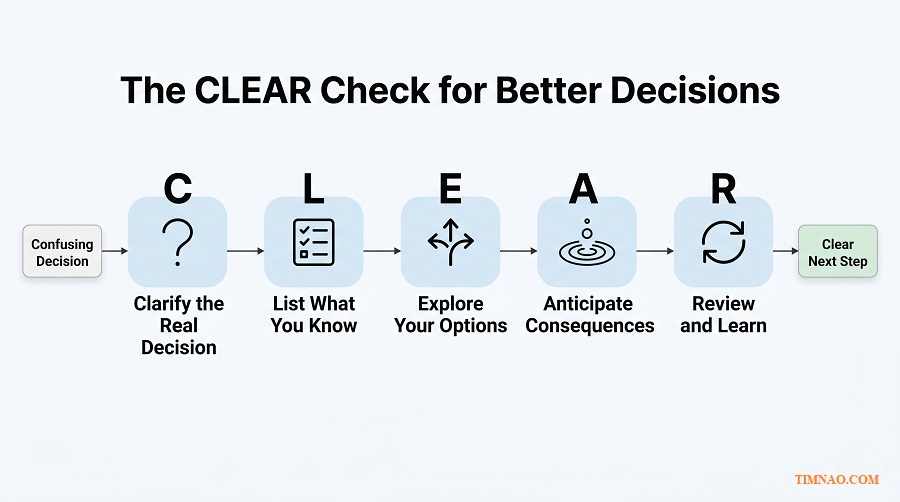
CLEAR stands for:
- C — Clarify the real decision
- L — List what you know and what you need
- E — Explore more than two options
- A — Anticipate consequences
- R — Review and learn
You can use it in five minutes for small choices or spend longer on bigger decisions.
C — Clarify the real decision
The first question is:
“What am I actually deciding?”
This sounds simple, but many people skip it.
You may think you are deciding whether to quit a project, but the real decision might be whether to change the way you are doing it. You may think you are deciding whether to buy a course, but the real decision might be whether this is the right time to invest in that skill.
A clear decision statement helps you avoid solving the wrong problem.
Instead of:
“I don’t know what to do with my life.”
Try:
“I need to decide which skill to focus on for the next three months.”
Instead of:
“My content is not working.”
Try:
“I need to decide whether to improve my topics, my headlines, or my publishing schedule.”
When the decision becomes clearer, the next step becomes less intimidating.
L — List what you know and what you need
After clarifying the decision, separate facts from missing information.
Use two simple columns:
What I know:
- The facts you already have
- Results you can observe
- Feedback you have received
- Limits you must respect
What I still need to know:
- Information that would affect the decision
- Questions you need to ask
- Risks you have not checked
- Costs you have not calculated
For example, suppose you are deciding whether to start a blog.
What you know:
- You enjoy writing.
- You can write two evenings per week.
- You want to build long-term traffic.
- You are interested in personal development topics.
What you still need to know:
- Who is the target reader?
- What problems will the blog solve?
- How much time can you commit for six months?
- What basic SEO skills do you need?
- How will you measure progress?
This step prevents two common problems: rushing with too little information, or researching forever without acting.
You do not need all the information. You need enough of the right information.
E — Explore more than two options
Once you understand the decision, create options.
Do not stop at the first obvious choice. Also, do not trap yourself between only two extremes.
Ask:
“What else could I do?”
If you are deciding whether to leave a job, your options might be:
- Stay and change nothing.
- Quit immediately.
- Stay while applying elsewhere.
- Ask for a role adjustment.
- Build a side income before leaving.
- Take a short break and reassess.
If you are deciding whether to launch a product, your options might be:
- Build the full product now.
- Drop the idea.
- Test a small version first.
- Interview potential buyers.
- Create a waitlist.
- Offer a simple service version before creating the product.
Better options reduce emotional pressure.
Sometimes the best decision is not the boldest one. It is the one that lets you learn without risking too much too early.
A — Anticipate consequences
Every decision creates a ripple effect.
Some effects are immediate. Others show up later.
Before choosing, ask:
- What happens if this works?
- What happens if this fails?
- What will this cost in time, money, energy, or attention?
- Who else will be affected?
- What might I regret not considering?
- What will become easier if I choose this?
- What will become harder?
This step is not meant to scare you. It is meant to make the decision more honest.
For example, saying yes to a new opportunity may bring money and experience. It may also reduce your sleep, delay another goal, or create stress if your schedule is already full.
That does not mean you should say no. It means you should say yes with your eyes open.
A clear thinker does not only ask, “Can I do this?”
They also ask, “What will this require from me?”
R — Review and learn
The final step happens after the decision.
Most people make a choice, experience the result, and move on. But if you never review your decisions, you miss the lesson.
A short review can improve your future thinking.
Ask:
- What did I get right?
- What did I misunderstand?
- What information mattered most?
- What warning sign did I miss?
- What would I do differently next time?
- What did this teach me about how I think?
This is how you turn experience into wisdom.
Even a bad decision can become useful if it teaches you how to make a better one next time.
The CLEAR check is not about guaranteeing perfect decisions. It is about building a repeatable thinking habit. When you practice it often, you become less reactive and more intentional.
Your 7-Day Critical Thinking Skills Practice Plan
Critical thinking skills become stronger when you practice them in normal life.
You do not need to wait for a major crisis. In fact, it is better to practice on small situations first. That way, when something serious happens, your mind already knows what to do.
This 7-day plan is simple. Each day gives you one practical exercise. You can spend 10 minutes a day if you are busy, or 20–30 minutes if you want to go deeper.
The goal is not to become perfect in one week. The goal is to build awareness.
You can track this 7-day practice in a notebook, Notion, or Google Docs. Keep it simple: one decision, one assumption, and one lesson per day.
Day 1: Pause before one reaction
Choose one moment today where you would normally respond quickly.
It might be a message, a comment, a request, a headline, or a small frustration.
Before responding, pause and ask:
- What happened?
- What am I feeling?
- What story am I adding?
- What response would help the situation?
Then choose your next step.
This exercise trains the basic skill behind clear thinking: creating space before action.
At the end of the day, write one sentence:
“Today, pausing helped me notice…”
Keep it simple. You are not writing an essay. You are training attention.
Day 2: Catch one assumption
Today, look for one assumption hiding inside your thoughts.
You can use this prompt:
“I am assuming that…”
For example:
- “I am assuming this person is upset with me.”
- “I am assuming I will fail because I struggled before.”
- “I am assuming this task will take all day.”
- “I am assuming people will judge me if I ask a question.”
After writing the assumption, ask:
- What evidence supports this?
- What evidence does not support this?
- What else could be true?
This practice helps you separate facts from mental stories.
It also makes your thinking kinder. Many assumptions are just fear wearing a serious face.
Day 3: Check one claim
Pick one claim you hear or read today.
It could come from a video, social media post, sales page, article, conversation, or advertisement.
Use the claim-reason-proof check:
- What is the claim?
- What reason is given?
- What proof supports it?
For example, if someone says, “This productivity app will help you get twice as much done,” do not accept or reject it immediately.
Ask:
- What does “twice as much” mean?
- Who has this worked for?
- What kind of work does it help with?
- Is the result from the app or from better habits?
- Would this solve my actual problem?
The goal is not to become suspicious of everything. The goal is to become less easily pushed around by confident statements.
Day 4: Use the 5 Whys on a small problem
Choose one repeating issue.
Do not pick the biggest emotional problem in your life. Start small.
Examples:
- “I keep delaying my workout.”
- “I keep forgetting to reply to emails.”
- “I keep buying courses but not finishing them.”
- “I keep feeling rushed in the morning.”
Ask why several times until you reach something practical.
Problem: “I keep feeling rushed in the morning.”
Why? Because I wake up late.
Why? Because I go to sleep too late.
Why? Because I scroll on my phone at night.
Why? Because I use my phone to relax.
Why? Because I do not have another simple evening routine.
Now the solution is not “be more disciplined.” It might be:
- Put the phone across the room.
- Choose a 15-minute wind-down routine.
- Set a fixed “screens off” time.
- Prepare clothes and breakfast the night before.
This is what good problem-solving does. It finds a lever you can actually pull.
Day 5: Use analytical and creative thinking on one decision
Choose one decision that feels unclear.
First, use analytical thinking.
Write:
- What are the facts?
- What are the constraints?
- What patterns do I see?
- What option seems most realistic?
Then switch to creative thinking.
Write:
- What else could I try?
- What is a smaller version?
- What would make this easier?
- What option have I not considered?
- What would I suggest to a friend in the same situation?
This exercise helps you avoid two traps.
Analysis without creativity can make you rigid. Creativity without analysis can make you scattered.
Together, they help you choose options that are both realistic and fresh.
Day 6: Run a mini pre-mortem
Pick one plan you are considering.
It could be starting a habit, publishing content, launching an offer, applying for a job, or having a difficult conversation.
Write this sentence:
“Imagine this did not work. The most likely reasons are…”
List three to five reasons.
Then ask:
“What can I change now to reduce one of those risks?”
For example:
Plan: “I will write three blog posts per week.”
Possible failure reasons:
- The schedule is too ambitious.
- I do not have topics prepared.
- Editing takes longer than expected.
- I get stuck trying to make every post perfect.
Adjustment:
“I will publish one strong post per week and keep a simple topic list ready.”
This does not make the plan weaker. It makes it more realistic.
A good pre-mortem protects your future effort.
Day 7: Review one decision and one thinking pattern
On the final day, look back.
Choose one decision you made this week, even a small one.
Ask:
- What helped me think clearly?
- Where did I react too quickly?
- Which question was most useful?
- What bias or assumption showed up?
- What will I practice next week?
Then choose one habit to keep.
Do not try to keep everything at once. Pick one.
Maybe your habit is pausing before replying. Maybe it is asking, “What am I assuming?” Maybe it is using the CLEAR check before important decisions.
Small habits become powerful when you repeat them.
The real benefit of this practice plan is not that you will suddenly make perfect choices. You will still get things wrong sometimes. You will still feel emotional, rushed, or unsure.
But you will also start catching yourself sooner.
That is progress.
And in real life, catching yourself sooner can change everything.
What to Remember When You Practice Critical Thinking
Critical thinking skills are not just for school, debates, or complicated business decisions. They are everyday tools for living with more clarity.
Here are the most important ideas to remember:
- Biases are normal, but they should not run your decisions. Confirmation bias, anchoring bias, availability bias, and false choice thinking can all make your judgment narrower than it needs to be.
- The CLEAR check gives you a simple decision-making process. Clarify the real decision, list what you know, explore more options, anticipate consequences, and review what you learned.
- Good thinking is practical, not perfect. You do not need every answer before you act. You need enough clarity to take the next wise step.
- Small daily exercises build stronger thinking. Pausing, checking assumptions, testing claims, using the 5 Whys, and reviewing decisions can all become natural with practice.
- Better decisions come from better questions. The quality of your thinking often improves the moment you ask, “What else could be true?” or “What am I missing?”
- Critical thinking helps you respond with intention. Instead of being pushed around by emotions, pressure, trends, or fear, you learn to choose your next step with more calm and confidence.
Clear thinking is not something you master once and keep forever. It is a habit you return to, especially when life feels noisy, uncertain, or emotionally charged.
Start small. Pause once. Question one assumption. Check one claim. Review one decision.
That is how critical thinking becomes more than an idea. It becomes the way you move through life with a clearer mind and a steadier hand.
☕ If this guide helped you think a little more clearly, make better decisions, or solve problems with more confidence, you can support the blog by buying me a coffee. Your support helps me keep creating practical, beginner-friendly guides like this. Thank you for reading and supporting the work! 🙏✨