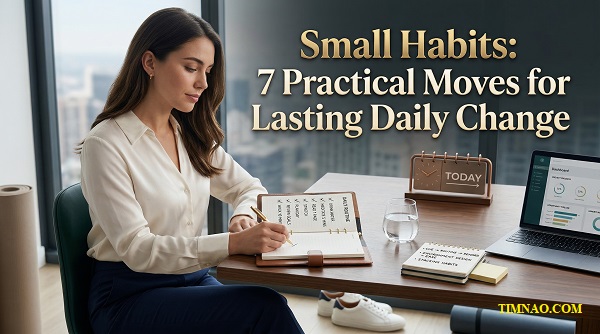
Small Habits, Hopeful Momentum: A Powerful Guide to Big Results
Small habits can completely change the way you work, save money, and stay consistent without forcing a huge life reset. If you often start strong and quit after a few days, this guide will show you a simpler way to build routines that fit real life.
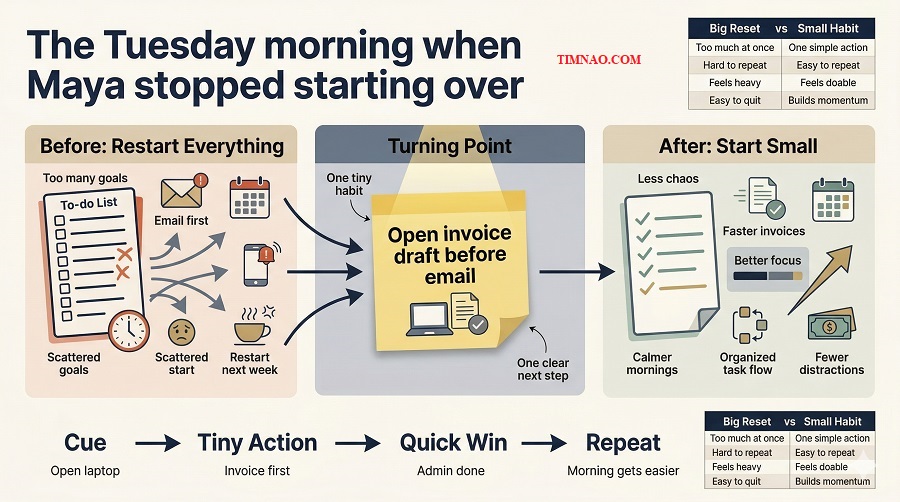
The Tuesday morning when Maya stopped “starting over”
Why her big reset kept failing
Maya did what a lot of beginners do when they get serious about changing their life: she tried to fix everything in one shot.
On Monday night, her plan looked perfect on paper. Wake up earlier. Exercise. Drink more water. Stop checking her phone first thing. Make a healthy breakfast. Answer client emails faster. Spend less. Sleep earlier. Read before bed. No excuses.
By Tuesday morning, the whole plan was already wobbling.
She snoozed her alarm twice, opened social media before getting out of bed, skipped breakfast, and started her workday feeling behind. By lunchtime, she had that familiar thought again: I’ll restart properly next week.
That cycle is more common than people admit. The problem is usually not a lack of ambition. It is a plan that asks for too much change at once.
Maya was not lazy. She was overloaded. She had freelance work, scattered admin tasks, and a desk full of unfinished little things that kept draining her attention. Her “fresh start” routine was too big for a real Tuesday.
That matters because failed resets are expensive in quiet ways. They cost time, confidence, and often money too.
When you keep restarting:
- important work gets delayed
- small admin tasks pile up
- follow-ups happen too late
- stress triggers impulse spending
- you begin to doubt yourself, even when the real issue is the system
The tiny shift that actually changed her day
Maya’s turning point was not a dramatic breakthrough. It was one tiny habit tied to one real problem.
Her biggest daily pain point was avoiding client admin in the morning. She would check messages, jump between tabs, get distracted, and postpone simple tasks like sending invoices or confirming deadlines. That delay created cash flow stress later.
So instead of rebuilding her whole routine, she made one smaller rule:
Before opening email, open the invoice and task list for five minutes.
That was it.
No complicated tracker. No motivational wallpaper. No “new life” checklist.
Just one tiny action, placed at the start of the workday.
At first, five minutes did not look impressive. But it did three useful things right away:
- It reduced mental clutter before the day got noisy.
- It helped her spot overdue admin before it became a problem.
- It gave her one quick win early in the morning.
Within a couple of weeks, she noticed something interesting. She was not magically more disciplined. She was simply starting the day with less chaos.
That had a ripple effect.
Because invoices were going out faster, payments arrived with less delay. Because admin was handled earlier, she had more clean time for client work. Because she felt more in control, she made fewer stress-driven choices later in the day.
This is where small habits become practical, not just inspirational.
A tiny habit can lead to:
- faster payments
- fewer forgotten tasks
- better focus
- lower stress
- more trust in yourself
For beginners, that is the real promise. Not overnight transformation. A small action that makes tomorrow easier than today.
What beginners can learn from Maya’s morning
Maya’s story works because it follows three beginner-friendly rules.
Start with friction, not fantasy
Do not ask, “What would my ideal life look like?”
Ask, “What is the one repeated point of friction in my day?”
That question gives you a better starting point.
Maybe your real friction is:
- checking your phone before work
- skipping lunch and ordering expensive takeout
- forgetting to follow up with leads
- leaving your workout to “later”
- ending the day without planning the next one
A habit that removes friction is much more likely to stick than a habit that only sounds impressive.
Shrink the habit until it feels easy
Beginners often fail because their first habit is too large.
A better target is something so small that it feels almost too simple:
- 5 minutes of planning
- 1 follow-up message
- 1 glass of water
- 10 minutes of focused work
- 2 minutes of stretching
Small does not mean weak. It means repeatable.
And repeatable actions are what build results.
Tie the habit to a real outcome
The fastest way to stay interested in a habit is to connect it to something you care about in real life.
Not “because I should.”
But:
- because I want fewer late fees
- because I want more paid work
- because I want calmer mornings
- because I want to stop feeling behind
- because I want to trust myself again
That shift matters. When a habit is linked to a visible benefit, your brain stops treating it like a random chore.
The habit loop that makes change easier to repeat
Cue, routine, reward in plain English
A habit feels mysterious until you break it into parts.
Most habits follow a simple loop:
- Cue: the trigger that starts the action
- Routine: the action itself
- Reward: the benefit your brain connects to that action
This sounds technical, but it is easy to spot in normal life.
Take afternoon snacking:
- Cue: feeling tired at 3 p.m.
- Routine: grabbing something sugary
- Reward: quick comfort or energy
Or phone checking:
- Cue: a boring moment or a hard task
- Routine: opening social media
- Reward: distraction or relief
Once you see this loop, habits stop looking like personality traits. They start looking like patterns.
That is good news, because patterns can be changed.
Why repetition matters more than motivation
Many beginners think habits are built by feeling motivated enough, long enough.
In reality, habits are usually built by repetition.
When you repeat the same action after the same cue, your brain starts to save effort. It learns the sequence. Over time, the routine becomes more automatic.
This is why a tiny repeated action can outperform a big emotional promise.
For example:
- reading 3 pages every night often works better than planning to read a book every weekend
- a 10-minute walk after lunch often lasts longer than a big fitness challenge
- sending 1 outreach message a day often beats waiting for a “deep work day” to do 20 at once
The more often you repeat the loop, the less internal debate you need.
That is especially useful when life is busy. You do not want every good behavior to require a full motivational speech.
Why cravings and relief keep habits alive
A habit does not survive because the action is perfect. It survives because the reward feels meaningful.
Sometimes the reward is obvious, like enjoying a snack. Sometimes it is subtle, like relief, completion, or a sense of control.
That is why some unhelpful habits are so sticky. They solve a feeling fast.
Scrolling can relieve discomfort. Online shopping can create a quick emotional lift. Avoiding a task can briefly reduce stress.
The same principle can work in your favor.
If you want a good habit to stick, make sure it gives you something your brain cares about:
- a visible checkmark
- a cleaner desk
- a calmer mind
- a finished task
- a sense of momentum
This is also why “just use willpower” advice fails so often. If a bad habit gives quick relief and a good habit feels dull, the old pattern usually wins.
A better move is to redesign the loop so the better habit feels easier and more satisfying.
How to build a simple habit loop that actually works
If you are starting from scratch, use this beginner-friendly formula:
- Choose one cue you already encounter daily.
After coffee. After lunch. When you sit at your desk. After brushing your teeth. - Choose one routine that is small enough to repeat.
Two minutes of budgeting. Five minutes of writing. One glass of water. One follow-up email. - Choose one immediate reward.
Mark it done. Enjoy a coffee afterward. Use a tracker. Take a small pause and notice that you completed it.
Here is a practical example:
Goal: stop feeling financially disorganized
Cue: after dinner
Routine: check spending for two minutes
Reward: mark the day complete on a tracker
Or this one:
Goal: get more client work
Cue: after opening your laptop
Routine: send one pitch or follow-up
Reward: add it to your outreach count for the week
This works because it removes vagueness. You are not hoping to “be more organized” or “market yourself more.” You are building a loop your brain can actually learn.
A quick check before you commit
Before you lock in a new habit, test it with these three questions:
- Is the cue obvious?
- Is the routine small enough for a messy day?
- Is the reward immediate enough to feel real?
If the answer to any of those is no, adjust the habit before expecting consistency.
That small adjustment can save you weeks of frustration.
Why habit stacking works better than waiting to feel ready
Waiting for the right mood usually delays change
A lot of people think they need the right moment before starting.
When work calms down.
When the house is less messy.
When Monday comes back around.
When motivation returns.
The problem is that life rarely becomes perfectly convenient.
If your habit depends on a special mood, it will keep getting postponed.
That is why habit stacking works so well. It does not ask you to find extra motivation or extra time. It attaches the new habit to something you already do.
Instead of saying, “I’ll meditate when I feel ready,” you say, “After I brush my teeth, I’ll sit quietly for two minutes.”
Now the habit has a place to live.
Habit stacking borrows structure from your real life
Habit stacking means linking a new behavior to an existing routine.
The formula is simple:
After I do [current habit], I will do [new small habit].
That matters because existing habits are already stable. They already happen with little effort. When you attach a new action to one of them, you make remembering easier.
For beginners, this is one of the most practical ways to reduce resistance.
Examples:
- After I make coffee, I will review my top 3 tasks.
- After I sit at my desk, I will work for 10 minutes before opening social media.
- After lunch, I will walk for 5 minutes.
- After I brush my teeth, I will stretch for 2 minutes.
- After dinner, I will check my spending.
Notice what these all have in common: they use a real anchor.
Not “later.”
Not “sometime tonight.”
Not “when I feel focused.”
A real action is much better than a vague intention.
Why it works especially well for beginners
Habit stacking is powerful for beginners because it solves three common problems at once.
It removes the “when”
One of the biggest reasons habits fail is that the timing is fuzzy.
You want to read more, save more, move more, post more, or plan better. But when exactly?
A stack answers that immediately.
It reduces mental effort
When the new habit is connected to something automatic, you do not need to keep deciding whether to do it.
That matters because decision fatigue is real. By the end of the day, even useful habits can feel heavier than they should.
It makes consistency easier than intensity
Beginners often overvalue big effort and undervalue stable rhythm.
Habit stacking flips that.
It helps you do small useful things often enough for them to become part of who you are.
Three simple habit stacks you can try this week
If you want a practical starting point, copy one of these and adjust it to your life.
For better focus
After I open my laptop, I will work on my most important task for 10 minutes before checking messages.
For better money habits
After dinner, I will review today’s spending for 2 minutes.
For better energy
After lunch, I will walk for 5 minutes instead of scrolling on my phone.
The goal is not to pick the most impressive stack. The goal is to pick the one you are most likely to repeat.
And once that starts to feel normal, you can build from there.
That is where the real momentum begins: not when you finally feel fully ready, but when a small habit becomes easy enough to survive ordinary life. From here, the next step is to look more closely at the routines you already have and decide which ones are helping you move forward and which ones quietly keep pulling you back.
Build an environment that makes the right move obvious
Stop blaming yourself for a setup that keeps pushing you off track
A lot of people think habit problems are discipline problems.
Sometimes they are not.
Sometimes the real issue is that your environment keeps steering you toward the wrong move. Your phone is always face-up on the desk. Snacks are easier to reach than fruit. Your notes are buried under random papers. Your budget app is hidden, but shopping tabs are open. Your walking shoes are in a cupboard, while the sofa is ready and inviting.
In that kind of setup, even good intentions have to fight too hard.
That is why environment design matters so much. If you make the right move obvious, you lower the effort needed to start. And for beginners, that is often the difference between “I should do this” and “I actually did it.”
Think of it this way: habits do not just live in your mind. They live in your room, your desk, your kitchen, your phone, and your calendar too.
Remove friction from the habit you want to keep
If a good habit feels annoying to start, you will postpone it more often than you think.
The easiest fix is to reduce friction before the moment of action.
Here are simple examples:
- Want to drink more water? Put a filled bottle on your desk before work starts.
- Want to read more? Leave the book on your pillow, not on a shelf across the room.
- Want to spend less? Delete saved card details from shopping sites.
- Want to exercise in the morning? Put your clothes and shoes out the night before.
- Want to write or study? Open the document you need before you stop working for the day.
These changes look small, but they do something powerful: they shorten the distance between intention and action.
That matters because beginners often fail at the starting line, not in the middle. The habit does not break because the task is impossible. It breaks because the first step feels inconvenient.
A good test is this: when the moment comes, can you begin in under 10 seconds?
If the answer is no, simplify the setup.
Make bad habits slightly harder, not dramatically impossible
You do not always need perfect self-control. Sometimes you just need one extra layer of inconvenience.
For example:
- Put distracting apps in a folder instead of on your home screen.
- Keep sweets out of sight instead of on the counter.
- Move the TV remote away from the sofa.
- Log out of shopping accounts after each order.
- Keep your phone off your desk during focused work.
Notice the pattern. You are not trying to build a prison around yourself. You are just making the unhelpful option less automatic.
That tiny pause matters.
A bad habit often wins because it is fast, familiar, and effortless. When you slow it down even slightly, you create a space where a better choice can enter.
For someone trying to save money, this can reduce impulse purchases.
For someone trying to protect work time, it can reduce mindless checking.
For someone trying to eat better, it can reduce “I just grabbed what was there” decisions.
The goal is not perfection. The goal is to stop making the wrong move the easiest move in the room.
Use visible cues that quietly pull you forward
A good environment gives reminders without needing motivation speeches.
Visible cues work because they keep your goal in front of you in a light, practical way.
That could be:
- a sticky note with today’s one priority
- a checklist on the fridge
- a budget number on a whiteboard
- a yoga mat already unrolled in a corner
- a notebook open on your desk
- a simple meal plan taped inside a cupboard door
These cues should be obvious, not decorative.
If you are trying to improve your money habits, a visible savings target can keep your spending decisions grounded. If you are trying to protect work time, a printed “top task before inbox” reminder can save your morning from disappearing. If you are trying to build a healthier routine, keeping good food visible and convenient often works better than promising yourself you will “be better this week.”
Your space does not have to be beautiful. It has to be useful.
Keep the setup flexible as your life changes
One reason people quit good habits is that they keep using a system that no longer fits their life.
A routine that worked during a quiet month may stop working during a busy season. A workspace that helped you focus last month may feel messy and draining now.
That does not mean you failed. It means your setup needs an update.
Once a week, ask:
- What habit felt easy this week?
- What habit felt harder than it should?
- What in my environment helped?
- What in my environment got in the way?
This keeps your system alive. A useful environment is not static. It evolves with your goals, schedule, and energy.
Small habits that improve money, time, and opportunity
Start with habits that create a visible return
Not all small habits are equally useful.
If you are busy, start with habits that improve one of these three areas:
- money
- time
- opportunity
That gives your effort a practical return. You are not building random routines just to feel productive. You are choosing habits that make daily life work better.
A simple rule helps here: if a habit does not improve something you can feel or measure, it is easier to drop.
Let’s break this down.
Small habits that help you keep more money
A lot of people focus only on earning more and ignore the money they leak through disorganization.
That is where tiny financial habits can help.
Good beginner examples include:
- Check spending for two minutes after dinner
This helps you notice patterns before they become monthly regrets. - Review subscriptions once a month
One quiet audit can save more than a week of “trying to be careful.” - Plan three simple meals before the week starts
This cuts panic spending on takeout and random grocery trips. - Move a small amount to savings automatically
Even a modest automatic transfer builds the habit of paying yourself first.
These habits matter because they reduce preventable losses. They do not need to be dramatic to be useful.
Saving an extra amount each week may not feel exciting today. But over a few months, it can create emergency breathing room, reduce debt pressure, or free up money for tools, training, and better decisions.
Small habits that help you protect time
Time loss is often hidden inside little gaps: a slow start, too much switching, endless checking, small delays that turn into a tired evening.
That is why time habits are so valuable.
Practical examples:
- write tomorrow’s top 3 tasks before ending the workday
- start your first task before opening messages
- use a 10-minute tidy-up reset after work
- batch small admin tasks at one fixed time
- spend five minutes preparing for the morning before bed
These habits do not just make you feel organized. They reduce restart time.
And restart time is expensive.
When you lose 15 minutes here, 20 minutes there, and 30 minutes to indecision later, you are not just losing time. You are losing focus, consistency, and often the energy needed for higher-value work.
A five-minute planning habit can easily return far more than five minutes the next day.
Small habits that create better opportunities later
Some habits do not produce money today. They make you easier to trust, easier to hire, or better positioned when an opportunity appears.
That is still valuable.
Examples include:
- sending one follow-up message each workday
- adding one strong work sample to your portfolio each week
- writing down ideas after client calls
- reading 10 pages in your field
- updating one section of your profile or resume each month
These habits build assets.
An asset can be:
- skill
- proof of work
- clarity
- consistency
- visibility
- credibility
This is important for beginners because opportunities rarely arrive as rewards for “potential.” They usually go to people who look ready, respond clearly, and have something to show.
One small weekly improvement may not feel big. But ten weeks later, you may have a cleaner portfolio, a stronger pitch, better follow-up habits, and more confidence in conversations that matter.
How to choose the right habit for your current season
Do not try to build money habits, productivity habits, fitness habits, content habits, and home habits all at once.
Pick the category that solves the most expensive problem in your life right now.
Ask yourself:
- Am I losing money through disorganization?
- Am I losing time through poor planning?
- Am I missing opportunities because I am not visible or prepared?
Then choose one habit that gives the fastest useful return.
For example:
- If money feels tight, start with a spending or meal-planning habit.
- If your days feel scattered, start with a planning or task-start habit.
- If your growth feels stuck, start with a habit that builds skill or visibility.
That is how small habits become strategic, not random.
A simple small habits workflow for busy beginners
Use one problem, one habit, one anchor
When people are overwhelmed, they often make one of two mistakes: they either do nothing, or they build a complicated system they cannot maintain.
A better option is a small habits workflow that is simple enough to use on a normal week.
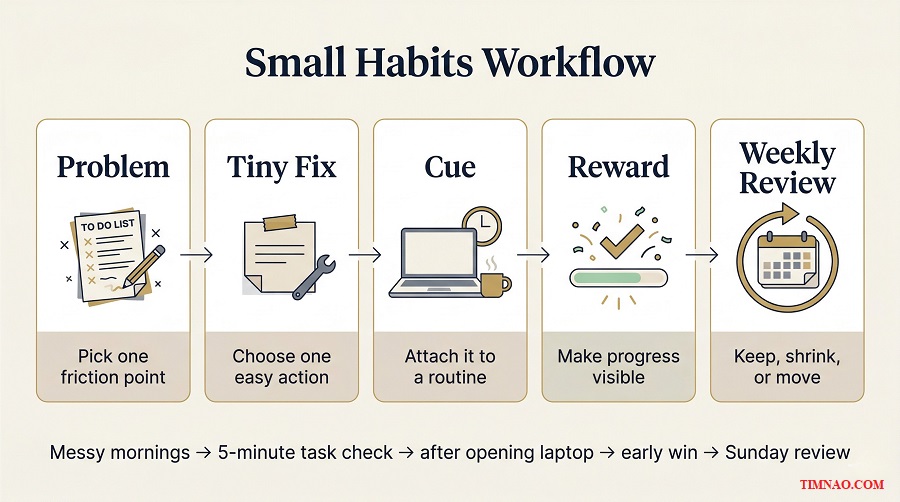
Start with this formula:
one problem -> one habit -> one anchor
That means:
- choose one real problem
- match it to one small habit
- attach it to one clear moment in the day
Here is an example:
- Problem: I keep forgetting important admin tasks.
- Habit: Spend five minutes checking them.
- Anchor: Do it right after opening my laptop.
That is simple, specific, and realistic.
Step 1: Pick the friction point, not the dream version
Do not begin with “I want to become my best self.”
Begin with the repeated friction point.
Maybe it is:
- messy mornings
- impulse spending
- slow work starts
- skipped workouts
- forgotten follow-ups
- cluttered evenings
Your first habit should remove friction, not perform ambition.
That is why “write for five minutes after coffee” usually works better than “become a morning writing person.” One solves a real starting problem. The other sounds good but gives you nothing concrete to do.
Step 2: Shrink the habit until it survives busy days
A strong beginner habit should still work on a low-energy Wednesday.
That means it should be:
- clear
- short
- easy to start
- realistic without extra motivation
Good examples:
- 2 minutes of tracking spending
- 5 minutes of planning tomorrow
- 10 minutes of focused work before email
- 1 follow-up message
- 1 page of reading
- 1 healthy lunch prepared in advance
If the habit only works when you feel inspired, it is too large.
Step 3: Decide how you will track proof
Tracking keeps a new habit from feeling invisible.
You do not need a complicated app. Use the simplest tool you will actually keep using:
- a notebook
- a wall calendar
- a checklist
- a note on your phone
- Google Sheets
- Trello
What matters is not the tool. It is the proof.
You want to be able to see:
- Did I do it?
- How often?
- Is it helping?
That simple feedback loop gives you something solid to work with instead of vague feelings.
Step 4: Review once a week and adjust without drama
At the end of the week, do a quick review.
Ask:
- Did I actually do the habit?
- Was the timing right?
- Did it make life easier?
- What needs to change next week?
Sometimes the best adjustment is to make the habit smaller. Sometimes it is moving it to a better time. Sometimes it is changing the environment around it.
The key is to review without turning it into self-criticism.
You are not collecting evidence that you are bad at habits. You are testing a system.
That mindset makes a huge difference. It keeps you learning instead of restarting from zero every few days.
A busy-beginner workflow you can copy this week
If you want a plug-and-play version, use this:
- Choose one daily problem that keeps repeating.
- Define one tiny habit that would reduce it.
- Attach it to something you already do.
- Prepare the environment the night before if needed.
- Track one checkmark each day.
- Review after seven days.
That is enough.
It may not look impressive on paper, but it works because it respects real life. And once one habit starts holding, the next section becomes easier to build. From there, the conversation naturally shifts from setting up good habits to protecting them, avoiding common mistakes, and turning early progress into something that lasts.
Four real-world ways to apply this this week
If you have no audience and almost no spare time
This is the situation a lot of beginners are in, even if they do not say it out loud.
You want to improve your life, earn more, or build something useful, but your schedule already feels full. You do not have a big following, a polished brand, or hours of free time. By the end of the day, you mostly want to switch off.
That is exactly why small habits matter here.
When your time is limited, the goal is not to create a perfect routine. The goal is to create one tiny action that keeps you moving forward, even on ordinary days.
A practical starting point is this:
- Choose one direction: learning, earning, or organizing
- Give it 10 minutes
- Attach it to a fixed moment
For example:
- after dinner, spend 10 minutes improving one skill
- after opening your laptop, spend 10 minutes on one work sample
- before bed, spend 10 minutes planning tomorrow instead of scrolling
That may sound modest, but it works because it gives you consistency without asking for a dramatic lifestyle change.
A beginner-friendly weekly version could look like this:
- Pick one useful skill or project.
- Work on it for 10 minutes a day.
- Keep a simple record of what you finished.
Your first measurable win does not need to be huge. It might be:
- one updated profile section
- one finished portfolio sample
- one better budget sheet
- one cleaner morning routine
- one week where you actually kept the promise to yourself
That matters more than it sounds. Small completed actions build trust in yourself, and self-trust makes the next week easier.
If you are a freelancer or creator trying to earn more consistently
For freelancers and creators, small habits work best when they protect two things:
- visibility
- follow-through
A lot of income problems are not talent problems. They come from uneven outreach, slow follow-up, forgotten admin, or inconsistent publishing. That is good news, because those are all problems small habits can help solve.
If this sounds familiar, do not try to “be more productive” in a vague way. Pick one habit that helps bring work in, and one habit that keeps work moving.
A simple weekly setup could be:
- After checking email, send one pitch, follow-up, or check-in
- Before ending the day, spend five minutes on invoices, deadlines, or client notes
These habits are small, but they touch real outcomes.
One extra follow-up can lead to:
- a reply from an old lead
- a faster decision from a prospect
- a reminder to a client who meant to pay
- a clearer relationship with someone who may hire again
And five minutes of admin can save you from:
- missed invoices
- unclear deadlines
- unnecessary stress
- scrambling later in the week
The first measurable win here is often surprisingly small and surprisingly important:
- one reply
- one discovery call
- one invoice sent earlier
- one smoother project week
That is how momentum starts in real business life. Not with a giant reinvention. With habits that reduce revenue friction.
If you run a small business and need better systems, not more chaos
Small business owners often carry too much in their heads.
Sales, customer questions, payments, content, operations, supplier issues, planning, and the hundred tiny decisions that fill the gaps between everything else. In that kind of environment, habits are most useful when they reduce decision fatigue.
The smartest move is usually not “do more.” It is “make repeated important actions easier to repeat.”
Good small business habits often live in one of these areas:
- lead follow-up
- numbers review
- customer care
- operational tidiness
For example:
- review new leads at the same time each weekday
- check one key number twice a week
- confirm tomorrow’s priority before leaving work
- spend 10 minutes cleaning up operational loose ends every afternoon
These habits help because they stop important work from becoming random work.
A beginner business owner might think, “I already know I should follow up faster.” But knowing is not the same as having a repeated trigger that makes it happen.
A stronger version looks like this:
- At 4:00 p.m., review new leads for 10 minutes
- On Tuesday and Friday, check one key metric
- Before closing the shop or laptop, write tomorrow’s first task
Your first measurable win may be:
- fewer forgotten leads
- quicker replies
- clearer daily direction
- fewer surprises in your numbers
And once those basics improve, your business feels less reactive. That gives you more room to make better decisions instead of constantly cleaning up avoidable messes.
If your week is unpredictable and routines keep breaking
Some people do not need a more ambitious habit plan. They need a more flexible one.
If your week changes a lot because of family demands, shift work, health, caregiving, study, or irregular client deadlines, strict routines can fail quickly. Not because you are inconsistent, but because the routine is too fragile.
The answer is not to give up on habits. It is to build habits with a minimum version.
A minimum version is the smallest form of the habit that still counts.
For example:
- full version: 30-minute walk
minimum version: 5-minute walk - full version: detailed budget review
minimum version: log today’s spending in one line - full version: one hour of learning
minimum version: read one page or watch five minutes of a lesson - full version: full inbox reset
minimum version: answer one important email
This changes everything because it protects continuity.
When life gets messy, most people either skip the habit entirely or feel like they failed. A minimum version keeps the habit alive without pretending your schedule is always ideal.
That is often the real win.
You do not need a routine that looks impressive online. You need one that survives your actual week.
If your schedule is unpredictable, try this rule:
- Define the normal version.
- Define the minimum version.
- Decide in advance when the minimum version is allowed.
- Count both as keeping the habit alive.
That one adjustment can stop the stop-start cycle that makes progress feel impossible.
The setbacks that quietly break momentum
Going too big too early
This is one of the most common reasons people lose momentum.
The habit sounds exciting at the beginning, but the size of it quietly creates resistance. A 45-minute morning routine. A total spending reset. A daily content system. A perfect meal plan. A full evening shutdown process.
None of those are bad in themselves. They are just often too large for the first step.
When a habit is too big, you do not only skip it more. You also start associating it with pressure. That makes returning to it harder every time.
A better rule is simple: make the first version smaller than your ego wants.
That could mean:
- 5 minutes instead of 30
- 1 follow-up instead of 10
- 1 healthy lunch prepared instead of a full weekly prep
- 2 minutes of planning instead of a whole productivity system
Smaller habits feel less impressive, but they are more repeatable. And repeatability is what creates results.
Expecting motivation to carry the whole process
Motivation helps you start. It usually does not help you continue for long.
The problem comes when people mistake a motivated day for a working system. They feel inspired, do a lot, and assume that same energy will appear tomorrow.
Usually, it does not.
That is why habits need structure more than emotion. A clear cue, a small action, and a simple setup will carry you farther than waiting to feel inspired again.
If you notice that your progress only happens on “good days,” your system is probably too dependent on mood.
A stronger setup asks:
- what will I do when I am busy?
- what will I do when I am tired?
- what will I do when I do not feel like it?
If you have no answer to those questions, the habit is not ready yet.
Missing a few days and turning it into a full reset
This is where a lot of good momentum disappears.
One missed day becomes three. Three becomes “this week is ruined.” Then comes the familiar promise to restart on Monday, next month, or after life gets calmer.
That reset mindset feels logical in the moment, but it is one of the fastest ways to make habits feel fragile.
A better approach is this:
- do not treat a missed day as proof
- do not turn a wobble into a story about yourself
- restart at the next available moment
That might mean:
- missing your evening planning habit and doing it the next morning
- skipping a walk and taking the five-minute version later
- forgetting to log spending and picking it back up after dinner tomorrow
The habit stays stronger when your identity stays calm.
You are not trying to prove that you never slip. You are trying to prove that you return faster.
Tracking too much and making the system heavier than the habit
Tracking can help. Overtracking can quietly kill momentum.
This happens when the habit itself is small, but the tracking becomes a separate project. Suddenly you are maintaining color-coded dashboards, extra apps, detailed categories, and daily reviews for something that should take two minutes.
The result is predictable: the system becomes harder to maintain than the habit it was meant to support.
A better option is to track only what you need to answer three questions:
- Did I do it?
- How often?
- Is it helping?
For many beginners, a simple checkmark is enough.
If you make the system too elaborate too soon, you risk turning progress into admin. That is one of the quietest ways momentum gets lost.
Keeping the environment the same and hoping behavior changes anyway
You can have a strong intention and still keep running into the same triggers.
If your phone stays beside you while you work, distractions stay easy. If convenient junk food remains visible, your eating decisions stay harder. If your work tools are buried under clutter, focus keeps costing more effort than it should.
This matters because habits do not happen in a vacuum. They happen inside a setup.
If the setup keeps rewarding the old behavior, the new one has to work too hard to survive.
That is why small environment changes are not optional extras. They are often part of the habit itself.
Sometimes the best habit fix is not more discipline. It is:
- putting the notebook on the desk
- moving the phone away
- opening tomorrow’s file in advance
- laying out the clothes the night before
- deleting saved payment methods
When momentum keeps breaking, look at the room, not just the goal.
A 7-day sprint to make your first habit stick
Day 1: Choose the one habit that solves a real problem
Start with one habit only.
Not three. Not a morning routine bundle. Not a life reset.
Choose one small behavior that improves a repeated point of friction.
Good examples:
- check spending for two minutes after dinner
- write tomorrow’s top three tasks before bed
- send one follow-up after opening email
- walk for five minutes after lunch
The best first habit is not the most impressive. It is the one most likely to make daily life easier.
Before you move on, finish this sentence:
This habit matters because it will help me __________.
That keeps the habit connected to a real outcome.
Day 2: Attach it to a clear anchor
Now decide exactly when the habit happens.
A vague plan is one of the fastest ways to lose a good idea. “Later” is not an anchor. “When I have time” is not an anchor either.
Use something concrete:
- after coffee
- after brushing my teeth
- after lunch
- after opening my laptop
- before turning off the lights
This is where many habits become more realistic immediately. The action now has a home.
If you cannot describe the starting moment clearly, the habit is still too loose.
Day 3: Prepare the environment before the moment arrives
Do not wait until the habit window opens to get ready.
Make the first step obvious in advance.
That could mean:
- leaving the budget notebook on the table
- placing walking shoes by the door
- opening the task list before ending work
- putting a water bottle on your desk
- moving your phone away from your work area
The simpler the opening move, the easier it is to begin without resistance.
This step matters because a lot of habits fail before they start. Not because people change their minds, but because the setup is too inconvenient at the exact moment of action.
Day 4: Do the smallest complete version
Today is not about proving ambition. It is about proving repeatability.
Do the habit in its smallest full form.
Examples:
- one follow-up email
- two minutes of expense logging
- five minutes of walking
- one page of reading
- three minutes of planning
Then stop.
This is important. A lot of beginners sabotage themselves by doing the habit once and then immediately expanding it into something harder. That creates hidden pressure for tomorrow.
You are not testing your maximum effort. You are teaching your brain that the habit is safe, short, and doable.
Day 5: Notice the first useful result
By now, you want to start seeing what the habit changes.
Ask yourself:
- Did this save time?
- Did it reduce stress?
- Did it make tomorrow easier?
- Did it help me avoid a mistake?
- Did it move money, work, or energy in a better direction?
Write down one concrete benefit.
For example:
- “I knew what to do first this morning.”
- “I noticed an unnecessary subscription.”
- “I finally sent the invoice.”
- “I felt less behind after lunch.”
- “I did not waste the first half hour of work.”
These small results are what make habits feel worth keeping.
Day 6: Test the habit on a messy day
Today, assume life will not be ideal.
Maybe you are tired. Maybe work runs late. Maybe your mood is flat. Maybe the day simply gets away from you.
That is not a problem. It is part of the test.
Use one of these questions:
- What is the minimum version today?
- What would still count?
- How can I keep the chain alive without making this harder than it needs to be?
This is where habits become durable.
A habit that only works in perfect conditions is not ready for real life. A habit that survives a messy day starts to become part of you.
Day 7: Review, keep, shrink, or adjust
At the end of the week, do a quick review.
Ask:
- Did I do the habit more days than not?
- Was the timing natural?
- Did the habit solve the problem I picked?
- What made it easier?
- What made it harder?
Now choose one of four options:
- Keep it as it is if it felt doable and useful
- Shrink it if it still felt heavy
- Move it if the timing was wrong
- Swap the cue if you kept forgetting it
This review should feel practical, not emotional.
You are not grading your worth. You are refining a small system.
And that is the real lesson of the week: habits stick better when you build them like a working setup, not a personality test.
What Matters Most as You Build Better Habits
- Start with one small habit that solves one real daily problem, not a full personal reset.
- Choose habits that improve money, time, or opportunity, so the benefit feels practical and visible.
- Use anchors and environment design to make the right move easier than the old default.
- Build a minimum version of the habit for busy or unpredictable days, so progress does not collapse when life gets messy.
- Expect setbacks, but do not turn them into full resets. The goal is to return quickly, not stay perfect.
- Keep tracking simple. A habit needs proof and consistency, not a complicated management system.
- A 7-day sprint works because it helps you test a habit in real life, adjust it fast, and keep only what actually fits.
Enjoyed this article and found it helpful? ☕✨
You can support my work and help me create more practical content like this here: [Buy Me a Coffee](https://timnao.link/coffee) 💛