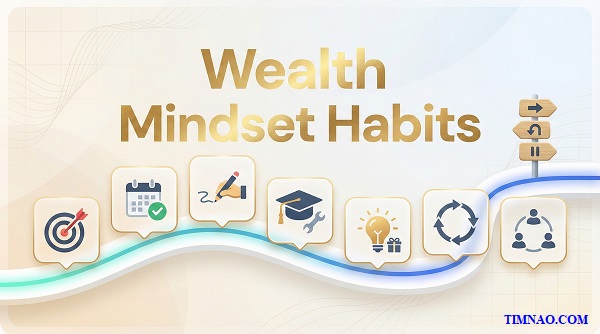
Wealth Mindset Habits That Feel Real: A Powerful, Hopeful Career Playbook 🚀
If you’ve ever read a classic success book and thought, “This is inspiring… but what do I actually do on Monday?” — you’re not alone.
This article takes the best timeless ideas from old-school success thinking (like setting a clear aim, building belief through action, and sticking with a plan) and upgrades them for modern life: jobs, freelancing, side income, and building a career you’re proud of.
You’re going to learn wealth mindset habits that don’t require hype, luck, or pretending you’re “positive” 24/7. Just practical moves a beginner can start using immediately.
By the end, you’ll have:
- a one-sentence career goal that actually guides your week,
- a simple system to turn that goal into daily actions,
- and a realistic plan to build momentum without burning out.
The “Desire Upgrade”: from vague wanting to a measurable target you can hit
If you’ve ever said, “I just want to earn more,” you’re not alone. It’s a normal thought. The problem is that your brain can’t work with it.
Vague goals create vague days.
A beginner-friendly way to build wealth mindset habits is to stop treating money and career growth like a wish—and start treating them like a project. Not a stressful project. A clear one.
Here’s the upgrade that changes everything:
Desire becomes useful when it has a number, a deadline, and a trade.
1) The Number: pick a target your brain can measure
A number removes the fog. It tells you when you’re moving—and when you’re not.
Good beginner targets:
- “Increase my income by $300/month”
- “Save $1,000 in 90 days”
- “Get 2 freelance clients by the end of next month”
- “Move into a new role with +15% salary by September”
Not-so-helpful targets:
- “Be successful”
- “Make a lot of money”
- “Get a better life”
- “Stop being broke”
If choosing a number feels scary, start smaller. The number doesn’t have to be impressive. It has to be real.
A simple rule:
- If you’ve never earned side income before, start with $100–$300/month.
- If you’re already earning, choose a target that feels like a stretch but not impossible.
2) The Deadline: choose a time window that creates focus (not panic)
Deadlines are not punishment. They’re a finish line.
For beginners, the sweet spot is usually:
- 30 days for “proof” (samples, portfolio, first outreach)
- 60–120 days for money results (income increase, promotion path, job switch progress)
Try this:
- If you’re building a new skill: set a 90-day goal.
- If you’re improving at work: set a 60-day “visibility + performance” goal.
- If you’re doing a side gig: set a 30-day “first revenue” goal.
3) The Trade: decide what you’ll give in return (this is where it gets real)
This is the part most people skip, then wonder why nothing changes.
Money rarely shows up because you “want it badly.”
Money shows up when you trade value.
Common “trades” that actually work:
- Time (consistent effort every week)
- Skill (learning something that solves a real problem)
- Performance (doing measurable work people can trust)
- Distribution (marketing, outreach, networking, visibility)
Your trade doesn’t have to be extreme. It just has to be honest.
Examples of clear trades:
- “I’ll trade 6 hours/week to learn and pitch a service.”
- “I’ll trade one visible project at work and weekly updates.”
- “I’ll trade daily practice + 10 applications per week for 8 weeks.”
The 90-second exercise: turn your desire into a “target statement”
Grab a note (paper or Notion). Answer these three lines:
- My target number is: ______
- My deadline is: ______
- My trade is: ______
Then combine them:
“By ______, I will achieve ______ by trading ______ consistently.”
Example:
“By May 30, I will earn $300/month freelancing by trading 5 hours/week for learning, creating proof, and outreach.”
That sentence is not motivational fluff. It’s a steering wheel.
The “desire drift” problem (and how to stop it fast)
A lot of people start strong, then drift after 7–10 days. Not because they’re lazy—because daily life is loud.
Two small habits keep your desire alive without being cringey:
Habit A: Keep your target visible
- Put the target statement on your phone lock screen
- Add it to the top of your daily note
- Write it on a sticky note near your desk
Habit B: Convert desire into one daily “next action”
Ask every morning:
“If I only do one thing today that supports my target, what is it?”
Good “next actions” (small but real):
- Practice a skill for 20 minutes
- Improve one portfolio piece
- Send 2 outreach messages
- Apply to 1 job
- Write 1 short post about your work
This is how desire becomes momentum.
A quick reality check: desire without action becomes frustration
If you’ve been “wanting” something for months, you don’t need more wishing. You need a cleaner system.
Here’s the simplest truth:
- Desire gives direction
- Action gives proof
- Proof creates confidence
- Confidence creates better action
That cycle is the whole game.
Definite Chief Aim, modern version: your one-sentence Career Aim
Once your desire is measurable, the next step is turning it into a sentence that can guide your week.
Classic success advice often calls this a “definite aim.” In modern life, think of it as:
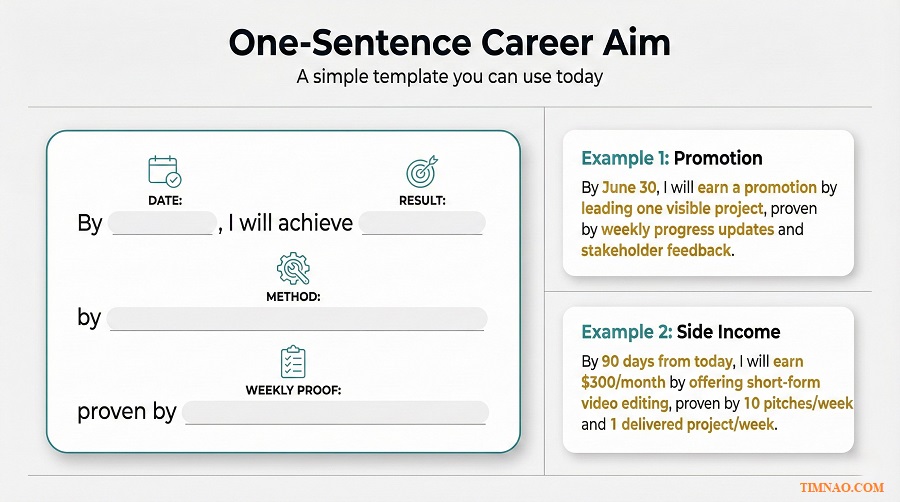
Your one-sentence Career Aim.
It should do three jobs:
- tell you what you’re building,
- tell you how you’ll build it,
- tell you what “progress” looks like weekly.
The one-sentence Career Aim template (beginner-friendly)
Use this:
By (date), I will achieve (result) by (method), proven by (weekly actions).
Examples (employee path):
- “By July 1, I will earn a promotion by leading one project with measurable impact, proven by weekly progress updates and stakeholder feedback.”
- “By May 30, I will increase my salary by 15% by applying to 5 roles/week and completing two portfolio projects.”
Examples (side income path):
- “By June 15, I will earn $300/month by selling video editing as a service, proven by 10 pitches/week and 2 sample edits completed.”
- “By 90 days from today, I will build a $500 emergency fund by doing weekend delivery shifts and saving 100% of tips.”
Examples (career switch path):
- “By September 1, I will switch into a junior analytics role by completing two portfolio projects, proven by 5 applications/week and weekly skill practice.”
The Career Aim must pass the “Tuesday Test”
A good aim answers: What should I do this Tuesday?
If your aim is too vague, you won’t know what to do after the initial motivation fades.
Ask:
- Can I list 3 weekly actions from this aim immediately?
- Can I measure those actions?
- Would a stranger understand what I’m building?
If not, tighten it.
Make it yours: choose one of these “paths” (don’t mix three at once)
Beginners often try to do everything:
- get a promotion,
- start a business,
- learn three skills,
- post content daily…
That usually collapses.
Pick one primary path for the next 60–120 days:
- Grow inside your current job
- best when you have a stable role and want higher pay/position
- Switch jobs for a pay jump
- best when your current company has limited growth or compensation
- Build a side income
- best when you need extra cash or want future freedom
You can still do small maintenance in other areas, but your aim should focus on one lane.
Add “proof” to your aim (this is the part most people miss)
A Career Aim becomes powerful when it includes proof—something you can show.
Proof looks like:
- a shipped project,
- a portfolio piece,
- a measurable improvement,
- feedback from stakeholders,
- a case study of what you changed and the result.
If you want your aim to feel real, add one proof line:
“Proven by: ______.”
Examples:
- “Proven by: 2 portfolio projects on GitHub”
- “Proven by: weekly report showing improved conversion/time saved”
- “Proven by: 10 pitches/week and documented client results”
The “Aim Ladder”: your goal needs a weekly rung
Big goals feel heavy. Weekly goals feel doable.
Turn your aim into a ladder:
- Aim (90 days): result + deadline
- Weekly rungs: 3 commitments
- Daily micro-actions: 1 small step
Here’s a simple ladder example for side income:
- Aim: “$300/month by June 15”
- Weekly rungs:
- create/improve 1 proof item
- practice skill 2–3 times
- send 10 pitches
- Daily micro-action: 20 minutes practice OR 2 pitches
This is how you stop “starting over.”
A short script that makes your aim stick (without sounding like a robot)
You don’t need dramatic affirmations. You need consistent self-direction.
Try this 4-line daily script (morning or evening):
- My aim: ______
- My trade: ______
- This week’s 3 commitments: ______
- Today’s next action: ______
If you want a tool to help draft this, use ChatGPT like a planning assistant—not a motivational poster generator.
Useful prompt:
- “Turn this aim into 3 weekly commitments + daily micro-actions: ____.”
Transition into the next piece
Now you have a measurable desire and a clear Career Aim. Great—but there’s one more decision that makes or breaks everything for beginners:
What exactly are you going to get good at?
That’s where specialized knowledge comes in—and we’ll make it simple so it doesn’t feel overwhelming.
Specialized knowledge (without overwhelm): choose the “one skill that pays”
If you feel overwhelmed by skills, you’re thinking correctly… but choosing incorrectly.
The internet offers infinite options:
- copywriting, design, coding, editing, marketing, analytics, sales, AI tools…
The solution isn’t to learn everything. It’s to choose one skill that pays, then build proof.
Here’s the beginner mindset shift:
Your next level usually comes from one focused skill + consistent proof.
The “one skill that pays” filter (3 questions)
Before you start learning, run the skill through this filter:
- Does it solve a problem people already pay for?
Look for problems that affect:- revenue (sales, conversion, retention)
- time (automation, speed, organization)
- risk (errors, compliance, stability)
- clarity (communication, writing, UX)
- Can I create proof within 14–30 days?
Proof beats certificates.
Proof can be:- one portfolio piece,
- a before/after improvement,
- a sample project,
- a case study.
- Can I keep practicing this skill weekly without hating my life?
If you dread it, consistency dies.
If a skill passes 2/3, it’s usually worth testing.
Match your skill to your path (career vs side income)
Different paths reward different skills.
If you want a promotion (inside your job):
- project management basics
- communication & writing
- stakeholder management
- process improvement
- data reporting (even basic spreadsheets)
Tools you might use:
- Google Sheets for simple dashboards
- Google Calendar for time-blocking and weekly planning
If you want to switch jobs:
- one core hard skill (role-specific)
- plus one “signal” skill that shows professionalism (writing, presentation, portfolio)
If you want side income fast:
Choose skills with:
- fast proof,
- clear output,
- easy communication.
Beginner-friendly examples:
- short-form video editing
- simple landing page design
- basic copywriting for product pages
- resume/LinkedIn optimization
- spreadsheet templates for small businesses
Skill stacking (the calmer way to get “specialized”)
You don’t need to be the world’s best at one thing. You can be “rare” by combining two simple skills.
Examples:
- Design + short-form video
- Writing + basic SEO
- Spreadsheets + business operations
- Customer research + content creation
This is how beginners become valuable faster: you become “the person who can do both.”
The Proof-First method (so you don’t get stuck in endless learning)
Here’s the trap:
- You keep learning…
- but you don’t ship anything…
- so you don’t get feedback…
- so your confidence stays low.
Proof-first flips it:
- Pick one small project
- something you can finish in 2–6 hours total
- Build an “ugly first version”
- don’t aim for perfect, aim for real
- Improve it once
- one round of polishing
- Publish or share
- share with a friend, a community, or a recruiter/client
- Collect feedback
- use feedback to choose what to practice next
Where to show proof (depending on what you do):
- LinkedIn for professional posts and portfolios
- GitHub for code/projects
- Canva for simple visuals and mockups
A simple 4-week beginner plan to build one paid skill
This is intentionally realistic. No heroic schedules.
Week 1: Choose + start
- Choose your one skill using the 3-question filter
- Create one mini project idea
- Do 3 practice sessions (20–30 minutes each)
Week 2: Build proof
- Finish the ugly first version
- Improve it once
- Write 5 bullet points explaining:
- the problem,
- what you did,
- the result (even if simulated),
- what you’d improve next
Week 3: Create a second proof item
- Make a variation (different niche, different format)
- Aim for faster completion than Week 2
Week 4: Add outreach (light, but consistent)
Choose one:
- Apply to 5 roles
- Send 10 pitches
- Message 5 people asking for feedback
This is how skill becomes opportunity.
What to do if you still can’t pick a skill
Use this “shortlist method”:
- Write 5 skills you’re considering
- Score each 1–5 on:
- Paid demand
- Speed to proof
- Interest/energy
- Choose the highest total and commit to 14 days of testing
Fourteen days is short enough to feel safe—and long enough to learn something real.
Imagination, updated: create a value offer (not a fantasy)
When people hear “imagination” in old-school success advice, they often picture vision boards and big dreams.
There’s nothing wrong with dreaming. The problem is when dreaming never turns into something other people can use.
In modern career growth, “imagination” is best translated like this:
Imagination = designing a clear offer that creates value.
An offer isn’t only for freelancers. Employees have offers too:
- “I can lead this project and reduce delays.”
- “I can automate this report and save the team 5 hours/week.”
- “I can improve onboarding so new hires ramp faster.”
If you want better pay, better roles, or side income, you need to answer one simple question:
What do you help people get, and how do you do it?
The Offer Triangle (simple and beginner-safe)
A strong offer has three points:
- Who you help
- What result you help them get
- How you help them get it (your method)
If any point is missing, your offer becomes confusing.
Here’s a beginner template you can steal:
I help (specific person) get (specific result) by (specific method).
Examples (career / employee):
- “I help our team reduce errors by building a simple checklist and dashboard.”
- “I help stakeholders make faster decisions by turning messy data into clear weekly reports.”
Examples (freelance / side income):
- “I help busy creators turn long videos into short clips by editing 10–20 second highlights.”
- “I help local businesses get more bookings by rewriting their service page and improving their Google profile content.”
Notice what’s not there:
- no vague “I help people succeed”
- no “I do everything”
- no fluffy statements that sound nice but don’t guide action
Start narrow (you can widen later)
Beginners often worry:
“If I choose a niche, I’ll miss opportunities.”
Actually, the opposite happens: when you’re clear, people know when to pick you.
Try narrowing with one of these:
- industry (fitness, beauty, local services, ecommerce)
- role type (coaches, real estate agents, cafe owners)
- problem type (editing, reporting, writing, automation)
Start narrow for 30 days. After you get traction, you can expand.
Add “proof” without waiting for permission
A value offer becomes 10x stronger when it includes proof. And proof doesn’t need to be a paid client or a promotion letter.
Beginner-friendly proof options:
- a sample (before/after)
- a mini case study (“here’s the problem, here’s what I changed, here’s what improved”)
- a portfolio item
- a short demo video
- a simple dashboard, checklist, or template
Where to show proof (official platforms):
- LinkedIn for professional proof and posts
- GitHub for technical projects
- Canva for clean visuals and one-page case studies
If you feel stuck, start with one “before/after”:
- Rewrite a messy paragraph into a clear one (writing)
- Turn a cluttered spreadsheet into a neat dashboard (data)
- Cut a long clip into 3 short clips (editing)
- Redesign one section of a landing page (design)
Proof is the bridge between “I think I can” and “Here’s what I can show.”
Make your offer feel real with a “deliverable”
A deliverable is the thing someone gets. It turns your offer from words into a product.
Examples:
- “3 edited short clips + captions”
- “1 resume rewrite + LinkedIn headline”
- “weekly dashboard + 10-minute summary”
- “audit + improvement plan”
If you’re employed, your deliverable might be:
- a new process
- a template
- a reporting system
- a documented workflow
- a measurable improvement in a metric
Deliverables make you easier to hire, easier to promote, and easier to pay.
Price and scope without the headache (beginner version)
If you’re freelancing, don’t start with a complicated pricing model. Pick one:
- Starter package (low risk, clear scope)
- Monthly retainer (stable, ongoing)
- Per-project (simple, one-time)
Beginner scope rule:
- Your first offer should be deliverable-based and finishable within 2–6 hours.
That forces clarity. It also prevents you from accidentally offering an entire universe for $50.
Quick exercise: build your first offer in 10 minutes
Open a note in Notion or your phone. Fill this out:
- I help: ______
- To get: ______
- By doing: ______
- Deliverable: ______
- Proof I can create in 7 days: ______
Example:
- I help: busy creators
- To get: more consistent short-form content
- By doing: editing long videos into highlights
- Deliverable: 5 short clips + captions
- Proof: 3 sample clips from public videos
Now you have something you can act on this week.
A natural next step
Once you have an offer, you’ll notice something: your motivation still rises and falls. That’s normal.
So the real question becomes: How do you stay consistent when you don’t feel like it?
That’s where self-suggestion becomes useful—if we keep it behavioral.
The self-suggestion technique that works (because it’s behavioral)
Let’s be honest: most people have tried “affirmations” and felt silly.
The reason they fail is simple:
- They’re too vague
- They don’t connect to action
- They fight your reality instead of guiding your behavior
A more practical approach is this:
Self-suggestion is not about hype. It’s about instruction.
You are training your brain with what you repeat.
If you repeatedly tell yourself:
- “I’m behind”
- “I’m not good at this”
- “I always mess up”
…your brain will start acting like that’s the plan.
The fix is not fake positivity. The fix is behavior-based scripting.
The “Behavior Script” (2 minutes, twice a day)
Use this format. It’s short on purpose:
- Aim: “By ___, I will ___.”
- Trade: “I earn it by ___.”
- This week: “I will complete ___, ___, ___.”
- Today: “My next action is ___.”
That’s it.
If you do this daily, you stop relying on mood. You start relying on direction.
Replace identity-talk with action-talk
Here are the most common unhelpful scripts beginners run:
- “I’m lazy.”
- “I’m not confident.”
- “I’m not talented.”
- “I’m bad at networking.”
Those are identity labels. They create helplessness.
Replace them with action statements:
- “I do 20 minutes even when I don’t feel like it.”
- “I practice, then I publish.”
- “I improve by reps, not by talent.”
- “I send two messages daily.”
Your brain can follow actions. It can’t follow insults.
The “when-then” upgrade (so you don’t quit on bad days)
This is the secret sauce.
Most people write goals for perfect days. Life doesn’t care.
So create when-then rules:
- When I feel tired, then I do the minimum action.
- When I feel scared to share, then I share a smaller version.
- When I want to procrastinate, then I start a 10-minute timer.
Examples of minimum actions:
- 10 minutes of skill practice
- Improve one paragraph / one slide / one clip
- Send one outreach message
- Apply to one job
Minimum actions keep momentum alive. Momentum keeps your aim believable.
How to use self-suggestion without lying to yourself
A lot of affirmations fail because they feel false.
Instead of:
“I am a millionaire.”
Use:
“I am becoming the type of person who ships work weekly.”
Instead of:
“Everything is easy for me.”
Use:
“I do hard things in small steps.”
This feels believable—and belief is important because it affects behavior.
The “evidence journal” (tiny, but powerful)
If you want self-suggestion to stick, give your brain evidence.
Every evening, write 3 proof bullets:
- What did I do today that supports my aim?
- What did I learn?
- What will I do tomorrow?
Example:
- Practiced editing 25 minutes
- Finished sample clip #2
- Tomorrow: send 2 pitches and polish captions
This prevents the classic beginner spiral:
“I did nothing” (even when you did something)
Tools that make this easier:
- Google Keep for quick notes
- Notion for a daily log
Self-suggestion for outreach (the part everyone avoids)
Most people don’t fail at skills. They fail at visibility.
Outreach is uncomfortable. That’s why it works.
Use a script that makes outreach routine, not emotional:
- “I am the type of person who sends 2 messages daily.”
- “I collect ‘no’ as data, not as a verdict.”
- “I don’t wait for confidence. I build it through reps.”
If outreach scares you, shrink it:
- send feedback requests instead of pitches
- ask one simple question
- comment thoughtfully before messaging
A beginner-friendly daily routine (10 minutes total)
This routine builds stability without being dramatic:
Morning (2 minutes):
- Read your Behavior Script once
- Choose today’s next action
Midday (3 minutes):
- Do a quick “reset”: what’s the next action now?
Evening (5 minutes):
- Write 3 proof bullets
- Decide tomorrow’s next action
Consistency becomes a system, not a personality trait.
A natural next step
Once your offer is clear and your behavior script keeps you steady, there’s still one thing that will multiply your results faster than grinding alone:
Other minds.
Not random noise. The right people, in the right structure.
The Mastermind idea, modern version: build a “personal board”
Most career problems feel personal:
- “Why can’t I stay consistent?”
- “Why can’t I pick a direction?”
- “Why does everything feel harder for me?”
But a lot of them are actually social problems:
- you have no feedback loop,
- no accountability,
- and no outside perspective.
A modern “Mastermind” doesn’t need a fancy name. Think of it as:
Your personal board.
A small set of people who help you:
- think clearer,
- move faster,
- and recover quicker when you get stuck.
What a personal board is (and what it’s not)
A personal board is:
- small (1–5 people)
- consistent (weekly or biweekly touchpoints)
- honest (feedback that helps, not flattery)
A personal board is not:
- a big chat group where nobody ships work
- a place to complain without commitments
- a group full of ego battles
The vibe you want is calm, practical, forward-moving.
The 3 roles that make a board work
You don’t need all three, but this structure is helpful:
- The Builder (execution energy)
They help you take action and stop overthinking. - The Strategist (clarity and direction)
They help you choose the right problem, not just work harder. - The Connector (relationships and opportunities)
They help you see people, communities, and doors you didn’t notice.
Sometimes one person covers two roles. That’s fine.
The “1-person board” (if you’re starting from zero)
If you’re shy or isolated, start with one person.
Pick someone who is:
- reliable,
- kind but honest,
- slightly ahead of you or strong in an area you need.
Make it simple:
- 20 minutes weekly
- same questions every time
Weekly check-in questions:
- What did I commit to last week?
- What did I actually do?
- What’s my commitment for next week?
- What’s blocking me (and what’s the smallest fix)?
This works because it creates gentle pressure to show up.
The “3-person board” (sweet spot for beginners)
Three people is powerful:
- enough variety of thinking
- small enough to stay focused
Structure (30–45 minutes weekly):
- 5 min: wins + proof shared
- 20 min: one hot seat (one person shares a problem)
- 10 min: commitments for next week
- 5 min: quick follow-ups
Rules (keep it healthy):
- no interrupting
- feedback must end with a suggested next action
- no vague “you got this”—make it concrete
Where to find your people (without feeling salesy)
Start closer than you think:
- coworkers who want growth
- classmates from a course
- someone you respect in an online community
If you’re reaching out cold on LinkedIn, keep it human:
Message structure:
- a specific reason you’re reaching out
- a small request (not a huge ask)
- an easy out (no pressure)
Example:
- “Hey ___, I liked your post about ___. I’m building proof in ___. Would you be open to a 15-minute chat? Totally okay if not.”
You’re not begging. You’re building a feedback loop.
How to bring value even when you’re a beginner
Beginners often hesitate because they think they have nothing to offer.
You do.
Value you can bring:
- consistency (“I’ll show up weekly” is rare)
- thoughtful questions
- sharing useful resources (templates, tools, prompts)
- giving feedback on clarity (“this offer is confusing / this is strong”)
You don’t need to be an expert. You need to be real and helpful.
Use your board to strengthen your offer (fast)
A personal board can improve your offer in one session.
Bring these to the call:
- your “I help ___ get ___ by ___” statement
- your deliverable
- your proof plan for the next 7 days
Ask:
- “What part is unclear?”
- “What would make this feel more valuable?”
- “If you were hiring me, what proof would you want to see?”
Then update your offer immediately after the call. That’s the win.
The board also protects your mindset (in a practical way)
When you work alone, every setback feels like a personal failure.
When you have a board, setbacks become:
- a data point,
- a plan adjustment,
- a normal part of the process.
That emotional stability is not “motivation.” It’s structure.
Organized Planning that doesn’t collapse after Day 3
Most plans don’t fail because they’re “bad.” They fail because they’re too ambitious for real life.
You plan like the best version of yourself:
- lots of energy,
- zero interruptions,
- perfect focus.
Then Day 3 shows up with work, family, stress, and your brain goes, “Let’s do this tomorrow.” And suddenly the plan is dead.
The fix is not more motivation. It’s a planning system that can survive normal days.
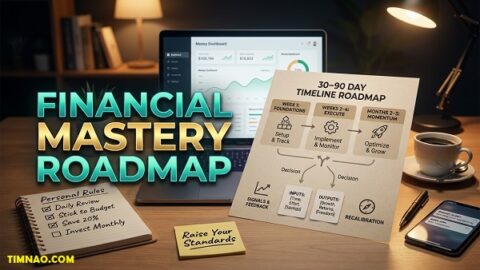
The “3-Part Weekly System” (simple enough to repeat)
If you want wealth mindset habits that actually stick, you need a weekly rhythm you can run even when you’re busy.
Here’s the system:
- One Proof Task (something you can show)
- One Skill Task (practice that improves you)
- One Outreach Task (visibility, applications, pitching, networking)
That’s it. Not 12 goals. Not a giant checklist. Just three pillars.
Examples:
- Proof: “Finish one portfolio piece”
- Skill: “Practice editing 3 times this week”
- Outreach: “Send 10 pitches / apply to 5 roles”
This works because it keeps the plan balanced:
- proof builds confidence,
- skill builds capability,
- outreach creates opportunity.
Build your plan around your actual calendar (not your fantasies)
Instead of asking “What should I do this week?” ask:
“When can I realistically do it?”
A beginner-friendly method is time blocking:
- Pick 2–4 blocks for your goal (30–90 minutes each)
- Put them in Google Calendar
- Treat them like a real meeting
If your schedule is chaotic, start smaller:
- 3 blocks of 30 minutes
That’s only 90 minutes/week, but it’s enough to build momentum.
The Minimum Action Rule (the real reason your plan survives)
Your plan needs a “bad day version.”
Because bad days are not an exception. They are part of the program.
Create minimum actions for each pillar:
- Proof minimum: 15 minutes improving one piece
- Skill minimum: 10 minutes practice
- Outreach minimum: 1 message or 1 application
When you hit a low-energy day, you do the minimum. That keeps the chain unbroken.
This is how you avoid the classic trap:
“I missed a day… so the week is ruined.”
No. The week is not ruined. The plan adapts.
The Weekly Scoreboard (so you always know if you’re winning)
You need a simple way to measure progress without getting emotional.
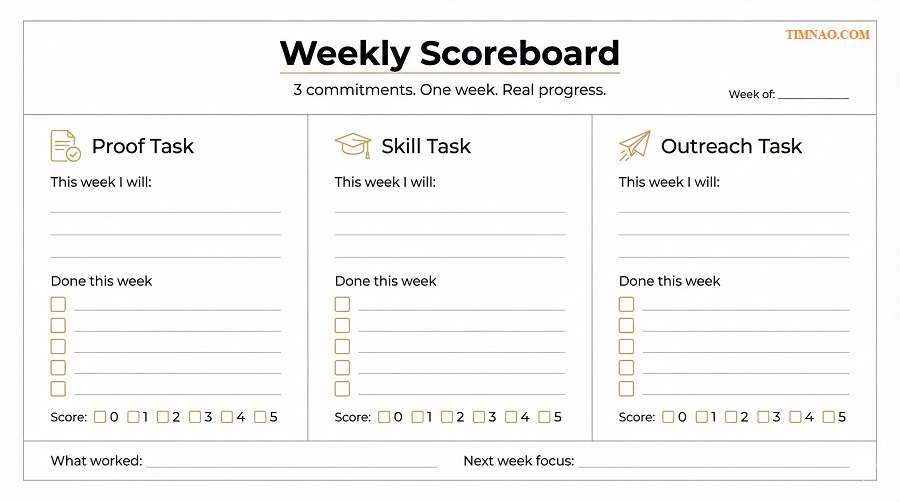
Create a weekly scoreboard with three checkboxes:
- Proof task done
- Skill reps done (e.g., 3 sessions)
- Outreach done (e.g., 10 messages)
Track it anywhere you’ll actually look:
- Notion if you like dashboards
- Trello if you like “To Do / Doing / Done”
- a notes app if you want it ultra simple
Your scoreboard is your anchor. When you feel lost, you return to it.
Make the plan “front-loaded” (the Day 3 antidote)
Most people accidentally plan like this:
- easy tasks early,
- hard tasks later.
Then later never happens.
Try the opposite:
- do one “meaningful” action early in the week
- keep later actions smaller
Example weekly structure:
- Monday/Tuesday: proof work (harder, higher value)
- Wednesday: skill practice
- Thursday/Friday: outreach and follow-ups
- Weekend: review and reset
Front-loading prevents the “busy week excuse” from stealing everything.
The 15-minute Weekly Review that keeps you consistent
Every week, do this review (set a recurring reminder):
- What did I finish? (proof)
- What did I practice? (skill)
- What did I publish/pitch/apply? (outreach)
- What blocked me? (name it clearly)
- What’s the smallest adjustment for next week?
This is where planning becomes mature:
- not dramatic,
- not perfect,
- just consistent improvement.
Transition to the next piece
Organized planning gets you moving. But sooner or later you’ll face the next challenge:
You’ll do the work… and results will still feel slow.
That’s where persistence comes in—without turning you into someone who stubbornly suffers for no reason.
Persistence with guardrails: push, pivot, or pause (without self-sabotage)
Persistence is one of the most misunderstood success habits.
Some people use it as an excuse to grind:
- “Never quit!”
- “Sleep is for the weak!”
Other people use “pivoting” as an excuse to restart every week:
- new idea,
- new niche,
- new tool,
- new plan…
Both extremes are exhausting.
A healthier approach is persistence with guardrails.
The Push / Pivot / Pause framework (use this when you feel stuck)
When you’re unsure what to do next, choose one:
Push = keep going with the same plan
Pivot = keep the goal, change the method
Pause = temporarily stop, but with a restart date
This prevents emotional decisions.
When to PUSH (stay the course)
Push when:
- you’ve been consistent for at least 4 weeks, and
- you see early signals, even if money hasn’t arrived yet
Early signals look like:
- replies improving (even if not “yes” yet)
- your work quality is clearly better
- your process is faster
- you’re getting feedback
- interviews are happening
- people are saving or sharing your work
In push mode, you don’t need a new plan. You need more reps.
A good push goal:
- “I will repeat this for 2 more weeks with small improvements.”
When to PIVOT (change the method, not the dream)
Pivot when:
- you’ve done real effort and the market stays silent
Examples:
- 40 pitches with almost no replies
- 50 applications with no interviews
- 20 posts with zero engagement and no new connections
- you dread the work so much you avoid it entirely
Pivot doesn’t mean you failed. It means you learned.
Small pivots (best for beginners):
- adjust your offer wording
- narrow the audience
- change the deliverable
- add proof before outreach
- try a different outreach channel
- change your “one skill” to a nearby skill
Example pivot:
- From “I do social media” → to “I create 10 short clips/week for real estate agents”
Same general area. Clearer value.
When to PAUSE (without quitting)
Pause is not “give up.” Pause is for real capacity limits:
- health issues
- family responsibilities
- overload at work
But a pause must have structure, or it becomes quitting in slow motion.
A healthy pause includes:
- a clear restart date
- a minimum action (optional but helpful)
Example:
- “I’m pausing heavy outreach for 2 weeks. I will still do 10 minutes practice daily. Restart outreach on March 15.”
This protects your identity:
“I’m someone who comes back.”
The “No Quitting on a Bad Day” rule
Here’s a rule that saves people from self-sabotage:
Never decide your future on a day you feel tired, ashamed, or panicked.
Bad days distort judgment. They make you think:
- “This will never work.”
- “I’m not cut out for this.”
- “Everyone else is ahead.”
On bad days, you follow the minimum action rule and sleep. You do not rewrite your whole life.
Persistence is easier when you track inputs (not outcomes)
Outcomes can be slow:
- money,
- promotions,
- job offers.
Inputs are controllable:
- practice sessions,
- proof items,
- pitches,
- applications,
- posts published.
If you track inputs, you can feel progress even when outcomes lag.
A beginner-friendly input tracker:
- Skill reps: ___ / week
- Proof shipped: ___ / week
- Outreach: ___ / week
This turns persistence into math, not emotion.
The “Two-Week Experiment” (your anti-chaos guardrail)
If you’re always switching plans, use this commitment:
“I will treat my next plan like a two-week experiment.”
During the experiment:
- you don’t change direction mid-week
- you make small tweaks only
- you collect data
After two weeks, you decide:
- push for 2 more weeks
- pivot
- pause with a restart date
This is how you become consistent without becoming stubborn.
Transition to the next piece
Persistence helps—but only if you avoid the modern pitfalls that classic success advice didn’t account for.
And there are a few that hit beginners especially hard.
Pitfalls that classic success advice doesn’t warn you about (and how to fix them)
Old-school success writing often assumes the world is simple:
- work hard,
- think positively,
- persist,
- win.
Modern life is messier:
- endless distractions,
- scams and shortcuts,
- comparison culture,
- burnout,
- information overload.
Let’s name the traps clearly—and give you fixes you can actually use.
Pitfall 1: “Hustle until you break”
Some people treat persistence like self-punishment. They push harder, sleep less, and wonder why they can’t stay consistent.
Fix: build a sustainable pace
Ask:
- “What can I do weekly for 3 months without hating my life?”
A sustainable pace usually looks like:
- 3–5 hours/week for side income (beginner)
- 2–4 focused blocks/week for career switching
- 1 visible project + weekly updates for promotion paths
If you burn out, you stop. Sustainable beats heroic.
Pitfall 2: Overplanning as procrastination
Planning feels productive because it’s clean. Execution is messy.
If you keep rewriting your plan, you might be avoiding the real work:
- outreach
- publishing
- asking for feedback
- shipping imperfect work
Fix: connect planning to a “ship date”
Every plan needs a “ship date”:
- “I will publish/prove/show this by Friday.”
Your calendar should include:
- one block for making it,
- one block for polishing,
- one block for publishing/sending.
Pitfall 3: “Mindset” without behavior
Repeating positive phrases can become a way to avoid discomfort.
Fix: make mindset practices action-linked
A mindset practice must end with:
- one next action
- a time when you’ll do it
Example:
- “I’m building confidence through reps. Today I’ll send 2 messages at 4 PM.”
That’s real.
Pitfall 4: Tool addiction (new apps, new AI tools, same results)
Modern creators get trapped in tools:
- new productivity apps
- new AI platforms
- new templates
Tools can help, but they can also become shiny procrastination.
Fix: choose one tool per function
- Planning: Google Calendar
- Tracking: Notion or Trello
- Writing/brainstorming: ChatGPT
Then stop shopping. Go execute.
Pitfall 5: Fake shortcuts and “guaranteed income” traps
The internet is full of promises:
- easy money
- no skills needed
- guaranteed results
Be careful.
Fix: follow the “value + proof” rule
Ask:
- “What value am I delivering?”
- “What proof can I show?”
- “Would this still work if I had to explain it to a friend honestly?”
If the model is vague, secretive, or relies on recruiting others, it’s a red flag.
Pitfall 6: Comparison that kills consistency
You see someone your age making more money, and your brain goes:
- “I’m behind.”
- “Why even try?”
Comparison destroys patience. Patience is required for growth.
Fix: compare to your last month
Track one monthly win:
- better portfolio
- better outreach volume
- better interviews
- better proof
- better discipline
Your only real competition is the version of you who kept drifting.
Pitfall 7: The “all-or-nothing” personality trap
A lot of beginners quit because they miss a day:
- “I failed.”
- “I broke the streak.”
- “I’m not consistent.”
Fix: use the Minimum Action Rule
If your minimum action is tiny, you’ll return faster.
The goal is not a perfect streak.
The goal is becoming someone who always comes back.
Pitfall 8: No feedback loop (you can’t improve what you don’t see)
If you’re not getting feedback, you might be practicing in the dark.
Fix: schedule feedback like a task
Every week, get feedback from one source:
- a peer
- a mentor
- a community
- your personal board
Feedback can be simple:
- “Is this offer clear?”
- “What would make this stronger?”
- “What’s missing?”
Feedback makes improvement faster—and persistence easier.
Three quick scenarios (so you can picture yourself doing this)
Reading advice is easy. Using it in real life is the hard part—because your situation comes with messy details: time limits, confidence dips, bosses, bills, and “I don’t even know where to start” days.
So here are three realistic scenarios. As you read, don’t ask, “Which one is perfect?” Ask:
“Which one is closest to my current season of life?”
Scenario 1: You want a promotion, but you feel invisible at work
You’re doing your job. You’re dependable. But promotions seem to go to people who are “seen,” not just people who work hard.
Your real problem: You don’t have a clear “proof trail” attached to your name.
Your goal for the next 60–90 days: Become visible in a calm, professional way—through measurable outcomes.
What this looks like (simple plan):
- Pick one measurable pain point your team already complains about
Examples:- repeated mistakes
- slow turnaround
- unclear handoffs
- messy reporting
- Create one small improvement project (keep it tight)
- a checklist
- a template
- a dashboard
- a mini process
- Send weekly “progress bullets” to your manager (3–5 lines max)
Keep it light:- what you shipped
- what improved
- what’s next
Example weekly update (copy style):
- This week: simplified the weekly report (reduced manual steps from 8 to 4)
- Result: saved ~45 minutes per cycle
- Next: add one summary chart + document the steps for the team
Why this works:
You’re not asking for attention. You’re giving clarity. And clarity is leadership.
One beginner trap to avoid:
Don’t try to “fix everything.” One visible win beats five half-finished ideas.
Scenario 2: You want side income, but you feel “not experienced enough”
You want an extra $200–$500/month, but you keep thinking:
- “Who would pay me?”
- “I don’t have a portfolio.”
- “I’m not special.”
Your real problem: You’re trying to start with confidence instead of starting with proof.
Your goal for the next 30 days: Build a tiny proof portfolio and do gentle outreach—without making it a big identity crisis.
What this looks like (simple plan):
- Choose one sellable skill with a fast proof loop
Examples:- short-form video editing
- simple landing page cleanup
- product description rewrites
- resume polishing
- basic spreadsheet templates
- Create 3 proof samples in 7 days
Proof doesn’t need permission. It needs effort.- before/after screenshots
- 3 short clips
- 1-page “case study” with bullet results
- Do “soft outreach” first (less scary)
Instead of pitching strangers immediately:- ask 5 people for feedback
- share a sample on LinkedIn
- offer a tiny free improvement to one person you already know
- Then do “small pitches” (simple, respectful, low-pressure)
- “I made this sample. If you want something similar, I can do X per week.”
Why this works:
Confidence becomes a side effect of output. You stop asking, “Am I good enough?” and start asking, “Is this sample useful?”
One beginner trap to avoid:
Don’t build a “perfect brand” first. Build proof first.
Scenario 3: You want a career switch, but you’re overwhelmed by options
You want a new role, but the internet keeps shouting:
- “Learn this!”
- “Do that!”
- “This field is dead!”
- “This tool is everything!”
And you freeze.
Your real problem: You’re trying to decide your entire future before you’ve run any experiments.
Your goal for the next 90 days: Choose one direction, build proof, and create a steady application pipeline.
What this looks like (simple plan):
- Choose one target role for 90 days
Not forever. Just long enough to get real feedback. - Pick one core skill + one proof format
Examples:- core skill: analytics
- proof format: two small projects + clear write-ups
- Set a weekly pipeline
- 2–3 skill sessions
- 1 proof session
- 5 applications/week
- 5 networking touches/week (comments + messages)
- Use a “push/pivot” checkpoint every two weeks
- If no interviews after consistent effort, adjust:
- resume
- portfolio clarity
- target roles
- networking approach
- If no interviews after consistent effort, adjust:
Why this works:
A switch is not one decision. It’s a series of reps that produce clarity.
One beginner trap to avoid:
Don’t wait until you feel ready to apply. Apply while you’re building.
How to choose your scenario (if you feel like you’re in all three)
If you’re tempted to do promotion + side income + career switch at once, choose your “main lane” using this quick rule:
- If you need stability now → prioritize promotion or job switch
- If you need extra cash now → prioritize side income
- If you feel stuck long-term → prioritize career switch
You can keep the others as “maintenance,” but don’t split your main focus.
Start-this-week plan: pick your pace and move forward
You don’t need a life overhaul. You need a week that creates traction.
Before you pick your pace, do one quick setup move:
Choose your “one sentence” aim for the next 60–120 days
Write it in a place you’ll actually see. If you want a clean digital setup, use:
- Notion for your weekly scoreboard
- Google Calendar to block time
- Trello if you prefer a simple board
Your aim should include:
- the result
- the deadline
- the method
- the weekly proof actions
Now pick a plan you can realistically repeat.
Plan A: 1 hour/day for 7 days (best for fast momentum)
This is the “I’m ready to move” plan. Keep it simple, not heroic.
Day 1: Aim + scoreboard
- Write your one-sentence aim
- Create your weekly scoreboard (Proof / Skill / Outreach)
- Decide your minimum actions (10–15 minutes versions)
Day 2: Offer + deliverable
- Write your offer: “I help ___ get ___ by ___”
- Choose one deliverable you can complete in 2–6 hours
Day 3: Proof session
- Build the “ugly first version” of a proof sample
- Don’t polish too early—finish first
Day 4: Improve + package
- Do one improvement pass
- Write 5 bullets explaining:
- the problem
- what you changed
- why it matters
- what result it creates
- what you’d improve next
Day 5: Outreach (soft)
Choose one:
- post your proof on LinkedIn
- ask 3 people for feedback
- message 2 people who could use your help
Day 6: Skill reps
- Practice your core skill for 45–60 minutes
- End by making something small (output, not only learning)
Day 7: Review + next week
- What did you ship?
- What got easier?
- What blocked you?
- Set next week’s 3 commitments
Your only job this week:
Ship one proof item and do one outreach step. That alone changes your trajectory.
Plan B: 2–3 hours/week (best for busy schedules)
This plan works when you’re balancing work, family, and real-life fatigue.
Session 1 (60–90 min): Proof + skill
- 15 minutes: review your aim + pick one task
- 60 minutes: build or improve proof
- 10 minutes: note what you’ll do next time
Session 2 (60–90 min): Outreach + planning
- 30 minutes: outreach (applications, pitches, messages)
- 15 minutes: follow-ups
- 15 minutes: plan your next week (3 commitments)
A gentle rule that keeps this alive:
- If you can only do one session, do the outreach session
Skill without outreach often stays invisible.
Plan C: you started before, but you keep falling off (momentum reset)
If consistency is your biggest issue, don’t add more tasks. Add structure.
For the next 14 days:
- Keep your daily behavior script (2 minutes)
- Do only the minimum actions on bad days
- Track inputs, not outcomes:
- skill reps
- proof progress
- outreach touches
Your “don’t break the chain” minimum:
- 10 minutes skill practice or
- 1 outreach message or
- 10 minutes proof improvement
This is how you rebuild trust with yourself.
A tiny checklist to prevent “Day 3 collapse”
Before the week starts, answer these:
- What are my 3 commitments?
- What is my minimum action on a bad day?
- When (exactly) will I do my 2–4 time blocks?
- Who will I report to (buddy, board, or just my own scoreboard)?
If you can answer those four, your plan is already stronger than most.
Optional quick FAQ (beginner-friendly)
Do I need to feel confident before I start?
No. Confidence usually shows up after you keep small promises to yourself. Start with proof and minimum actions. Confidence will follow.
What if I don’t know what I’m “best at” yet?
Treat “best at” as a result of reps, not a starting requirement. Pick one skill that pays, test it for 14 days, then decide if you push or pivot.
How do I avoid wasting time on the wrong direction?
Use the two-week experiment rule:
- commit to one plan for two weeks
- track inputs
- review and adjust, don’t panic-switch midweek
Is outreach really necessary?
If you want results faster, yes. Skill matters, but visibility creates opportunity. Start with soft outreach (feedback requests, sharing proof) if pitching feels scary.
I’m already busy. What’s the minimum that still works?
Two blocks per week:
- one proof/skill block
- one outreach/planning block
Even 2–3 hours/week can compound if it’s consistent.
What if I miss a week?
Don’t restart with shame. Restart with structure:
- do one minimum action today
- schedule your next two blocks
- set next week’s 3 commitments
The win is becoming someone who returns quickly.
Can I use AI tools to speed this up without becoming lazy?
Yes—use AI like an assistant, not a replacement.
- brainstorm offers
- refine wording
- create checklists
- plan weekly actions
If you want a practical helper for drafting scripts and plans, ChatGPT can be useful—as long as you still ship proof and do outreach.
What to remember when life gets busy
- Turn vague wanting into a measurable target: number + deadline + trade.
- Make your career aim pass the “Tuesday test”: it should guide weekly actions, not just inspire.
- Build proof early—proof creates confidence faster than motivation ever will.
- Keep plans alive with minimum actions and a simple weekly scoreboard (Proof / Skill / Outreach).
- Persist with guardrails: push, pivot, or pause—but don’t decide your future on a bad day.
- Start this week at a pace you can repeat. Consistency beats intensity, every time.
Disclaimer:
The strategies shared here are educational and meant to help you think clearly and take practical action. They don’t guarantee income, promotions, or specific outcomes. Please use your own judgment and consider professional guidance when making major financial or career decisions.
If this article helped you take even one clear step forward, you can support my work by buying me a coffee ☕️😊 It keeps this blog running and helps me create more practical, beginner-friendly guides you can use right away.
👉 Buy me a coffee here: https://timnao.link/coffee 💛