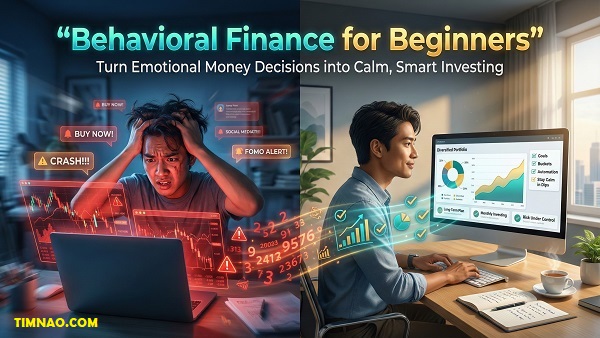
Behavioral Finance for Beginners: Transform Scary Markets into Smart Opportunities 🚀
Behavioral finance for beginners is not about memorizing complex theories—it is about finally understanding why your money choices often do not match your good intentions. You know you “should” save, invest early, and avoid chasing hype, but emotions, habits, and social pressure keep pulling you off track. Instead of blaming yourself, behavioral finance gives you a clear, practical way to see what is really going on inside your head when you earn, spend, and invest.
In this guide, you will learn how to spot your own emotional patterns, build simple systems that protect you from panic or FOMO, and turn market ups and downs into something you can calmly live with—rather than fear. Whether you are just starting to invest or trying to fix past mistakes, you will find step-by-step actions, real-life examples, and easy routines you can plug into your daily life right away.
Getting Started: What Is Behavioral Finance, Really?
Behavioral finance for beginners sounds fancy, but it simply explains why your money decisions often don’t match what you know is “right.” You already understand the basics: spend less than you earn, save regularly, invest for the future. Yet maybe your savings keep getting delayed, or you sell at the worst possible time. That gap between what you know and what you do is exactly where behavioral finance comes in.
Instead of assuming people are perfectly rational, behavioral finance starts from a more honest place: real humans are emotional, distracted, and heavily influenced by habits and other people. When you look at money through that lens, your past choices suddenly make sense. You are not “bad with money”; you were simply reacting on autopilot. Once you see the patterns, you can start to change them.
A simple definition you can actually use
Here is a definition you can keep in your head: behavioral finance is “how your brain and emotions affect your money decisions.” That’s it. You do not need to memorize complicated models. If a concept helps you make calmer, smarter choices with your money, it belongs in behavioral finance.
For beginners, the two most important questions are:
- What makes me panic, delay, or overreact with money?
- What small changes would make those reactions less likely?
You do not have to fix everything at once. Start by accepting that emotions are part of the process. The goal is not to “remove” emotions, but to design a system where your emotions don’t automatically press the sell button or stop you from investing at all.
Three everyday situations where behavioral finance shows up
To make this real, think about whether any of these have happened to you:
- You see friends brag about profits on social media, feel FOMO, and jump into the same coin or stock without real research.
- You open your portfolio during a dip, feel your stomach drop, and quickly sell “before it gets worse,” only to see prices recover later.
- You plan to start investing “next month” for years in a row because it never feels like the perfect time.
These are not random mistakes; they are patterns. Each situation reveals a different emotional trigger:
- FOMO and herd behavior.
- Fear and loss aversion.
- Procrastination and avoidance.
Behavioral finance for beginners is about recognizing which trigger is strongest for you right now. Once you can name it, you can build a specific habit or rule around it instead of just telling yourself to “be better” next time.
A quick self-check: where are you right now?
Before going deeper, take one minute to answer these questions honestly:
- When markets fall sharply, do you feel a strong urge to sell or “go to cash”?
- Have you ever bought something mainly because “everyone was talking about it”?
- Do you check your portfolio or prices more than once a day?
If you answered “yes” to two or more, you are completely normal—and you are exactly who this guide is written for.
Why Your Brain Struggles with Money (and How to Fix It)
Your brain did not evolve to manage bank transfers and stock charts. It evolved to keep you alive in a world where threats were physical and immediate. That’s why financial fear feels so strong: your nervous system treats a dropping portfolio like a rustling noise in the dark. Your heart rate increases, your thoughts speed up, and you want to do something right now.
Instead of fighting that reaction, a smarter approach is to assume your brain will overreact—and prepare for it in advance. Think of this section as a “user manual” for your own mind. We will look at three of the biggest troublemakers and pair each one with at least one practical fix you can start using today.
Loss aversion: a 2-step habit to stop panic-selling
Loss aversion means losses feel roughly twice as painful as gains feel good. You might logically know that markets sometimes drop 10–20%, but when it happens to your money, it feels like something is seriously wrong. This can push you to sell at exactly the wrong time just to stop the discomfort.
Here is a simple two-step habit to tame loss aversion:
- Define your “normal pain range” in advance.
Write down a sentence like: “For my long-term stock investments, a drop of up to 20% is uncomfortable but normal.” Put it in your notes app or investing journal. When a downturn happens, read that sentence before making any changes. - Create a 24-hour pause rule for selling.
Promise yourself: “If I ever want to sell because I’m scared, I will wait 24 hours.” During those 24 hours, you are allowed to read, think, or talk to someone—but not to trade. Most panic urges fade surprisingly fast when you give them time.
You will still feel losses, but you will no longer let a bad feeling instantly become a bad decision. That is behavioral finance in action.
FOMO and herd instinct: a 3-question filter before you follow the crowd
FOMO (fear of missing out) and herd behavior show up when you see others making money quickly. Your brain tells you, “If you don’t hurry, you’ll miss this chance forever.” That is a powerful story, but usually an exaggerated one.
Next time you feel pulled into a popular trade, run this simple three-question filter:
- Does this fit my written goals and timeframe?
If you are investing for retirement in 20 years, chasing a short-term hype coin probably does not belong in your core plan. - Can I clearly explain how this investment makes money?
If you cannot explain it in one or two sentences without buzzwords, you probably do not understand it well enough to risk real money. - If this went to zero, would it damage my life plans?
If the answer is yes, you are risking too much. Reduce the amount or skip it entirely.
If an idea passes all three questions and you still want to try it, consider using a tiny “fun money” portion of your portfolio rather than touching your long-term core holdings. That way, FOMO cannot derail your main goals.
Overconfidence and confirmation bias: the 5-minute “devil’s advocate” exercise
Overconfidence makes you think you’re less likely than others to be wrong. Confirmation bias makes you filter the world so you mostly see information that proves you right. Together, they can lead you to double down on a weak idea and ignore clear warning signs.
To keep these in check, use a quick 5-minute “devil’s advocate” exercise before any major change:
- Write your idea in one line.
For example: “I want to move a big chunk of my savings into this tech stock because I think it will grow fast.” - List three things that could go wrong.
Company risk, sector risk, valuation risk, regulation, your own lack of experience—anything that could break your thesis. - Imagine you are advising a friend you care about.
If a friend described this same idea, would you tell them to go all-in, go small, or wait? Your answer here is often more balanced than your initial impulse.
You do not have to abandon every idea that has risks—every investment has them. The goal is to slow down just enough to see the full picture rather than only the upside. That small pause can prevent a lot of emotional investing mistakes.
Investing During Market Panic: What Crashes Really Look Like
Investing during market panic feels like taking an exam where the questions keep changing. Prices move fast, headlines are dramatic, and everyone seems either terrified or strangely confident. If you are not prepared, it is easy to confuse noise with real danger and make decisions you later regret.
Crashes have happened many times in history and will happen again. The details change, but the pattern of human behavior is surprisingly similar each time. Understanding that pattern helps you react calmly instead of treating every drop as the end of the world.
What usually happens in a crash (in plain language)
While no two downturns are identical, many follow this rough pattern:
- Stage 1 – Ignoring the signs: Markets have been rising for a while. Warnings appear, but most people stay optimistic.
- Stage 2 – Real fear: Losses deepen. You start seeing words like “crash” and “crisis” in the news. Some people begin selling to “reduce risk.”
- Stage 3 – Panic and capitulation: Selling becomes emotional. People sell good assets just to stop the stress. This is often when prices are most attractive for calm, prepared investors.
- Stage 4 – Stabilization and recovery: The worst headlines fade. Prices stop falling and gradually recover.
Knowing this pattern does not make a crash pleasant, but it does make it less mysterious. When you can say, “We’re probably somewhere in the middle of this cycle,” you feel less like the world is ending and more like you are in a difficult but understandable phase of a long journey.
Design your personal “panic plan” in advance
The best time to create a plan for investing during market panic is when markets are calm. Your goal is to decide in advance how you will behave, so you are not improvising under stress.
A basic panic plan for beginners could include:
- Your threshold for action:
For example: “If my portfolio drops up to 15%, I will do nothing but keep investing monthly. If it drops more than 15–20%, I will review my allocation but still avoid big, sudden moves.” - Clear “do not do” rules:
Such as: “I will not sell everything and move to cash based only on headlines. I will not open new leveraged positions during a crash.” - A communication rule:
For example: “If I feel overwhelmed, I will talk to a trusted friend or advisor before making any large change.” - A reminder of your time horizon:
Write down: “This money is for [goal] in [X] years. A bad year now does not equal failure.”
Keep this plan somewhere visible. When the market gets rough, read it aloud before you log in to your investment account. Putting your own words in front of your emotional brain is surprisingly effective.
What to do in the first 24 hours of a big drop
Imagine you wake up and see the market is down sharply. Here is a practical 24-hour checklist to follow:
- Do nothing for the first 30–60 minutes.
Do not open your trading app immediately. Have a coffee, breathe, and let the first wave of emotion pass. - Read your panic plan and one-page investing policy.
Remind yourself of your rules and time horizon. Ask: “Has any of this actually changed today?” - Check your safety bucket, not just your portfolio.
Confirm that your emergency fund and near-term cash are intact. This helps your nervous system understand you are not in immediate danger. - Look at percentages, not just dollar amounts.
A $5,000 loss sounds huge until you realize it is a 10% move in a long-term growth bucket. Percentages give better context. - Decide if today requires action or just observation.
In most cases, the answer will be “observe.” If your allocation is way off target, you might mark a date to rebalance calmly in a few days rather than reacting instantly.
By the end of those 24 hours, your emotions will usually have cooled enough for you to think much more clearly. Even if you decide to make a change, you will be doing it from a place of intention instead of panic. When you combine this kind of practical routine with the self-knowledge from earlier sections, you move from being a passenger in your investing journey to being the driver.
Building Your Defense: A System to Avoid Emotional Investing Mistakes
If behavioral finance for beginners had one main mission, it would be this: protect you from your own worst financial impulses. Most emotional investing mistakes happen fast—one bad evening, one scary headline, one “hot tip” from a friend. A solid defensive system slows you down just enough so you can respond with your plan instead of your panic.
Think of this as building a “safety net” around your money decisions. You will still feel fear, excitement, and FOMO. That is normal. But with the right structure, those feelings will not instantly translate into buy or sell orders.
Turn Your Intentions into a One-Page Investing Rulebook
The simplest, most underrated tool in behavioral finance for beginners is a one-page investing rulebook. This is not a fancy document. It is a short, clear set of rules written by “calm you” for “emotional you” to follow later.
Here is a straightforward structure you can copy into your notes app today:
- Your goal:
- “I’m investing for retirement in 25+ years.”
- “I’m building a down payment fund for a house in 7 years.”
- Your time horizon:
- Short term (0–3 years) → mostly cash and safe assets.
- Long term (10+ years) → more stocks, less worry about short-term drops.
- Your target mix:
- For example: 80% global stock index funds, 20% bond funds.
- Your contribution plan:
- “I invest $300 on the 1st of each month automatically.”
- Your sell rules:
- “I sell only if my goal changes, the investment changes dramatically, or I need money for a planned major expense—not because of short-term fear.”
Write this in your own words so it sounds like you. Print it out or pin it somewhere visible. Every time you feel tempted to change something, read this page first and force yourself to justify why this moment is truly different from what you planned for.
Use Automation So Emotions Arrive Too Late
Automation is your best friend when fighting emotional investing mistakes. When your system is already moving money into your investments every month, “doing nothing” becomes your default. You have to make an effort to interrupt the process, which is exactly what you want.
Here is how to set up an effective defensive automation:
- Step 1 – Automate your savings:
Ask your bank or employer to send a fixed amount to a savings or brokerage account as soon as you get paid. When the money never touches your spending account, you do not miss it as much. - Step 2 – Automate your investments:
On your investment platform (for example, Vanguard, Fidelity, Charles Schwab), set a recurring investment into your chosen funds on the same date each month. - Step 3 – Automate dividend reinvestment:
Enable automatic reinvestment of dividends so your money keeps compounding without you needing to decide what to do each time.
With this setup, your behavioral finance plan continues working even on days when you feel stressed, tired, or scared. If a big market drop happens, your automated system quietly buys at lower prices while your emotional brain is still arguing with itself.
Build Buckets So Every Dollar Has a Job
One reason beginners panic is that all their money feels like “one big number.” When that number goes down, it feels like everything is at risk. A very practical fix is the bucket strategy: divide your money based on when you need it.
You can start with three simple buckets:
- Bucket 1 – Now & near future (0–2 years):
- Cash and very safe instruments.
- Covers rent, bills, emergency fund, and any planned big purchases.
- Bucket 2 – Medium-term (3–7 years):
- A mix of bonds and some stocks.
- For goals like a house deposit, further study, or a car.
- Bucket 3 – Long-term growth (7+ years):
- Mostly or fully in diversified stock funds.
- For retirement and long-term wealth building.
Once you set this up, you can literally label your accounts by bucket: “Safety,” “Medium Goals,” “Growth.” When the market drops, you remind yourself: “Only my long-term growth bucket is bouncing around. My safety bucket is fine.” That mental separation reduces panic and helps you avoid selling long-term investments to solve short-term worries.
Add “Speed Bumps” Before You Can Make Big Moves
A final defensive trick is to add small obstacles—“speed bumps”—before large decisions. Emotions are fast; good thinking is slow. You want to make big moves slightly inconvenient.
Here are a few practical speed bumps to consider:
- Remove trading apps from your phone; keep them on your laptop only.
- Use a simple rule: “No investment decision over $X without sleeping on it.”
- Require yourself to write a short “why I’m doing this” note before any big change.
None of these block you completely. They simply force you to pause. That pause is often the difference between a calm adjustment and an emotional mistake.
Turning Volatility into Opportunity Without Gambling
Once you have your defense in place, volatility starts to look a little less scary. Instead of thinking, “The market is crazy, I should get out,” you can think, “The market is moving, how does my plan tell me to respond?” The goal is not to outsmart everyone, but to let volatility work for you without turning your portfolio into a casino.
For behavioral finance for beginners, “opportunity” should never mean “huge, all-in bets.” It should mean small, consistent actions that use price swings to gently improve your long-term results.
Learn to Love Dollar-Cost Averaging (DCA)
Dollar-cost averaging is simple: you invest a fixed amount of money at regular intervals, no matter what the market is doing. Instead of trying to pick the perfect day, you show up every month.
Here is how DCA helps you use volatility without guessing:
- When prices are high, you buy fewer units.
- When prices are low, you buy more units.
- Over time, your average purchase price tends to be more reasonable than if you just threw in random lump sums based on your mood.
To put DCA into practice:
- Choose a realistic amount you can invest monthly without stressing your budget.
- Set an automatic recurring investment into a broad index fund or ETF.
- Commit to doing this for at least 12–24 months, through both “good” and “bad” news.
If you stick with it, you will notice something important: you stop obsessing about whether “now” is the right time. You already decided that your job is to show up consistently; the market’s job is to bounce around.
Rebalancing: Quietly Buying Low and Selling High
Rebalancing is a calm, rule-based way to respond to volatility. It means you occasionally adjust your portfolio back to its original target mix. You are not forecasting the future; you are just keeping your risk where you want it.
Here is a practical way to do it:
- Decide your target mix—for example, 70% stocks, 30% bonds.
- Once or twice a year, check your actual mix.
- If it has drifted too far (for example, to 80% stocks, 20% bonds), you sell a bit of the “too large” part and buy the “too small” part.
This quietly forces you to:
- Trim what has gone up a lot (selling high).
- Add to what has lagged or dropped (buying low).
Beginner tip: you can often rebalance using new contributions instead of selling. For example, if stocks have risen and now make up too much of your portfolio, direct your next few investments into bonds until your mix is back on track. This avoids unnecessary taxes or fees.
“Buying the Dip” the Smart, Boring Way
“Buying the dip” has become a meme, but there is a sensible, low-drama version of it that fits nicely into a behavioral finance plan.
Here is a simple framework:
- Keep your regular DCA and core plan intact. That is non-negotiable.
- Set aside a small “opportunity reserve”—maybe 5–10% of what you invest each year.
- Decide ahead of time when you are allowed to deploy that reserve. For example:
- If the broad market index is down 20% from its recent high, you invest one third of the reserve.
- If it falls 30%, you invest another third.
- You never use more than the reserve, no matter how dramatic it feels.
This way, you lean into big drops without guessing the bottom or risking everything. You also avoid emotional “buy the dip” on individual speculative stocks that simply might not recover.
Spotting When You’ve Crossed the Line into Gambling
To make sure you are still “turning volatility into opportunity” and not just gambling, watch for these warning signs:
- You feel a rush or high when placing trades.
- You are using borrowed money or leverage to “boost” your gains.
- You cannot clearly explain how much you could lose and what you would do if that happens.
- A single bad trade would seriously damage your long-term goals.
If you see yourself in these points, pause and step back. There is nothing wrong with having a small, clearly defined “experiment” portion of your portfolio. But your core should be boring, diversified, and aligned with your long-term behavioral finance plan—not driven by adrenaline.
Practical Tools, Apps, and Routines for Everyday Investors
So far, you have seen principles and strategies. Now we turn them into a daily and weekly system that fits into real life. You do not need complicated software to apply behavioral finance for beginners. A small set of well-chosen tools and simple routines is enough.
You can think of your setup in three parts: where your money lives, how you track it, and how you reflect on your behavior.
Build a Simple, Strong “Money Stack”
Your “money stack” is the combination of accounts and platforms you use. For most beginners, a clean, minimal stack works best:
- Bank account: where your salary arrives and bills are paid.
- Brokerage or investment platform: where you hold your long-term investments. Reputable examples include Vanguard, Fidelity, and Charles Schwab.
- Budgeting tool: to keep your spending and saving on track.
- Note/journal tool: to capture your decisions, goals, and lessons.
Once you have this stack, connect it to your system:
- Set an automatic transfer from your bank to your brokerage on payday.
- Set automatic investments in your brokerage.
- Use your budgeting tool to make sure you are not overcommitting.
The goal is flow: money moves smoothly from income → savings → investments, with as few manual steps (and emotional decisions) as possible.
Tools to Track Progress Without Obsessing
Tracking is crucial—but overtracking can feed anxiety. You want enough visibility to stay in control without turning money into a constant source of stress.
Here is a simple way to do it:
- Use your brokerage’s built-in dashboard for daily or weekly glances.
- Once a month, update a basic spreadsheet (for example, in Google Sheets) with:
- Account balances (bank, brokerage, retirement).
- Your current asset allocation versus your target.
- Your total net worth.
This monthly snapshot lets you see progress and spot problems early. More importantly, it trains you to think in months and years instead of hours and days. That shift alone dramatically reduces emotional investing mistakes.
Journaling: Your Personal Behavioral Finance Lab
A decision journal is where you turn experience into insight. You do not need to write essays—short notes are enough. Before or after any meaningful money move, answer a few quick questions:
- What am I doing? (e.g., “Buying $500 of a global stock ETF.”)
- Why am I doing it? (goal, time horizon, logic).
- How do I feel right now? (excited, scared, calm, stressed).
- What do I expect to happen in the next 6–12 months?
Set a reminder to review these notes later. You will start to see patterns: maybe you are always nervous before good decisions and overconfident before bad ones. Maybe investing during market panic has actually worked better for you than buying at euphoric times. This is your own behavioral finance data, and it is far more powerful than generic advice.
You can store these notes in any app you like—Notes, Notion, Google Docs, a physical notebook. The important thing is that you keep them in one place and revisit them.
Daily and Weekly Routines That Support Calm Investing
Finally, tie everything together with routines. Routines are where tools and theory turn into behavior.
Here is a simple structure you can adopt immediately:
- Daily routine (5–10 minutes):
- Glance at your budgeting app or bank account to stay aware of spending.
- Avoid checking your portfolio unless something specific requires it.
- Weekly routine (15–20 minutes):
- Review any upcoming expenses and confirm your automatic transfers are still viable.
- If you felt strong emotions about money that week, add a short journal note.
- Monthly routine (30–45 minutes):
- Update your net worth and allocation spreadsheet.
- Check whether your investments still match your one-page rulebook.
- Decide if any rebalancing or small adjustments are needed.
This rhythm keeps you engaged without letting money dominate your thoughts. And because it is based on time (daily/weekly/monthly) rather than on price swings, your behavior becomes more stable than the market.
Over a year or two, these routines quietly reshape how you think and feel about investing. You become less reactive, more intentional, and much less vulnerable to emotional investing mistakes. That is the real promise of behavioral finance for beginners: not perfect predictions, but better habits that compound over time—just like your money.
A Simple 30-Day Behavioral Finance Starter Plan
A lot of people read about behavioral finance for beginners and think, “This makes sense… but what do I actually do on Monday morning?” This 30-day starter plan is the bridge between theory and action. It walks you, step by step, from “I kind of understand my emotional investing mistakes” to “I have a real system that runs in my daily life.”
You do not need to be perfect or turn into a finance expert in 30 days. The goal is much more realistic: build a simple structure around your money so that, a month from now, you react more calmly to market news, you know your numbers, and you follow a written plan instead of your moods. Think of it as a 30-day experiment where the subject is you.
To keep this practical, each block of days has a clear theme, daily or near-daily actions, and simple checkpoints. You can stretch a phase if you need more time, but try not to skip steps. The real power of this plan is the order: awareness first, then systems, then practice, then long-term habits.
Days 1–7: Get Clear on Your Money Picture and Triggers
The first week is about two things: seeing where you actually stand and noticing how you feel about money. Before you try to optimize anything, you need a clean snapshot and honest self-awareness.
Day 1–2: Take a calm snapshot of your finances
Set aside an hour in a quiet spot with a notebook or notes app. List:
- All your accounts: bank, credit cards, loans, investment accounts.
- Current balances (rough figures are fine to start).
- Any regular investments or savings you already have in place.
You are not judging or fixing anything yet. The job is simply to bring everything into the light. At the end of Day 2, write one sentence about how this snapshot makes you feel—relieved, stressed, surprised, embarrassed. This emotion is part of your behavioral finance story.
Day 3: Define your main money goal for the next 10+ years
Pick one primary long-term goal that investing will support. For example:
- “Retire comfortably at 60.”
- “Reach financial independence in 20 years.”
- “Build a college fund for my child.”
Write this goal where you can see it later. This is the destination your 30-day plan will be aligned with. When markets get noisy, this goal will help you remember why you are investing at all.
Day 4: Map your time horizons and buckets
Decide what money you will need:
- In the next 0–2 years (safety and bills).
- In the next 3–7 years (medium goals).
- Beyond 7–10 years (long-term investing).
Roughly group your current balances into these three horizons. You do not have to make any transfers yet. Just see whether you are accidentally investing short-term money too aggressively—or leaving long-term money doing nothing in cash.
Day 5–6: Spot your top emotional investing triggers
Look back over your past money decisions. Note at least three moments where you:
- Sold or bought quickly because of fear or excitement.
- Put off investing because “now feels uncertain.”
- Followed a tip mainly because others were doing it.
For each moment, write:
- What happened.
- What you felt.
- What you did.
- What you wish you had done instead.
By Day 6, circle one or two patterns that hurt you the most (for example, panic selling or FOMO buying). These will be your main targets for improvement over the rest of the month.
Day 7: Create a simple “money reflection” ritual
Choose a specific time each week (for example, Sunday evening) for a short money check-in. For now, it can be just 10–15 minutes where you:
- Glance at your account balances.
- Note any strong money feelings from the week.
- Jot a couple of bullet points about what you learned.
This small ritual is the backbone of behavioral finance for beginners: you are training yourself to think about money on a schedule, not only when something dramatic happens.
Days 8–15: Design Your Personal Money System
Week two is about building your basic “operating system.” You will create your one-page rulebook, start automation, and assign jobs to your money buckets. After these days, you will have a simple but powerful structure protecting you from emotional investing mistakes.
Day 8–9: Write your one-page investing rulebook
Using your insights from week one, draft a one-page document that covers:
- Your main long-term goal.
- Your rough time horizon (in years).
- A target asset mix (for beginners, something like 70–80% stocks, 20–30% bonds for long-term goals is common—but adjust to your comfort).
- How much you aim to invest each month.
- Your rules for selling (only for goal changes, investment changes, or planned needs—not fear).
Keep the language simple. Pretend you are writing instructions for your future self on a stressful day. If you cannot explain it to “stressed you,” simplify it.
Day 10–11: Choose your core investments
Next, pick 1–3 core investments that match your plan. For most beginners, this will be:
- One broad stock index fund or ETF (for example, a global or total market fund).
- One bond fund or similar lower-risk asset, if your plan calls for it.
If your platform is with a brand like Vanguard, Fidelity, or Charles Schwab, look for their low-cost, diversified options rather than trying to pick individual stocks. Your goal is to build a stable core, not to find the next rocket ship.
Make a note of the exact fund names or tickers you will use. These will be the default destinations for your monthly contributions.
Day 12: Set up your three buckets in practice
Now that you know your horizons, you can start aligning accounts:
- Keep your 0–2 year money (safety bucket) in cash or very low-risk accounts.
- Begin directing your long-term money into the core investments you just chose.
- If you have medium-term goals, consider a mix of safer and growth-oriented assets based on your comfort.
You do not have to reshuffle everything in one day. Start by clearly labeling your accounts (for example, “Safety – 1–2 years,” “Growth – 10+ years”) so you mentally separate them.
Day 13–14: Automate your savings and investing
Take two days to handle the logistics:
- Arrange a recurring transfer from your main bank account to your investment account right after you get paid.
- On your investment platform, schedule an automatic monthly purchase into your chosen fund(s).
Even if the amount is small at first, automation makes a huge difference. It turns “I plan to invest” into “I am investing every month,” which is key for long-term results and for staying calm when markets wobble.
Day 15: Define your “panic rules” in writing
Now that you have a structure, give it a shield. In your one-page rulebook, add a short “panic section” that says something like:
- “If my long-term portfolio falls up to 15–20%, I will not sell. I will continue automated contributions.”
- “If I feel strong fear, I will wait at least 24 hours before changing anything.”
- “I will not use leverage or borrow money to invest under stress.”
These sentences might look simple, but when you are in the middle of investing during market panic, they become anchors. You are telling your future self, “We expected this; here is how we said we would handle it.”
Days 16–23: Practice Staying Calm While Small Stakes Are on the Line
By week three, you have a plan on paper and some automation running. Now it is time to practice behaviors that will matter when the market is turbulent. The idea is to simulate the kinds of feelings you will face in real downturns—but in a controlled, lower-stress environment.
Day 16: Do a “what if the market dropped 20%?” thought experiment
Sit down with your notebook and imagine your long-term portfolio is suddenly worth 20% less. Answer these questions:
- What would your first emotional reaction be?
- What would your current rules tell you to do?
- What mistakes have you made in the past in similar conditions?
Then, write a short “script” you would like to follow next time:
“I will log in, check my allocations, read my rulebook, and then walk away for 24 hours before acting.”
This mental rehearsal may feel silly, but it is powerful. You are giving your brain a template for how to react in future stress.
Day 17–18: Identify and limit your biggest information triggers
Think about where you usually encounter panic-inducing money news:
- A financial news app.
- Certain YouTube channels.
- Group chats or social media accounts.
For each source, decide whether it genuinely helps you follow your plan. If not, make a simple change:
- Turn off notifications.
- Unsubscribe or mute for 30 days.
- Move the app off your phone’s home screen.
You are not banning information forever; you are designing a calmer environment while you strengthen your new habits.
Day 19–20: Create your “fun money” sandbox
To reduce FOMO and emotional investing mistakes, deliberately set aside a small “play” portion of your portfolio—maybe 5% or less. The rules for this sandbox:
- You can use it for higher-risk ideas, individual stocks, or themes you are curious about.
- If it goes very well, great. If it goes badly, your long-term goals are still safe.
- You never top it up from your long-term bucket just because you are chasing losses.
This simple separation lets you experiment and learn without constantly endangering your serious money.
Day 21–22: Run a mini “FOMO drill”
Find a recent story or asset that has been hyped as “the next big thing.” Then:
- Notice your gut reaction—do you feel you are missing out?
- Run it through your 3-question FOMO filter (Does it fit my goals? Do I understand it? Can I afford to lose it?).
- Decide whether it belongs in your sandbox or nowhere at all.
The point is not whether you invest in that specific thing. The point is to practice a structured response when FOMO hits, instead of instantly opening your trading app.
Day 23: Review your behavior journal so far
Look back at any notes you have taken over the past 2–3 weeks: your snapshot, your emotional triggers, your panic script, your FOMO drills. See if any pattern jumps out:
- Do you tend to feel anxious on certain days or after specific kinds of news?
- Are there times when you feel especially tempted to break your rules?
Write 2–3 sentences about what you have learned about yourself. This is your personal behavioral finance data—more valuable than any generic tip.
Days 24–30: Lock in Habits and Prepare for the Long Term
The final week is about turning your 30-day experiment into something that can last for years. You will refine your routines, decide what to keep, and set gentle reminders for your future self. Think of this week as “making your system permanent, but flexible.”
Day 24–25: Polish your weekly and monthly money routines
Look at how your last few weeks have gone and adjust your routines so they feel sustainable:
- Weekly (10–20 minutes):
- Check that automated transfers and investments went through.
- Note any strong money emotions and how you responded.
- Monthly (30–45 minutes):
- Update your net worth and allocation in a simple spreadsheet.
- Compare actual allocation to your target.
- Decide whether rebalancing is needed (only if it has drifted significantly).
Write these routines down in your calendar or task manager as recurring events so you do not rely on memory.
Day 26: Set realistic rules for checking your portfolio
Decide how often you want to log in and see your portfolio value. For many beginners, a healthy rule is:
- “I check my portfolio once a week for a quick glance, and once a month in depth.”
If you have been checking multiple times a day, this will feel weird at first. But over time, less frequent checking reduces anxiety and impulsive decisions. You might be surprised how much calmer you feel when you are not riding every small price move.
Day 27: Decide how you will react to the next big headline
Write down a short protocol for big news events, such as “Market crashes,” “Recession fears,” or “Breaking economic news.” For example:
- “I will not trade within 24 hours of reading a major scary headline.”
- “I will read my one-page rulebook before opening my brokerage app.”
- “If I still feel unsure, I will ask a trusted friend or professional for perspective.”
You are not trying to predict what news will come. You are simply deciding how you, as an investor, will respond.
Day 28–29: Review and update your one-page rulebook
By now you have lived with your rules for a few weeks. Re-read your one-page investing policy and ask:
- What feels clear and helpful?
- What feels unrealistic or confusing?
- Are there any new rules you want to add (for example, your FOMO filter or panic rules)?
Make small edits so this document truly reflects what works for you in real life. Keep it to one page. If it grows longer, simplify wording instead of adding more detail.
Day 30: Write a letter to your future self
On the last day, write a short letter to the “you” who will face the next big downturn or hype cycle. Include:
- A reminder of your main goals and time horizon.
- A summary of what you have learned about your emotional investing mistakes.
- Encouragement to trust the system you have built—your buckets, your automation, your routines.
Store this letter with your rulebook. When things get noisy again (and they will), read it. It will remind you that you already did the hard work of thinking all this through when you were calm.
At this point, you have something incredibly valuable: not just knowledge of behavioral finance for beginners, but a working, personal framework you can actually live with. You understand your triggers, you have defenses in place, and you practice your plan regularly. From here, every additional bit of learning or strategy has a solid foundation to stand on.
New to Behavioral Finance for Beginners? Honest Answers to Your Biggest Questions
When people first hear about behavioral finance for beginners, the ideas sound interesting—but also a bit abstract. This FAQ section is here to close that gap. Think of it as a quick-reference guide you can come back to whenever a doubt or emotional investing mistake shows up in real life.
Each answer is designed to be practical, short enough to remember, and concrete enough that you could act on it today. If you find yourself nodding along to more than one question, that is a good sign: it means you are exactly the person behavioral finance was made to help.
What is the simplest way to start with behavioral finance if I feel overwhelmed?
Start small and focus on one thing: awareness. For the next two weeks, any time you think about money—whether it is checking your balance, seeing a market headline, or hearing a friend brag about a trade—pause for five seconds and silently name what you are feeling: “anxious,” “excited,” “curious,” “jealous.”
You do not have to change your behavior yet. Your only job is to notice the emotion before you act. That tiny habit is the foundation of behavioral finance for beginners. Once you get used to catching yourself in the moment, all the other tools—rules, automation, buckets—become much easier to implement and follow.
Do I need a lot of money before behavioral finance really matters?
No. In fact, the earlier and smaller you start, the better. Emotional investing mistakes do not magically disappear when the numbers get bigger; they just become more expensive. Practicing good habits with $100 or $1,000 today prepares you for the day when you are managing $100,000 or more.
If you are at the very beginning, behavioral finance simply means:
- Spend a bit less than you earn.
- Automate a small monthly investment (even a modest amount).
- Avoid impulsive decisions based on fear or FOMO.
What matters is not the initial amount—it is the pattern you are establishing. Over time, consistency and discipline compound just like money does.
How can I tell if I’m making decisions based on fear instead of logic?
A quick test is to look at speed and urgency. Fear-based decisions usually feel rushed: “I need to do something right now.” You may find yourself opening apps repeatedly, rereading the same scary headline, or imagining worst-case scenarios. Logical decisions, even when they involve risk, feel slower and more deliberate.
To separate the two, use a simple rule:
- Any time you feel a strong urge to make a big move (sell everything, go all-in, switch strategy overnight), enforce a 24-hour rule.
- During those 24 hours, you are allowed to reflect, read, or ask questions—but not trade.
If, after 24 hours, you still feel that the action fits your long-term plan and rulebook, you can move forward. More often than not, the emotional urgency will have softened, and you will see clearer alternatives.
Is it ever okay to follow trends or “hot tips”?
It can be, but only under very clear conditions. Blindly following trends is a common emotional investing mistake. However, completely ignoring the world around you is not realistic either. A balanced approach looks like this:
- Keep your core portfolio—the money tied to your long-term goals—in diversified, boring investments that fit your plan.
- If you want to explore trends or tips, do it from a small sandbox (for example, up to 5% of your total investable money).
- Always ask: “If this goes to zero, will it hurt my main goals?” If the answer is yes, your position is too big.
This way, you can participate in new ideas, learn, and even enjoy the process, without putting your entire future at the mercy of the latest hype.
What should I do if I already made big mistakes in the past?
First, accept that you are in very good company—almost every investor has a story they are not proud of. Beating yourself up endlessly is not helpful; extracting lessons is. Here is a practical way to turn regret into progress:
- Pick one or two past mistakes that hurt the most.
- Write a short “post-mortem” for each: what happened, what you felt, what you did, and what you wish you had done.
- From each story, extract one rule you will follow going forward (for example, “No large investments without sleeping on it,” or “No using leverage,” or “I will never invest rent money”).
Then add those rules to your one-page investing policy. Your past mistakes become guardrails instead of ghosts. Behavioral finance for beginners is not about having a perfect record; it is about learning faster from each experience.
How often should I check my portfolio to avoid emotional investing mistakes?
There is no one-size-fits-all answer, but a good guideline for most beginners is:
- Quick glance: once a week.
- Deeper review and decisions: once a month.
If you find that checking your portfolio leads you to constantly tweak, switch, or worry, reduce the frequency. Remember: the market moves every second, but your goals likely span years or decades. You want your behavior rhythm to match your goals, not the ticker.
A practical trick: remove investment apps from your phone’s home screen and make logging in slightly inconvenient. That extra step is sometimes all it takes to prevent unnecessary stress-driven decisions.
Can behavioral finance really help me “profit from panic,” or is it just about avoiding losses?
At the beginner level, your first big win from behavioral finance is reducing self-inflicted damage—not panicking in downturns, not chasing every spike, and sticking to your plan. Over time, those avoided mistakes add up to surprisingly large differences in results.
Once your defense is solid, you can start using volatility more proactively:
- Continuing your automatic investments during downturns (buying more when prices are lower).
- Rebalancing calmly when markets move a lot, so you buy relatively low and sell relatively high at the portfolio level.
- Deploying a small, pre-defined “buy the dip” reserve during deep market corrections.
So yes, there is an upside: you can turn chaos into opportunity, but it starts by not being part of the chaos yourself.
What You Can Actually Use: Core Lessons to Remember
To close this guide, let us distill everything into a handful of clear, practical lessons you can carry with you. If you remember and apply just these points, you will already be miles ahead of most people who never think about their own behavior around money.
- Your behavior is more important than your predictions.
You do not need to know where the market will be next month. You do need to avoid panic selling, chasing hype, or investing money you cannot afford to tie up. A simple, consistent plan beats clever guesses over the long run. - Make “calm you” write rules for “emotional you.”
Your one-page investing policy, panic plan, and FOMO filters are not theoretical documents; they are messages from your most rational self to your future stressed self. The more clearly you write them, the easier it becomes to stay grounded when emotions flare up. - Automate what you want to repeat.
Automatic transfers and investments turn good intentions into habits. When your system invests for you every month, you are less tempted to wait for “the perfect time”—and you naturally benefit from volatility through dollar-cost averaging. - Separate your money into clear buckets.
Having a safety bucket for near-term needs and a growth bucket for long-term goals changes how you experience market swings. A drop in your long-term portfolio becomes uncomfortable, not catastrophic, because you know your short-term needs are covered. This mental separation is a powerful behavioral finance tool. - Give yourself a safe place to experiment.
A small, clearly defined sandbox for higher-risk ideas lets you satisfy curiosity and learn, without constantly endangering your core goals. Label it honestly, size it modestly, and keep it separate in your mind and accounts. - Think in decades, act in days, and decide on a schedule.
Your big goals—retirement, financial independence, major life milestones—live on the scale of decades. Your actions—saving a bit more this month, setting up automation, following your 30-day plan—happen day by day. The bridge between them is your routine: weekly and monthly check-ins where you review, adjust, and recommit to your plan.
If you take one thing away, let it be this: behavioral finance for beginners is not about becoming a cold, perfectly rational robot. It is about accepting that you are human—and then building a money system that works with your real thoughts and feelings instead of fighting them. Over time, that alignment is what lets your decisions, your habits, and your investments quietly move in the same direction: toward the life you actually want.
Disclaimer:
The information in this article is for educational and informational purposes only and does not constitute financial, investment, tax, legal, or professional advice. Nothing here is a recommendation to buy, sell, or hold any specific security, asset, or financial product. You are responsible for your own decisions and should carefully consider your personal situation, risk tolerance, and financial goals before acting on any ideas discussed.
Investing involves risk, including the possible loss of principal. Past performance is not a guarantee of future results, and market conditions can change rapidly. Before making any major financial or investment decisions, you should consider consulting a qualified financial advisor or other licensed professional in your jurisdiction. The author and publisher of this article make no warranties about the accuracy, completeness, or suitability of the information provided and are not liable for any losses or damages arising from its use.
If this guide helped you feel a little calmer and smarter about your money, you can say thanks by buying me a coffee ☕️💛 It keeps me energized to create more practical, beginner-friendly content like this.
👉 Buy me a coffee here