
4D Food Printing: What Changes After the Printer Stops?
A flat strip that curls when it meets hot water is easy to demonstrate. The hard part is working out why that curl matters. Does it make the product easier to ship? Does it give the diner a better experience? Or does it turn a reliable piece of pasta into one more thing a kitchen has to troubleshoot?
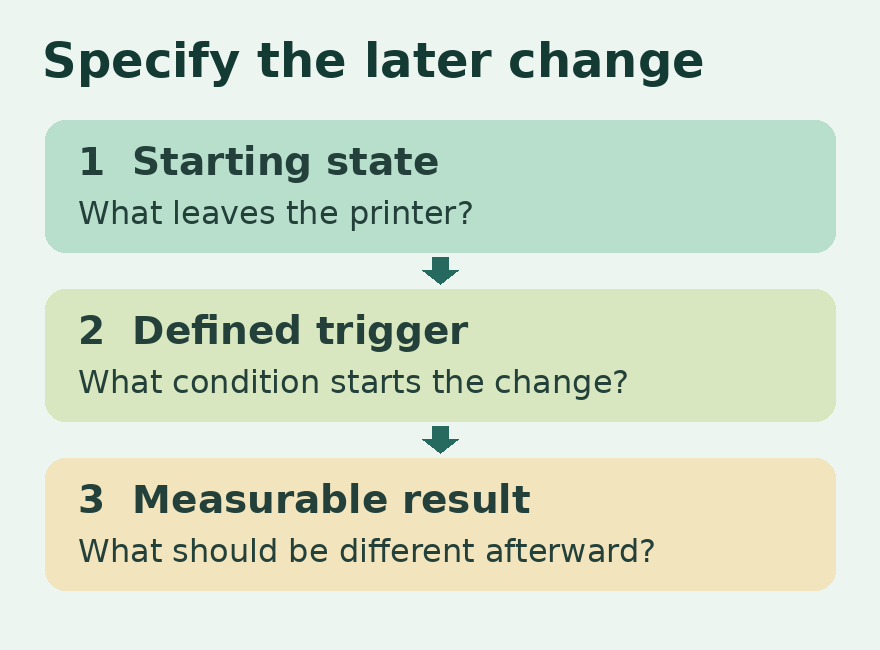
4D food printing starts with two specifications instead of one: what the piece should look like when it comes off the printer, and what it should do later under a defined condition. The additional dimension is the change over time, not a special nozzle or a different set of printer axes. Shape is one possible change. A planned color shift is another. Neither is valuable merely because it happens.
This guide uses three experiments to separate the evidence from the sales pitch. It then walks through what a small food brand would actually need to measure before commissioning a prototype. It is a product evaluation guide, not a recipe, a food safety plan or an endorsement of any equipment.
What makes a food print 4D?
A food printer can place an edible formulation in layers or along a programmed path. If the result is a decorative shape that stays essentially as placed, that is a 3D food print. The shape may be intricate and the printer may save time; neither makes the product 4D. For this guide, a 4D food print is a printed edible structure designed to undergo a specified change after fabrication. A buyer should be able to describe the starting state, what triggers the change, and how to tell whether the final state meets the brief.
Ordinary baking and cooking change virtually everything: dough can rise, sugar can brown, and starch can swell. If an ordinary printed cookie happens to spread more than intended, the spread is a defect, not evidence of 4D design. If the print path is chosen so two otherwise comparable pieces bend in different directions during the same baking step, the delayed change is part of the design. The comparison matters more than the adjective.
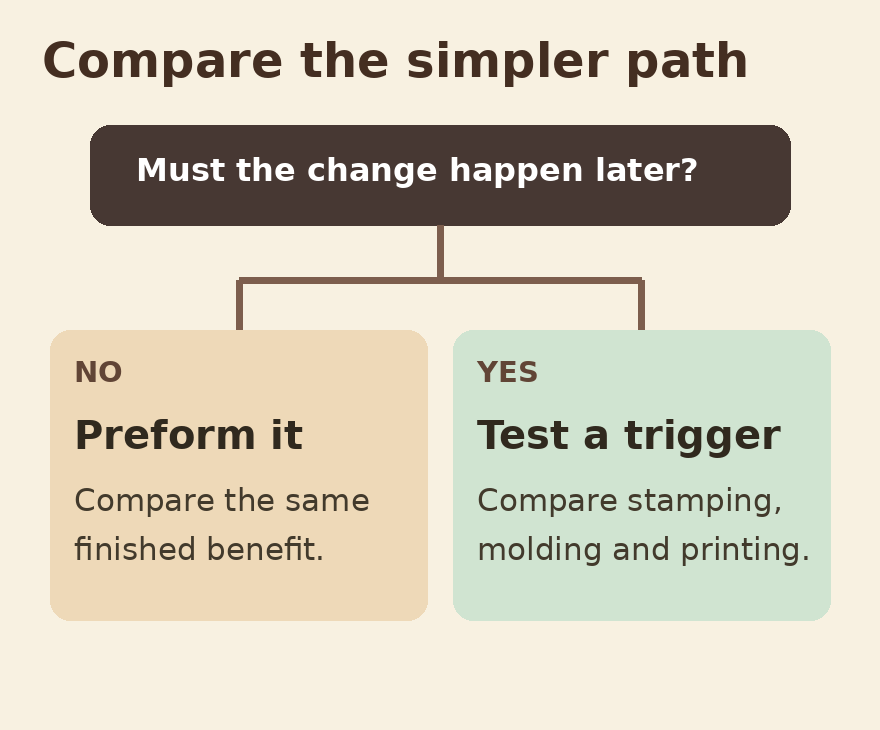
That definition also leaves room for a useful neighbor: food that changes on purpose but was made by stamping, cutting or molding. The distinction is not an argument about which method is more innovative. It tells you how to reproduce the result and what machinery you would actually need. If a simple mold gives a food brand the desired change at a lower total cost, it is no disadvantage that the mold is not a printer.
Three experiments show three different things
A sheet of pasta can change shape without being printed
In the 2021 Science Advances study Morphing Pasta and Beyond, researchers affiliated with Carnegie Mellon University and other institutions used a customized tool to stamp grooves in a flat sheet of dough. During cooking, the two faces did not expand in the same way at the same rate, so the sheet bent. By changing the groove pattern, the group could vary the resulting form. They interpreted the effect through a model of how water uptake and swelling differed across the structure.
The study is often mentioned next to 4D printing because it illustrates a programmable shape change. The distinction belongs in the first sentence of a sales brief: this pasta was groove-stamped, not extruded layer by layer through a food printer. The researchers used a fabrication step to encode a later response, but the fabrication method itself was simpler than printing. That is useful evidence for someone evaluating adaptive food, not evidence that a food printer is needed to make a flat pack work.
The research suggests a packaging question worth asking, not a ready-made savings figure. A shorter or flatter piece might use less space than a bulky cooked-design equivalent. But comparison by volume must still use the same net quantity and count whatever protection is required. If pieces fracture, stick together, require wider seals or arrive deformed, the apparent saving can disappear. The study does not establish what any particular seller will save after packing, storage and shipping.
A printed dough can bend during baking
A 2026 study by Mengyue Xu and colleagues at Wageningen University & Research illustrates the printing side of the distinction. The researchers used a pea-based formulation to study how printed dough filaments changed shape during baking. They proposed that differences in bubble size and distribution through the material helped explain local curvature, and found a relationship between the print path and the direction of bending under the conditions they studied. Their demonstration included forms resembling flowers and edible utensils.
That is stronger evidence of a connection between a printing decision and a later shape than a video showing only a baked piece. It does not establish that a utensil made this way can withstand the demands of a busy food service, replace an ordinary utensil or be produced at a viable price. The formulation, equipment and conditions in the study matter. Substituting another ingredient or changing dimensions could leave the original demonstration irrelevant to the product brief.
A printed food can change color without needing to curl
In a 2023 study in Foods, Yaolei Zhu and colleagues printed food structures and examined color after microwave treatment. One setup combined an anthocyanin-containing potato portion with a lemon-and-starch gel; the study also examined a curcumin-containing formulation. In the stacked system, movement of acidity through the structure helped explain the observed shift, and the strength of the gel was associated with how quickly it appeared. Printing arranged the materials; the later treatment enabled the change.
This experiment shows why color can be a useful design target in its own right. If a buyer just wants a stable contrasting color, the simpler benchmark is a product colored in advance. If a buyer wants the color to appear at a particular moment, the target also needs an acceptable time window and a way to measure it. A food that changes color in a research setup is not an accuracy-tested indicator of doneness or a microbiological safety test. Those are different claims requiring separate validation.
| Demonstration | Fabrication and response | Unanswered product question |
|---|---|---|
| Tao et al., 2021 | Stamped flat dough changes shape during cooking. | Does a packed, shipped and prepared product retain its space advantage? |
| Xu et al., 2026 | Printed pea-based dough bends during baking; the print path matters under studied conditions. | Does the same process hit tolerances, texture and output targets across production batches? |
| Zhu et al., 2023 | Printed formulations show a planned color shift during microwave post-treatment. | Can the timing and appearance survive the equipment and service variation buyers face? |
Decide where the change earns its place
Start with the moment that would get better. A packaging team hopes to save space before use. A restaurant might care about a visible transition during presentation. A product developer might want a different shape after processing, without handling each piece again. These are separate jobs with separate customers. A restaurant can demonstrate a transition to its guests; a product shipped to homes cannot assume customers will watch closely or follow an unusually forgiving preparation window.
For a packaging case, start by inspecting the order rather than the individual piece. Does the folded or curved geometry consume space the packaging line actually pays for? Could a smaller pouch reduce cartons, shelf footprint or shipment volume, or does the bottleneck sit somewhere else? If both designs fit into the same shipping configuration, an impressive reduction in the volume occupied by one piece does not automatically turn into money saved by the business.
For a visual case, ask what the diner should notice and whether the team can deliver it under ordinary conditions. A transition that requires extra staffing or a presentation step might be attractive for a limited event but unsuitable for a high-throughput venue. An ordinary preformed product may be better when the customer simply wants an attractive final plate. This is a perfectly useful reason to stop a prototype, not an indictment of the underlying science.
There is a similar distinction between a custom service and a scalable product. A design studio might be paid to make one presentation prototype for a qualified partner. An ongoing food business has to repeat it under specified constraints. The first can justify a narrowly scoped demonstration. The second still has to account for line time, consistency, shelf life, packaging, labeling and the cost of a unit no one can sell. A commissioned sample is not a forecast of market demand.
The quickest test of the commercial argument is to write the comparator in the project name: “A flat-pack piece versus our existing molded piece,” not “4D food pilot.” The buyer can now reject the project despite a successful bend if the existing piece is cheaper, more reliable or better liked. A pilot that cannot produce that answer is a demonstration in search of a decision.
Ask for process evidence, not a highlight reel
Give the partner one task they can fail. Describe the starting shape, the condition at which the transition should happen, the acceptable final shape or color, and the window in which it should be measured. Include what counts as a damaged piece and what counts as a correctly transformed piece. For a shape test, a simple dimension or orientation rule is more informative than a description like “attractively curved.” For a color test, agree on how readings or images will be compared so lighting is not doing the work.
Run a comparator under the same relevant conditions. A plain piece made with the same basic material can help assess whether the geometry contributes to the effect. A commercially familiar preformed piece addresses a different question: whether the new process creates enough value to replace the current solution. Neither comparator alone answers both questions. In a proposal, make the engineering comparison and the buyer comparison separate line items.
Ask the partner to show the entire batch, not just the best pieces. Record everything that started, everything rejected before processing, and everything that missed the target after processing. Track batches separately. A team that sees every failure can tell whether the issue is fragile geometry, an unstable starting form or a problem during handling. Pooling all results into one average can hide that the second batch was markedly worse than the first.
| Observation | What it helps you decide |
|---|---|
| Starting dimensions and intact count | Whether the process made comparable test pieces in the first place. |
| Response by batch and by intended use condition | Whether a successful demonstration masked slow, broken or inconsistent units. |
| Rejection reason at each stage | Whether further work should target forming, storage, handling or the response itself. |
| Total hands-on time and usable output | Whether the cost estimate includes changeovers, cleaning, rejects and inspection. |
If the proposed supplier cannot provide a consistent denominator, the priority is fixing how the pilot records results. A photograph can provide useful evidence of one example, but a sequence of selected photographs cannot tell you how many failures it excluded. Ask for a small report that covers the unsuccessful pieces as well as the attractive ones. That report should describe how test items were identified and where they stopped meeting the brief.
Watch how the partner explains variation. A change that is consistent immediately after production may no longer be consistent after the expected storage interval. The commercially important observations could fall at three times: after fabrication, when the partner would normally release the batch, and at the point the user is supposed to see the result. Measurements made at only one moment cannot tell you what happened before or after it. The appropriate storage and food handling conditions are for the qualified team to establish and validate, not for the buyer to invent in the briefing document.
For a time-limited visual change, keep a record of the first readable result and the end of the useful viewing window. For an intact shape, look beyond whether a piece bent at all. One outcome may be acceptable only while it is supported on a tray, another only if it can be transferred without breaking. Agree on the handoff that would be used in practice. This distinction can keep a partner from spending the entire pilot improving a result that still fails at the next unavoidable step.
Worked example: A smaller pack that costs more
Hypothetical scenario, not study data or market quotes. A specialty food brand already sells a shaped product. It commissions a controlled comparison to see whether a piece formed flat, then changed during preparation, could reduce its packaging and distribution costs. The brand has not authorized customer sampling and is not evaluating food safety from this data. Its commercial gate is narrower: the new design should use less space at no higher cost per usable unit.
Assume the control and prototype each start with 100 pieces of equal planned net quantity. The current design costs $80 in processing and $20 in packaging and distribution for this batch. After all losses, 95 pieces meet the agreed acceptance checks. The total is $100, or approximately $1.05 per usable piece. The prototype costs $100 to process and $12 to pack and distribute. Only 82 pieces pass. The prototype batch costs $112, or approximately $1.37 per usable piece.
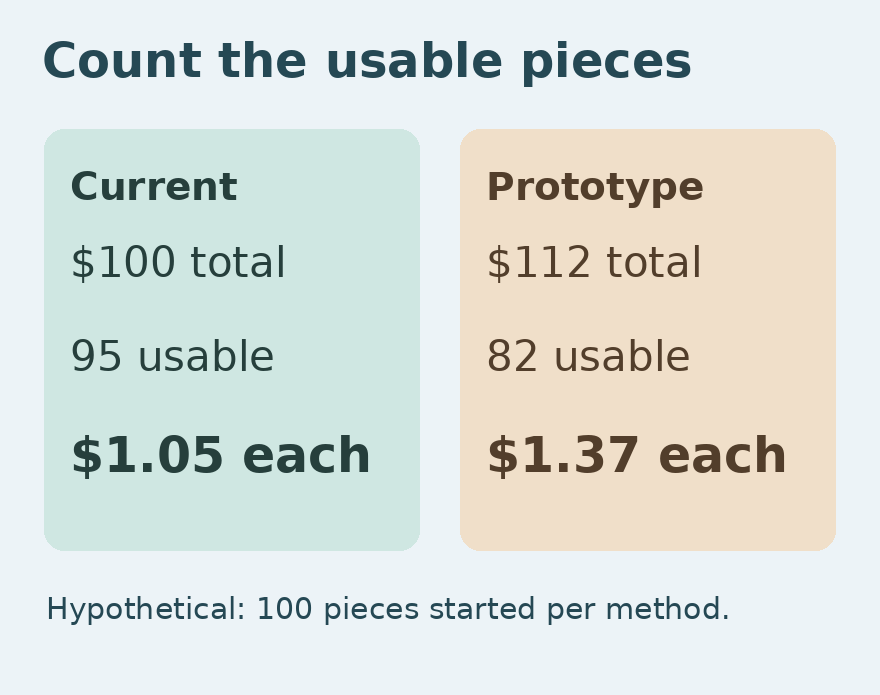
Packaging and distribution fell by $8 in this example. The total did not fall, partly because forming the new design cost more and partly because fewer pieces were usable. Even if all 100 prototype pieces passed at the same $112 cost, each would still cost $1.12. That favorable what-if does not beat the roughly $1.05 control. Fixing defects could help, but it cannot close this particular gap by itself.
What should the brand investigate next? Ask what drove the $20 processing difference. If the time is mostly associated with programming a new tool path and the same design can be reused, test that assumption rather than automatically writing off the expense. If every future run requires the extra handling, pricing or packaging changes would need to justify it. A prototype that can be stamped rather than printed is also worth asking about, because the business goal is low-cost transformation rather than a print badge on the package.
There is also a possible premium version, but it deserves a different test. A buyer might pay for a distinctive presentation, independent of pack size. In that case, measure actual willingness to pay by comparing offers or seeking purchase commitments through an appropriate qualified channel, not by tallying approving comments. Do not use a possible premium to rewrite the original cost threshold after a disappointing batch. Name the new proposition and test it separately.
Before commissioning a pilot, ask the supplier which features were produced by the printer and which emerged later. Request a sample batch record with the starting geometry, the hold time before the trigger, the observed change, and the count of rejected pieces. Decide who will inspect that record before paying for a second trial. A demonstration supplied by the vendor is useful for selecting what to test, but it cannot replace results on your own packaging line or under your intended service conditions.
If a supplier cannot provide repeatability data, reduce the next commitment. Compare one functional specification rather than an entire product line: for instance, a final dimension window that matters for a pack or a grip that can be measured consistently. Define the criterion before seeing the results. This stops a video of one unusually good specimen from becoming the acceptance standard.
What a product trial still cannot authorize
Food-contact suitability applies to the parts and conditions actually used, not just to the ingredient list or a label on the base machine. The U.S. Food and Drug Administration describes food-contact substances as including materials in processing equipment, preparation surfaces and packaging. Commercial requirements vary by jurisdiction and operation, so use this as a prompt to engage the applicable authority and a qualified food safety professional, not as a checklist certifying compliance.
Ask the equipment supplier to identify each food-contact component and document its intended conditions of use. Think beyond the nozzle to the feed path, seals, build surface and any tool that touches the material after printing. The supplier should be able to distinguish the parts that contact food directly from parts that do not. An undocumented component is an unresolved question, not a hole you fill with a generic claim about food-grade material.
The review also needs to consider whether residue can be removed reliably, how the equipment is changed over, and whether ingredients from one use can carry into another. Ask who owns verification and records, what a failed check looks like, and whether the product can be isolated until corrective action is complete. An operation that cannot answer those questions is not ready for a public test merely because a sample held its shape.
Do not treat a development print made on undocumented hobby equipment as ready for tasting or sale. Do not copy processing conditions from a published experiment as a set of instructions for a different product. If you lack a validated edible process, begin by discussing the concept with a qualified partner or use a clearly labeled non-food mockup to test packaging or presentation without serving it. That still answers real questions about size, handling and user expectations while keeping the safety decision where it belongs.
Keep the responsibility for these questions clear in the contract. A design partner might deliver a drawing and a feasibility report. An equipment supplier might document the intended use of its machine. Neither role automatically includes deciding whether a particular finished product is suitable for distribution. Ask who will make that decision and what evidence they require before ordering equipment. That conversation often reveals that the immediate purchase should be a scoped evaluation, not a machine or a promise that the team will be selling samples next month.
When to continue, narrow the pilot or stop
Continue if a buyer needs the delayed change, the effect is repeatable under defined conditions, and the route to a qualified test is practical. The next project can still be small. Ask whether one real use environment, one material family and one comparator are enough to reveal the likely failure. Learn from that result before introducing multiple shapes, flavors or triggers. If several variables change at once, a better result may not tell you which variable helped.
Narrow the pilot if the effect works but the business case is uncertain. A cleaner comparator, clearer measurement or one extra batch may answer more than a longer list of feature ideas. If the pilot succeeds visually but falls short on handling, repeatability or cost, decide which shortfall can plausibly be corrected and what evidence would change your mind. Give the next test a stop point before you spend.
Stop or switch fabrication methods if the end user does not benefit from the timing, a preformed option gives the same result, or the economics require an unproven price premium. If food contact or process controls cannot be established, stop before customer use regardless of how attractive the demo looks. The same thinking applies to teams selling design services: quote the deliverable you can substantiate and leave performance and safety claims with the people equipped to validate them.
Try this on one candidate product: Write two lines: “Before the trigger, the piece needs to…” and “After the trigger, the user gets…” Then name the non-print alternative and the first observation that would persuade you to abandon the idea. If you cannot finish each sentence, you are not yet ready to buy a printer or commission a production run. You are ready to clarify the job.