
Investment Decision Journal: What to Write Before You Trade
An investment decision journal records what you knew, what you assumed, what could prove you wrong, and what you decided to do before you see the outcome. You can use one for a purchase, a sale, a fund switch, a rebalance, or a decision to take no action. You do not need a trade to make the entry useful. In a good journal, “I verified the deadline and kept my existing plan” is just as legible as “I changed the plan.”
Here is the test: if the price moved in the opposite direction tomorrow, would you still recognize your reasoning? If a note says only “the company looks attractive,” probably not. A dated entry with a source, a comparison, a counterexample, and a review trigger gives you something you can audit. This guide includes an example of a genuine evidence check, a complete hypothetical decision, a cost worksheet, and a 30-day process you can use without trading.
The five fields worth writing before you decide
Start with the actual choice, not your feelings about a ticker. “Decide whether to change Fund A to Fund B in a long-term education account” is narrow enough to investigate. “Do something about this market” is not. Add the date, the purpose of the money, the earliest date it may be needed, and the alternatives you can realistically compare. Naming the account’s purpose is enough; do not place credentials, full account identifiers, or personal documents in the journal.
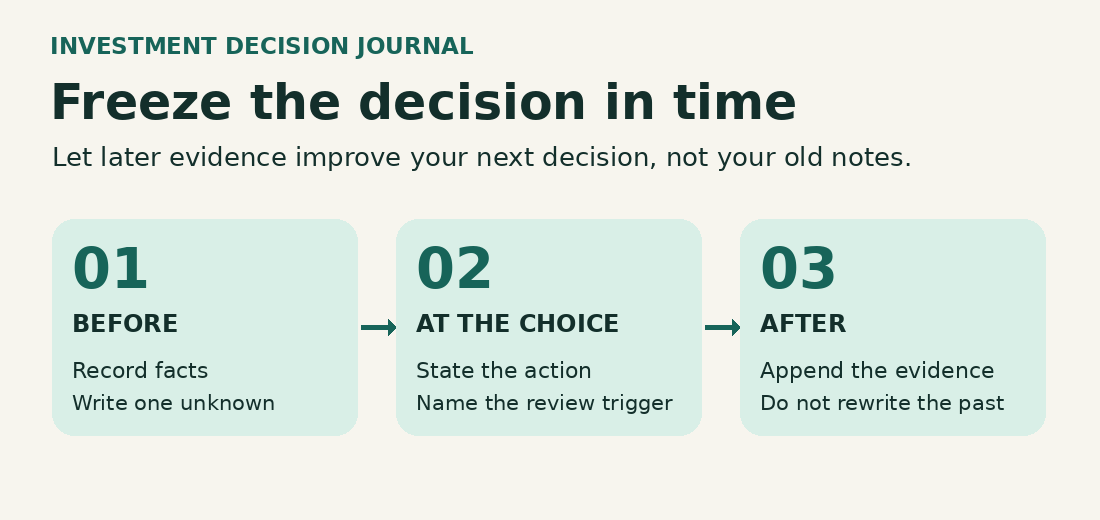
1. Trigger. Identify what brought the decision to your attention: a price alert, a document, a change in income, or a regular review. Timestamp when the fact became available and when you saw it. A rumor circulating on Tuesday and a company statement released on Thursday are not interchangeable. Leave the Tuesday note intact even if the rumor eventually proves correct.
2. Evidence. Record an observation with a source and its limits. “Down 9%” needs a start and end date, a currency, and the right instrument; it is not a statement about why the price declined. A one-day quote, a trailing twelve-month return, and a shareholder’s return after cash flows are different measures. Notice whether the source adjusts prices for distributions or splits where relevant.
3. Decision reason. Write the original job of the money and explain what has materially changed. If your income fell and essential costs arrive sooner, that is information about your ability to absorb a loss. If you are just watching prices more often and sleeping worse, that is information about your comfort with volatility. Both matter, but they call for different conversations. If you do not remember the original reason, say so. Do not improve your original thesis retroactively.
4. Counterevidence. Name an observation you would accept against your preferred conclusion. “I could change my mind if something happens” is not a test. “I would revisit my assumption about concentration if the next filing shows a large customer’s contribution fell and management cannot explain what replaced it” is. A trigger is a reason to review, not an instruction to place an automatic order.
5. Next step. Pick one action and a date or event. Examples: read the underlying filing by Thursday, confirm when a bill is due, compare two fee disclosures, seek qualified advice, or check again after the next report. Include the current decision, even if it is “no change pending verification.” If a deadline is real and near, write that above the routine review date so the journal does not make you miss it.
Check the primary document before giving an explanation a number
Imagine a post claiming that a U.S. public company lost a big customer. A practical first check is the issuer’s official investor-relations releases and filings in EDGAR. The investor education site Investor.gov explains the distinction between an annual Form 10-K, a quarterly Form 10-Q, and a current Form 8-K for specified events. This is about US reporting; for other markets, start with the issuer and the relevant official local disclosure system. The form name tells you where to look, not whether the company told the whole story.
Open the actual filing and write the reporting period before reading the number. Then check the date on the news item or screenshot. An older annual filing can set the baseline but cannot, by itself, refute a rumor about this week. For customer concentration, start in the business section and the financial statement notes; risk factors may describe exposure even when the customer’s identity is not named. Read the context around a number. Consolidated revenue and revenue of one segment have different denominators.
| Claim | First evidence to inspect | Common overreach |
|---|---|---|
| The price fell | Dated price series, correct instrument and currency | It does not identify the cause |
| Major customer left | Issuer notice, recent filings and concentration disclosures | Silence is not proof that it did not happen |
| A fund is cheaper | Current disclosure for the correct share class and account charges | A lower expense ratio is not the entire switching cost |
Keep the sentence you can support modest. “The last annual filing reports one customer above the stated concentration threshold at that date” leaves room for uncertainty. “The company is safe because there is no press release” jumps past the evidence. Write “not found in the documents I checked” when that is the true result. Search tools and AI can help locate a passage; they are not substitutes for reading the actual document, especially where a date, unit, or exception changes the meaning.
For a portfolio-level decision, change the evidence rather than forcing company filings into every entry. Compare the fund’s objective, benchmark, ongoing expense ratio, fee schedule, and actual exposures. Two funds with different marketing names can share many holdings. A bigger account-level question might be whether you have a workable time horizon and diversification, not whether a fund won a recent ranking. TimNao’s guide to long-term investing is useful background for that review.
A completed journal entry: one decline, two clocks
Teaching example, not a real person or security. Maya has a holding worth 4,000 fictional currency units after a weekly decline, in a portfolio worth 40,000 at the same point. Its current weight is 10%. Assume for illustration that the holding falls another 25% and every other holding remains unchanged. She would lose 1,000 on that position, or 2.5% of the 40,000 portfolio at the starting point. If other assets fall too, the total impact could be larger. That arithmetic describes an exposure; it is not a prediction or a portfolio limit.
On Tuesday at 9:10 she records the weekly decline and the screenshot. She labels the decline “confirmed from the dated series” and the screenshot “not independently verified.” Her original reason was that she believed the company could generate cash across several customer groups over a multi-year horizon. She opens the latest annual and quarterly filings, records which period each covers, and makes a note to check the issuer’s disclosures before interpreting the screenshot. She also writes the alternative: do nothing now while gathering information, rather than treating “sell” and “buy more” as the only choices.
Now give Maya a second, unrelated event. A client delays paying her invoice. An essential bill of 2,400 is due in 21 days; the cash she can identify for it today is 1,800, leaving a 600 gap before any other verified inflow. Her journal records a distinct decision about cash timing and captures the source of each number. She does not count the client’s promise as cash already available. She checks the due date and available resources and, if the decision is material or difficult, consults a qualified professional. Whether the social-media claim was true does not eliminate that gap.
A week later Maya learns that the screenshot was outdated. The holding falls again. Her addendum does not say that acting on the screenshot would therefore have been wise, or that waiting was necessarily wise. Instead it grades checks she could control. She verified the screenshot. She did not initially distinguish “cannot verify” from “false.” She also booked the cash review promptly after finding the gap. Two outcomes, one improvement: her next entry will have separate lines for market evidence and personal deadlines from the start.
Put a hurdle beside the alternative, not just beside the investment
For a fund switch, write the difference in ongoing fees and separately list one-time costs. The Investor.gov bulletin on fees distinguishes transaction costs from recurring expenses. Applying that distinction matters more than a broker’s headline commission: selling and buying can involve execution costs; a new share class may have different terms; account charges and taxes can vary. Use the actual disclosure and applicable local rules before relying on a figure, and seek qualified help for material tax or financial questions.
Suppose two fictional funds serve a comparable role. On an illustrative balance of 10,000 units, a 0.65% annual expense ratio is roughly 65 units at a constant balance; 0.20% is roughly 20. The approximate recurring difference is 45 units a year, before account costs or any change in balance. If total one-time costs are 60 units, the simple fee-only break-even is 60 divided by 45, or about 1.33 years. It is not a forecast, and the funds’ actual expenses are typically applied to changing asset values, not billed as the example’s flat annual fee.
| One-time cost | Recurring savings, constant balance | Simple break-even |
|---|---|---|
| 30 units | 45 units per year | About 8 months |
| 60 units | 45 units per year | About 16 months |
| 120 units | 45 units per year | About 32 months |
The table can flip the next step. If an earlier transaction charge isn’t documented, “verify the full one-time cost” is better than “lower fee wins.” If the balance were half as large, the illustrative savings would also be half as large at the same percentages; the fee-only hurdle would double if the one-time costs stayed fixed. If the old and new funds are materially different, the calculation is not a side-by-side return comparison. Ask whether the funds even solve the same problem before making expenses the deciding field.
Finally, log what you did not model. A useful line is: “I compared the disclosed fund fee, not the tax cost, future returns, currency conversion or risk of changing the investment objective.” When the fee advantage is uncertain, preserve the range and why it varies instead of rounding uncertainty into a precise recommendation. This makes the entry usable when you check it later and find that one of the assumptions changed.
What real data can improve in the journal
In its U.S. mid-year 2026 SPIVA scorecard, S&P Dow Jones Indices reported that 67% of the active U.S. large-cap equity funds in its comparison lagged the S&P 500 over the first half of 2026. This is a particular fund group, benchmark and six-month period. It does not tell you the odds that an individual stock will fall next month, and it is not a statistic about all investors, markets or funds. The reason to record it is practical: before calling a fund’s return impressive, decide what comparable benchmark would make that adjective meaningful.
A different kind of evidence comes from a 2000 study by Brad Barber and Terrance Odean in The Journal of Finance. It analyzed brokerage records covering 66,465 U.S. households during 1991–1996. The most active group earned 11.4% annually in that historical sample, versus a reported market return of 17.9%. Trading costs, instruments, services and investor behavior can differ today. Do not transfer the return gap to your account. The useful question is narrower: if you make more decisions than before, are you also recording friction, comparing to a reasonable alternative, and measuring whether the additional decisions improved anything?
If you track results, compare like with like. Use the same dates and currency. Check whether distributions are included. Separate portfolio performance influenced by deposits or withdrawals from changes in the underlying investment value. Where useful, record the simplest comparator you could actually choose, such as continuing the existing plan without the proposed switch. An index can be a helpful benchmark without being a feasible alternative in the exact form shown on a chart.
Beware of treating your journal as a backtest. It will contain a small set of decisions you considered, frequently under overlapping market conditions. A string of profitable entries may be the same exposure paying off repeatedly. A run of losing entries can also come from a common shock rather than several independent failures. When the evidence is thin, keep the conclusion small: “I repeatedly skipped comparing fees,” rather than “my strategy is proven” or “the market is impossible.”
Grade the process separately from the outcome
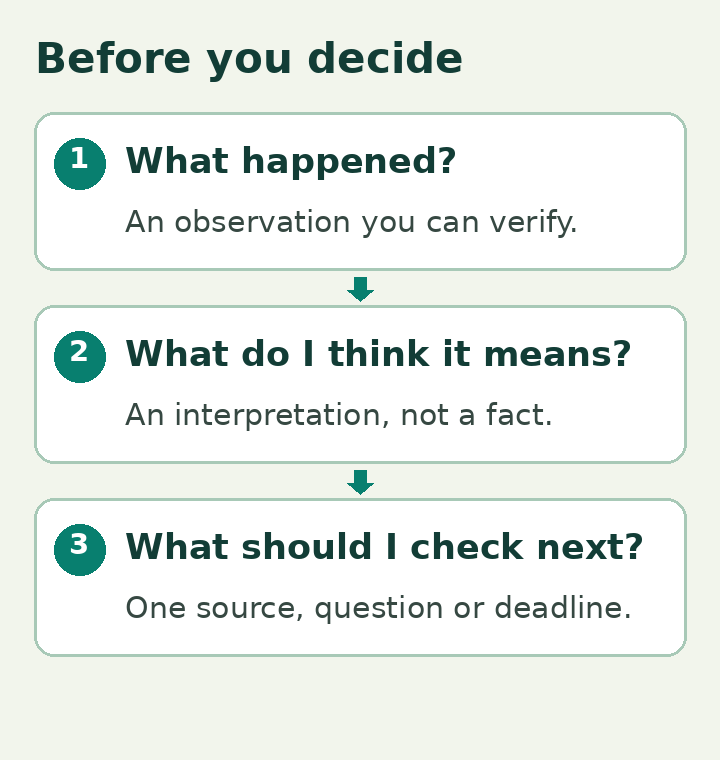
At a review date, make a clean copy of the original entry if the format is easy to overwrite. Then record what happened, what you learned, and which checks could reasonably have been performed at the time. Information that appeared after the decision goes on its own line. A correct forecast does not improve a weak evidence chain. An unfavorable price move does not prove that a reasonable decision was a mistake. You want to notice the cases where following the process costs little but prevents a large, avoidable error.
| Process | Outcome helped | Outcome hurt |
|---|---|---|
| Evidence checked | Keep the checks; don’t project a streak | Ask whether the downside was foreseeable and planned |
| Evidence skipped | Fix the process even if you got lucky | Identify the first check that would have changed your decision |
Use a simple score for habits, not asset quality. Give yourself one point each for a dated source, a genuine alternative, a cost or exposure check when relevant, a specific piece of counterevidence, and a review trigger. Mark a field not applicable with a reason rather than awarding yourself a free point. After four weeks, count the most common missed check. If four entries lacked the actual fee disclosure, fix that before adding more columns or making more decisions.
Write precise language around confidence. “High confidence that the number appears in the filing” is different from “high confidence that revenue will recover.” If you choose to quantify a prediction, define what would count as a success, by what outside date, and according to which data release. Record several outcomes before comparing confidence with frequency; a handful of calls is not useful calibration. For many readers, plain language tied to the evidence is easier to maintain than a column of percentages.
Copy this entry, then keep the first version
You can start on paper, in an offline note, or in a spreadsheet with one decision per row and a linked addendum. Use generic labels for holdings if you do not want your records tied to a named account. If you use a cloud service, avoid uploading statements, tax documents or account credentials simply to fill a template. Export a periodic copy if you depend on the history. The system is doing its job when you can recover the old entry without having to trust your memory.
Try the shortest version at times of stress: write the decision, one known fact, one unknown, the actual deadline, and one next check. For a significant decision, return to the rest before relying on the note. The purpose isn’t to slow down a genuinely time-sensitive obligation; it’s to catch the moments when an app, rumor, or dramatic chart has supplied urgency without a deadline. If you use a cooling-off rule, give it a clear exception for a real deadline and seek qualified help when appropriate.
For a recurring contribution, keep two different records. One records that a preset instruction executed on schedule; the other records an actual decision to reconsider the plan. You need not create a new investment thesis each time a standing contribution runs. Instead, document an exception when a material life event, a fee change, or a changed account objective brings the original plan back into question. That keeps the journal focused on decisions rather than turning it into a second transaction ledger.
Run a month of practice without making an extra trade
Week one: reconstruct one past decision. Choose a decision for which you can still find the original alert, statement, story or filing. Cover later performance while you write what was known at the time. Put remembered details in a different color or label them “reconstructed.” The goal is to see how much the later outcome has filled in gaps, not to discover a missed winning move.
Week two: use actual documents on a hypothetical choice. Compare two disclosure documents or examine two dated company filings. Write one sentence that the evidence supports, and one claim you cannot justify. If a percentage looks inconsistent, compare periods and units before drawing a conclusion. This week produces a trustworthy reference entry you can copy later.
Week three: record a no-action choice. Pick a real trigger that otherwise would have sent you straight to a quote screen. Write what changed, which comparison you made, and whether there is a verified deadline. You may discover the right next step is simply confirming the information later. If the situation genuinely calls for action or advice, the journal does not override that.
Week four: make one rule from your own evidence. Pull out the current month and note the most frequent omitted step. For example, “I will verify the actual share class before copying a fund fee” or “I will record which cash need prompted my review before checking individual holdings.” Keep that rule in the entry form. Delete a field you never use only if its omission has not hidden a repeated mistake. An easier system that captures decision-critical facts beats a beautiful spreadsheet you abandon after three weeks.
Start with the next decision you are about to make, not a perfect history of everything you own. Write the date, what changed, the assumption you’re making, and the one thing you’ll check next. If those four lines are clear enough that a later version of you can audit them, the journal has already done something useful.
For general education only. This is not personalized investment advice or a recommendation to buy, hold or sell a security. Investments can lose value. For material decisions, complex tax questions or money you need soon, consider a qualified professional who can assess your circumstances.